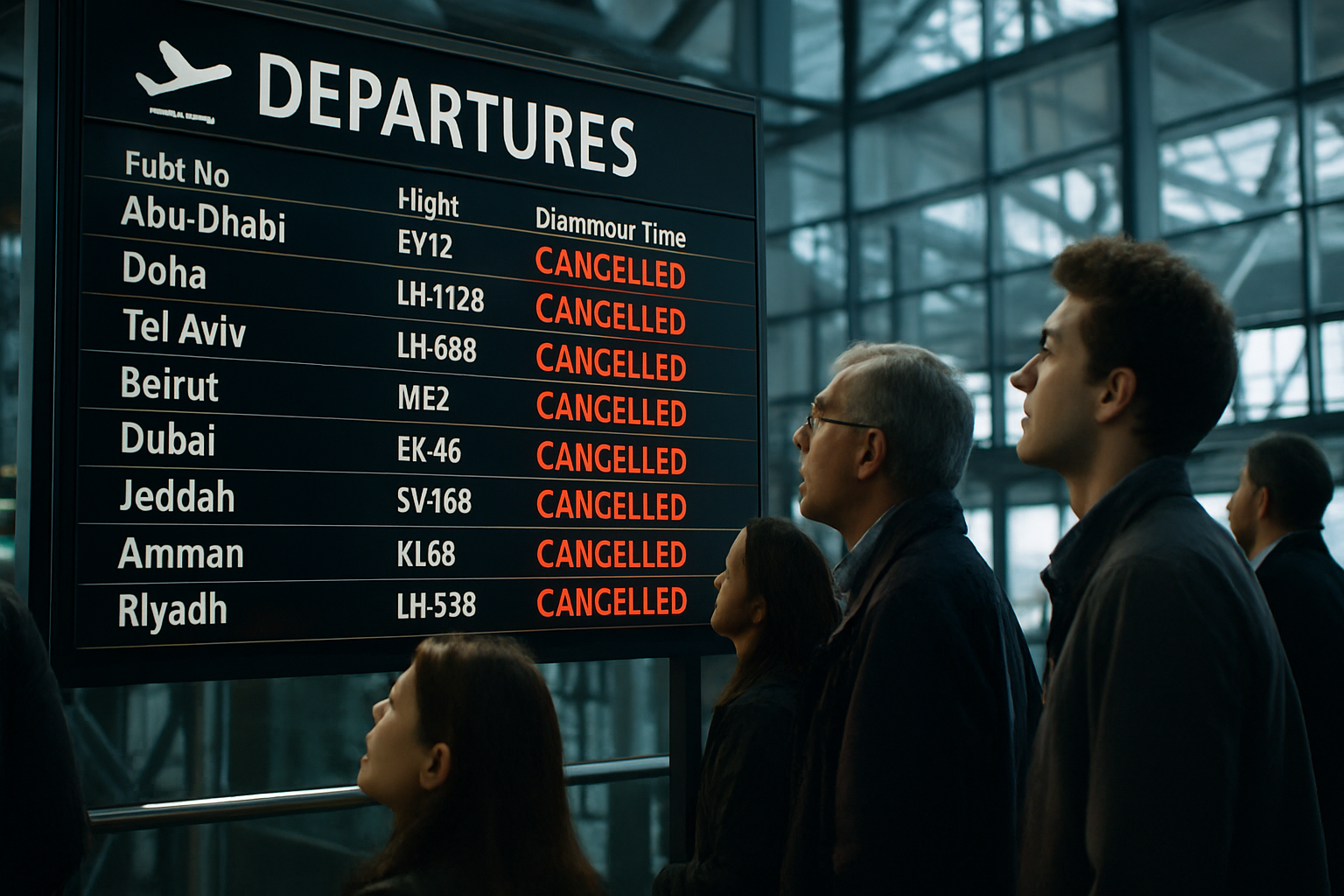
European airlines are cancelling hundreds of flights amid ongoing geopolitical uncertainty in the Middle East and soaring jet fuel prices, marking what aviation analysts are calling the most comprehensive disruption to European air travel since the COVID-19 pandemic.
The wave of cancellations, affecting multiple major European carriers, stems from escalating security concerns in the Middle East region combined with unprecedented fuel cost increases. Industry sources warn that the impact on flight services could persist for months, fundamentally reshaping European aviation routes and passenger booking patterns.
Scope of the Crisis
The current aviation crisis represents a continuation of disruptions that began in late February 2026, when Middle East conflicts triggered the closure of eight countries' airspaces simultaneously. Over 18,000 flights have been cancelled worldwide since March 1, with European carriers bearing a significant portion of the burden as traditional Middle Eastern hub connections have been severed.
Dubai International Airport, the world's busiest with over 86 million passengers annually, remains completely shut down due to missile damage. This closure has created cascading effects throughout the global aviation network, as Dubai serves as a critical Europe-Asia hub for millions of travelers.
"This is the most severe aviation disruption we've seen since the pandemic began. The combination of security concerns and fuel price volatility has created perfect storm conditions for the industry."
— Aviation Industry Analyst
Major Carriers Affected
Several major European airlines have suspended or drastically reduced Middle East operations. Air France-KLM has cancelled routes to Tel Aviv, Beirut, Dubai, and Riyadh. Wizz Air has implemented comprehensive suspensions to Israel, Dubai, Abu Dhabi, and Amman until March 7. Bulgaria Air suspended Tel Aviv flights through March 2, while airBaltic cancelled all Tel Aviv services until March 4.
The ripple effects extend beyond direct Middle East routes. Cyprus Airways has cancelled Dubai flights, and numerous other carriers have been forced to implement complex rerouting strategies that dramatically increase flight times and operational costs.
Fuel Price Crisis
Adding to the security concerns, jet fuel prices have surged from $85-90 per barrel to $150-200 per barrel, representing increases of up to 122%. This dramatic price spike stems from Iran's closure of the Strait of Hormuz, which affects 40% of global oil transit.
Airlines across Europe are implementing emergency fuel surcharges. Air France-KLM has added 50 euros to long-haul economy tickets, while Norwegian and other international carriers are following suit with significant fare increases to offset unsustainable fuel costs.
The energy crisis has broader implications beyond aviation. Natural gas prices have surged 24% in Europe and 78% in the United States, with Qatar's LNG production halt threatening European gas supplies. Oil prices have peaked at over $119 per barrel, marking the most severe global energy crisis in decades.
Passenger Impact and Evacuations
The crisis has stranded hundreds of thousands of passengers worldwide. European governments have activated the largest coordinated evacuation since the Arab Spring 2011, with Australia reporting 115,000 trapped nationals and Germany 30,000 stranded tourists.
Individual passengers face extreme costs for alternative routing. Swedish traveler Emily Grosser paid 6,000 SEK ($560) for alternative routing from Paris to Australia after her Dubai connection was cancelled, exemplifying the financial burden placed on travelers requiring emergency rerouting.
Cyprus activated its ESTIA evacuation plan for the first time in the country's history, coordinating the evacuation of over 2,000 EU nationals from the UAE. This represents a watershed moment in EU crisis management capabilities, demonstrating coordinated response mechanisms during international emergencies.
Economic Consequences
The aviation crisis has triggered broader economic disruption. Stock markets have crashed globally, with Pakistan's KSE-100 recording its largest single-day decline in history at -8.97%. European markets have suffered significant losses, and the Dow futures dropped 400-570 points.
Supply chains dependent on Middle Eastern logistics networks are experiencing severe disruptions affecting automotive, electronics, and textiles manufacturing. Persian Gulf trade routes, critical for Asia-Europe commerce, have been compromised by the closure of the Strait of Hormuz.
Strategic Petroleum Reserves Deployed
In response to the energy crisis, the International Energy Agency has announced the largest strategic petroleum reserves release in its 50-year history, deploying 400 million barrels from 32 member countries. Japan is releasing 80 million barrels starting March 16, marking the first such deployment since the 2011 Fukushima disaster.
Industry Transformation
Aviation industry experts warn that the current crisis is forcing a fundamental reconsideration of route planning and risk assessment. The over-dependence on Middle Eastern hubs for Europe-Asia connectivity has been exposed as a critical vulnerability, particularly with Russian and Ukrainian airspace already closed due to ongoing conflicts.
Airlines are implementing emergency protocols including enhanced fuel loading to avoid refueling in affected zones, complex rerouting through Caribbean stopovers for trans-Pacific routes, and dramatically increased operational costs. These adaptations are expected to become permanent features of international aviation.
"We're witnessing a template-setting moment for 21st-century aviation crisis management. The industry must develop enhanced resilience planning and route diversification to reduce dependency on single regional hubs."
— European Aviation Safety Agency Official
Regional Tourism Shifts
The crisis is accelerating regional tourism pattern shifts across Europe. Croatia is reporting advantages as travelers seek safer European alternatives to traditional Middle Eastern destinations. Spain, which already leads Europe with 513.6 million tourist nights annually, is positioned to capture additional redirected demand.
Finland has launched an international marketing campaign promoting cottage holidays as peaceful destination alternatives. Meanwhile, the Caribbean faces a "perfect storm" with Middle East disruptions combining with Cuba's aviation isolation to create unprecedented challenges for Caribbean tourism.
Diplomatic Context
The current aviation crisis stems from the complete collapse of US-Iran nuclear negotiations, despite what had been described as a "broad agreement on guiding principles" - representing the most progress since the 2018 JCPOA collapse. The scope of disagreement proved insurmountable, with Iran excluding ballistic missiles and regional proxies as "red lines" while the US demanded comprehensive approaches including missiles, armed groups, and human rights issues.
This diplomatic breakdown led to Operation Epic Fury, the largest US-Israeli operation since 2003, followed by Iranian retaliation under "Operation True Promise 4," with Revolutionary Guards declaring "no red lines remain" in systematic targeting across the region.
Future Implications
Unlike weather-related disruptions that have predictable timelines, the recovery from this crisis depends entirely on military operations resolution and diplomatic tensions normalization. Aviation industry analysts cannot make long-term scheduling decisions while multiple airspaces remain closed and security situations remain volatile.
The crisis is expected to accelerate discussions about enhanced contingency planning, route diversification, and reduced dependency on strategic chokepoints. Enhanced security screening, mandatory conflict-coverage insurance, and pre-approval systems for high-risk destinations are likely to become standard features of international travel.
Consumer behavior is already shifting toward last-minute bookings and flexible arrangements, forcing airlines to adopt more agile business models. The choice facing the industry is between maintaining global connectivity despite security challenges or evolving toward more fragmented, security-conscious regional travel patterns.
Looking Ahead
March 2026 represents what UN Secretary-General António Guterres has called "the greatest test of multilateral cooperation and crisis management in the modern era." The rapid transition from diplomatic breakthrough to military confrontation demonstrates the fragility of crisis management in an increasingly multipolar world.
The resolution of this crisis will establish precedents for international dispute resolution, nuclear proliferation responses, and territorial sovereignty enforcement that will affect 21st-century conflict approaches globally. Success in containing the crisis could provide a diplomatic framework for future interventions, while failure might accelerate military approaches to international disputes for decades to come.
For European aviation, the current crisis represents a watershed moment that will influence route planning, risk assessment, and international cooperation frameworks for years to come. The industry faces fundamental questions about balancing global connectivity with security-conscious operations in an increasingly volatile geopolitical environment.