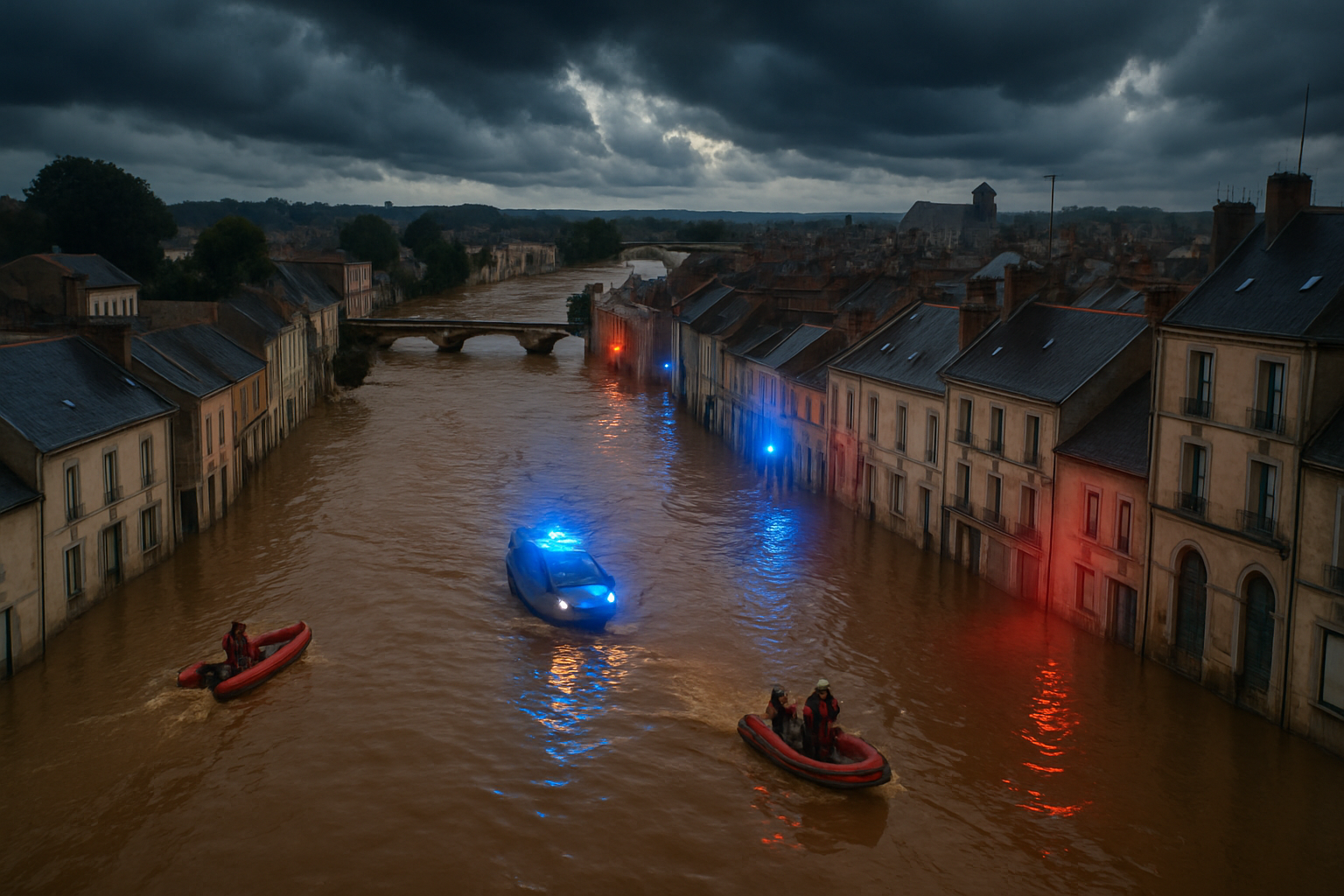
Europe's escalating climate crisis deepened on February 17, 2026, as severe flooding continued to devastate multiple countries, with France reporting dangerous water levels and Spain assessing catastrophic business losses from what meteorologists are calling an unprecedented succession of Atlantic storms.
French authorities maintained the highest red alert levels for four départements as flooding reached critical thresholds. The Charente-Maritime region joined Maine-et-Loire, Gironde, and Lot-et-Garonne under red alerts, with eleven additional départements under orange flood warnings including Charente, Corrèze, Dordogne, and Vendée.
Drinking water supplies have been disrupted across multiple communes in Gironde, while emergency services report hundreds of evacuations as rivers continue to burst their banks across the saturated landscape. The crisis represents the culmination of what experts describe as the most devastating weather emergency to strike Europe in recent memory.
Business Devastation Across Southwestern France
The economic toll of the flooding has reached catastrophic proportions, with businesses across southwestern France facing unprecedented losses. Towns including Marmande, La Réole, and Cadillac-sur-Garonne have been submerged under floodwaters rising above ten meters, inundating shops, spas, and restaurants.
Business owners are reporting damage in the thousands of euros, with many facing weeks of lost income as they attempt to rebuild. The crisis comes as climate-related insurance costs have already soared to billions of euros in 2024, leaving many businesses struggling to recover from increasingly frequent extreme weather events.
"We've never seen anything like this in our lifetime. The water came so fast, there was nothing we could do to save the inventory."
— Local Business Owner, Marmande
The flooding has particularly devastated the hospitality sector, with thermal spas and riverside restaurants bearing the brunt of the damage. Many establishments are questioning whether they will be able to reopen for the crucial summer tourist season, threatening the regional economy that depends heavily on tourism revenue.
Continental Crisis: Storm Succession Overwhelms Emergency Systems
The current flooding crisis is part of a devastating succession of Atlantic storms that have battered Europe throughout February 2026. The storm sequence—dubbed Kristin, Leonardo, Marta, Nils, and Oriana—has killed at least 16 people across Portugal, Spain, and France while requiring the deployment of over 26,500 emergency personnel in what Portugal described as its largest peacetime rescue operation.
Critical infrastructure has collapsed across the region. Portugal's A1 highway viaduct near Coimbra collapsed from catastrophic flooding, severing the vital Lisbon-Porto transportation corridor and requiring "several weeks" for repair according to Infrastructure Minister Miguel Pinto Luz.
Transportation networks across the continent remain severely disrupted, with railway suspensions, highway closures, and aviation delays affecting millions of travelers. The Castanheira-Alvarca railway line in Portugal remains indefinitely suspended, stranding thousands of Lisbon commuters.
Climate Context: Record-Breaking Weather Patterns
The crisis unfolds against the backdrop of January 2026 marking the 18th consecutive month of global temperatures exceeding 1.5°C above pre-industrial levels—a threshold scientists warn represents dangerous climate change acceleration. This extraordinary warming trend has overridden natural cooling cycles, enabling the simultaneous occurrence of global heat records and regional extreme weather events.
The European Union has activated its Civil Protection Mechanism, with Sweden and Denmark providing €246 million in emergency assistance—the largest coordinated European weather response to date. Emergency services have reached capacity limits across multiple nations, with traditional regional aid mechanisms strained by the simultaneous nature of the disasters.
International Response and Recovery Challenges
The scale of the crisis has prompted unprecedented international coordination, as individual nations' emergency services have been overwhelmed by the simultaneous multi-national emergencies. France has received over 1,600 emergency calls for fallen trees and debris removal, while wind gusts have exceeded 162 km/h in western regions.
Agricultural sectors across the affected regions face billions in damages, with thousands of hectares submerged and livestock requiring emergency evacuations. The Portuguese Douro wine region has suffered extensive damage to vineyard terraces, threatening the livelihoods of viticulturists and the region's renowned wine industry.
Recovery timelines are expected to stretch from months to years, with governments emphasizing the need to "build back better" with climate-resilient infrastructure designed for future rather than historical weather patterns. The crisis has exposed fundamental vulnerabilities in European infrastructure systems that were not designed to handle such extreme weather conditions.
Democratic Resilience Under Climate Pressure
The flooding crisis has created what experts term the "climate-democracy intersection," as extreme weather increasingly disrupts governance and electoral processes. Portugal's presidential election on February 8 proceeded despite the infrastructure crisis, though approximately 36,000 voters were unable to participate due to flooding and transportation disruptions.
This precedent highlights the growing challenge of maintaining democratic processes under accelerating climate change, as extreme weather events become more frequent and intense, potentially affecting voting access and government operations.
Warning Signs for the Future
Climate scientists warn that the February 2026 crisis provides a preview of routine conditions expected in the 2030s without immediate and comprehensive climate action. The simultaneous nature of disasters across multiple countries has overwhelmed traditional emergency response mechanisms that relied on mutual aid between neighboring regions.
The crisis represents what researchers call a "watershed moment" forcing fundamental reconsideration of European climate preparedness and adaptation strategies. Additional Atlantic storm systems are developing, raising concerns that the crisis may persist for weeks, establishing what meteorologists describe as a "new normal" of extreme weather frequency.
As Europe grapples with this unprecedented challenge, the international community faces a critical choice between reactive crisis management and transformative infrastructure adaptation for long-term resilience. The human impact extends beyond statistics: families have lost generational homes, small businesses face extinction, and mental health services report increased demand for support as communities struggle to cope with the scale of destruction.
The European flooding crisis of 2026 stands as a stark reminder that climate change is no longer a future threat but a present reality requiring immediate, coordinated, and transformative action across all levels of society.