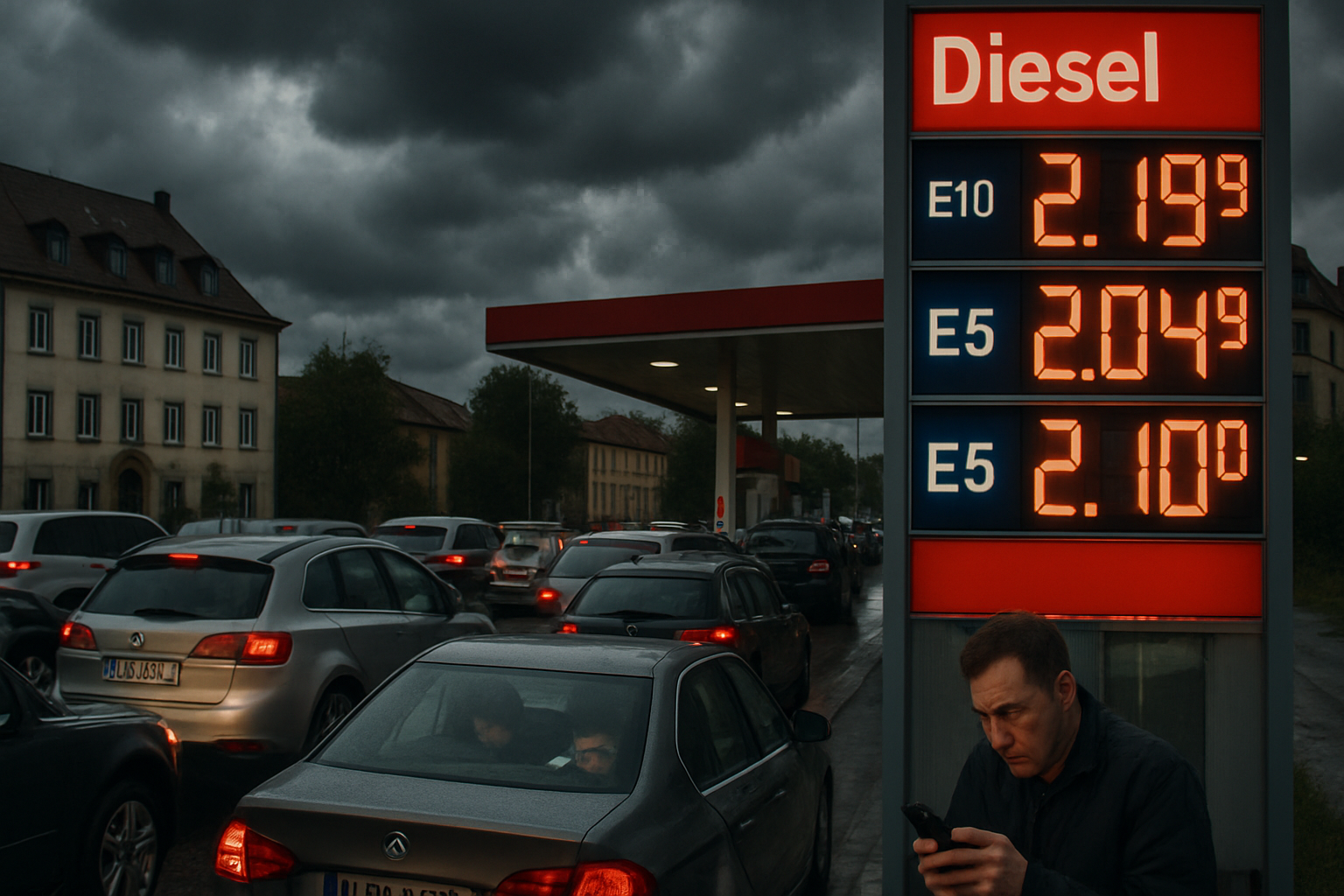
European fuel prices continue their relentless surge as Estonia recorded an all-time high diesel price of €2.169 per liter on Monday, while governments across Ireland, Norway, and Sweden scramble to implement emergency relief measures as the Middle East crisis pushes energy costs to breaking points nationwide.
The stark reality of Europe's deepening energy crisis has crystallized in these latest developments, with each country facing unique challenges but sharing the common burden of skyrocketing fuel costs that threaten to destabilize both economies and public confidence.
Estonia Breaks All-Time Diesel Record
Estonia's fuel market reached a historic milestone as diesel prices soared to €2.169 per liter, surpassing all previous records and highlighting the severe impact of global energy disruptions on smaller European economies. The price surge represents a continuation of the energy crisis that has gripped the continent since Iran's closure of the Strait of Hormuz began affecting global oil supplies.
The record-breaking price comes despite Estonia's impressive renewable energy infrastructure, which has made the Baltic nation a model for energy independence with 88% renewable electricity generation and continental Europe's largest battery storage system serving 90,000 households. However, Estonia's transportation sector remains vulnerable to global oil price volatility, particularly given the country's integration into European energy markets.
Ireland Prepares Comprehensive Emergency Response
Irish authorities are finalizing what Taoiseach describes as a multi-pronged approach to combat rising energy costs, with the Coalition government set to discuss several immediate relief measures including a tax rebate scheme for hauliers, double fuel allowance payments, and potential reductions in excise duty on fuel.
The urgency of Ireland's response reflects the mounting pressure on Irish consumers, who are facing what officials characterize as "brazen rip-offs" with heating oil prices approaching €2 per liter. The Irish transport sector, particularly freight and logistics companies, has been particularly vocal about the need for immediate government intervention.
Industry representatives have warned that without swift action, the cost increases could trigger broader economic disruptions across sectors dependent on fuel-intensive operations, from agriculture to tourism.
Norwegian Fuel Markets Under Pressure
Norway, despite being a major oil producer, is experiencing significant fuel price pressures with diesel costs exceeding 30 kroner per liter in multiple locations. The situation underscores how even oil-rich nations cannot insulate themselves entirely from global energy market disruptions when supply chains face fundamental disruption.
The price increases come as Norway grapples with the broader implications of the Middle East crisis, which has seen oil prices breach historic thresholds and triggered the largest strategic petroleum reserve release in International Energy Agency history.
Sweden Implements Emergency Tax Relief
Swedish Prime Minister Ulf Kristersson announced comprehensive emergency fuel tax reductions to EU minimum levels, effective May 1 through September 30, representing one of the most significant government interventions in the fuel market in recent Swedish history. The package includes gasoline price reductions of approximately 1 krona and diesel cuts of 40 öre, with an estimated cost of 1.5 billion kronor.
"The Middle East is putting the Swedish economy to the test," Kristersson stated, acknowledging that Sweden's integration into continental European energy markets has made the country particularly vulnerable to global supply disruptions.
The Swedish response also includes electricity subsidies for households facing high energy bills, representing a coordinated approach to address both transportation and heating costs. The Malmö region has been identified as particularly exposed due to its integration with continental European markets.
Historical Context and Global Impact
The current crisis represents the most severe energy disruption since the 1970s oil shocks, triggered by Iran's Revolutionary Guard declaration that the Strait of Hormuz is "unsafe for shipping." This 21-mile chokepoint handles approximately 40% of global seaborne oil transit, making its closure a catastrophic supply disruption with no realistic alternatives.
Oil prices have surged past $100 per barrel for the first time since 2022, with Brent crude reaching peaks of $119.50 and West Texas Intermediate recording an 18.98% single-day jump to $108.15. Natural gas prices have exploded by 24% in Europe and 78% in the United States, reaching €47.32/MWh—the highest levels since February 2025.
The crisis stems from the complete breakdown of US-Iran nuclear negotiations despite what had been described as "broad agreement on guiding principles"—the most progress since the 2018 JCPOA collapse. The diplomatic failure led to Operation Epic Fury, the largest coordinated military operation since 2003, prompting Iranian retaliation that closed the critical shipping lane.
Emergency Government Responses Across Europe
The European response has been swift and coordinated, with multiple governments implementing unprecedented market interventions:
- Hungary imposed immediate gasoline and diesel price caps to counter "war-driven price explosions"
- France deployed 500 fuel station inspectors to prevent price manipulation
- Romania outlined five emergency scenarios to prevent diesel from exceeding 10 lei per liter
- Slovakia activated strategic petroleum reserves for the first time under current protocols
- Latvia is preparing comprehensive April measures including excise tax reductions
EU High Representative Kaja Kallas has activated emergency coordination protocols representing the most comprehensive crisis management response in the bloc's history, including state aid programs for energy-intensive industries and enhanced fuel price manipulation surveillance.
Consumer Impact and Economic Implications
The human cost of the crisis is becoming increasingly visible across European societies. In Bangladesh, 170 million people face fuel rationing, while Pakistan has implemented wartime austerity measures including four-day work weeks. Bosnia-Herzegovina has been reduced to two days of gas reserves, highlighting the precarious nature of energy security even in developed regions.
The financial markets have reflected the severity of the situation, with Pakistan's KSE-100 index experiencing its largest single-day decline in history at -8.97%, and South Korea's KOSPI falling 12% with circuit breakers activated as the Korean won hit a 17-year low.
Aviation has been particularly hard hit, with over 18,000 flights cancelled worldwide—the most extensive disruptions since COVID-19. Dubai International Airport, the world's busiest with 86 million passengers annually, remains shut due to missile damage, while eight countries have closed their airspace simultaneously.
Long-term Energy Architecture Transformation
Energy experts emphasize that the current crisis exposes fundamental vulnerabilities in Europe's energy architecture that require years, if not decades, to address comprehensively. Samuel Ciszuk, a leading energy analyst, describes this as "the most severe energy security crisis in decades, exposing single-chokepoint vulnerabilities that were assumed away in planning."
The crisis has accelerated discussions about energy independence and supply diversification, with Estonia's renewable energy model gaining renewed attention as a potential template for other European nations. However, experts note that even Estonia's impressive 88% renewable electricity generation cannot fully insulate it from global fuel price volatility in the near term.
Qatar Energy Minister Saad Al Kaabi has warned that Gulf states may declare force majeure "within weeks" if the conflict continues, potentially driving oil prices toward $150 per barrel—a level he warns could "bring down the economies of the world."
Template-Setting Crisis Management
The March 2026 energy crisis is being characterized by international observers as a "template-setting moment" for 21st-century crisis management, testing multilateral cooperation and institutional resilience under extreme pressure. UN Secretary-General António Guterres has called it "the greatest test of multilateral cooperation and crisis management in the modern era."
The success or failure of coordinated European responses is seen as crucial for establishing frameworks for future nuclear crisis resolution approaches. Failure could accelerate military solutions and reshape Middle Eastern geopolitics for decades, while also undermining diplomatic credibility worldwide.
Recovery timelines remain uncertain, dependent on military operations resolution and diplomatic normalization rather than predictable economic factors. Unlike weather-related disruptions, the current crisis cannot be scheduled around, leaving aviation industries unable to plan and energy markets volatile as critical transit routes remain blocked.
Looking Forward: Energy Security Paradigm Shift
The events of March 2026 represent a watershed moment that is likely to influence European energy security planning for decades to come. The dangerous over-dependence on strategic chokepoints has been exposed, requiring fundamental restructuring to reduce vulnerability to geopolitical volatility.
While strategic petroleum reserves provide temporary relief—with the IEA coordinating the largest release in 50-year history at 400 million barrels from 32 countries—experts emphasize that only long-term supply diversification and accelerated renewable transitions can provide true energy security.
The crisis serves as a stark reminder that in an interconnected world, regional conflicts can instantaneously become global economic disruptions, fundamentally challenging assumptions about energy security that have guided policy for generations.