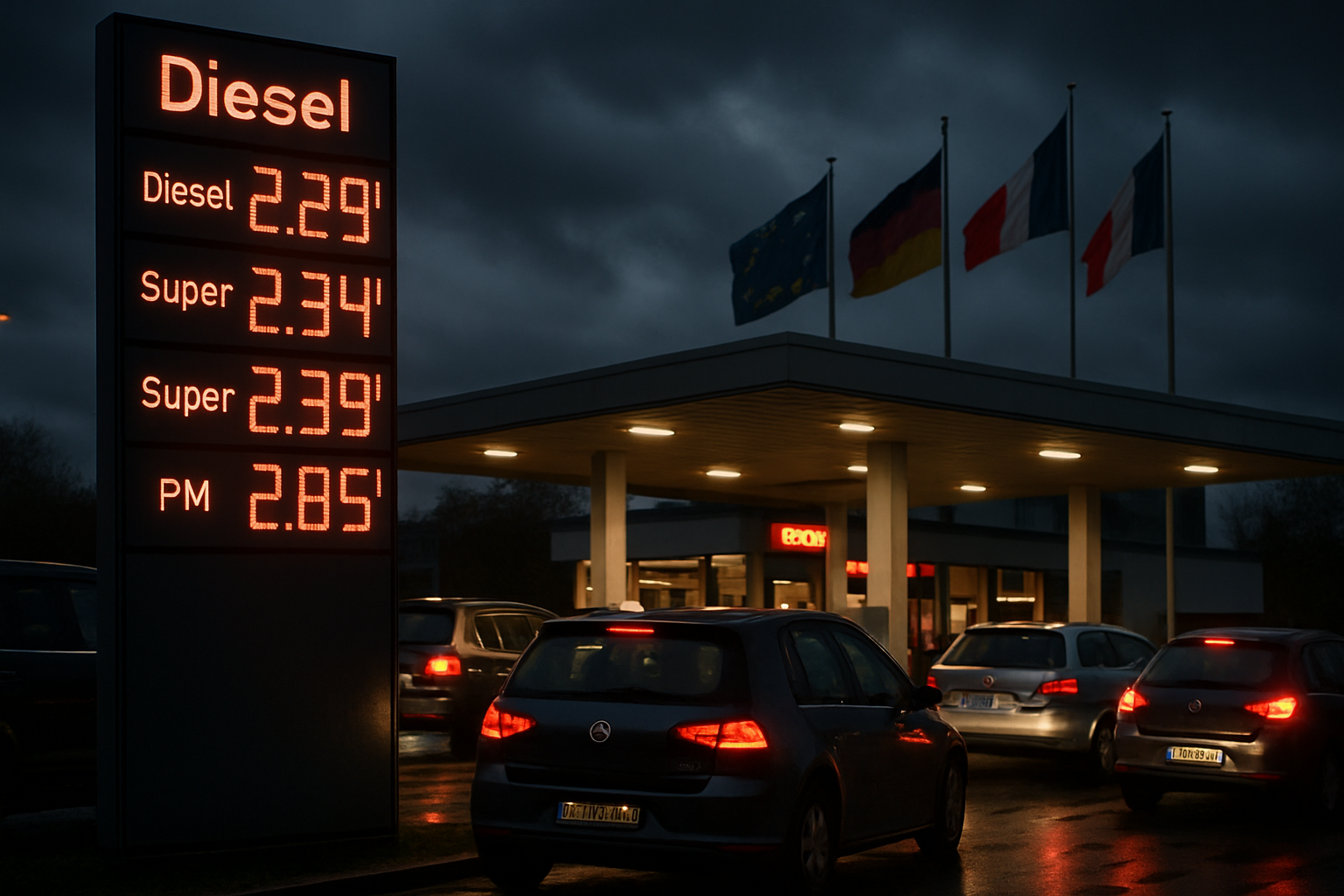
European governments are implementing extraordinary fuel price management strategies as the continent faces its most severe energy crisis in decades, with Hungary leading the charge by introducing price caps on gasoline and diesel while Slovakia taps strategic reserves and Romania develops comprehensive protection scenarios.
The crisis, triggered by Iran's closure of the Strait of Hormuz affecting 40% of global oil transit, has driven oil prices above $100 per barrel for the first time since 2022, forcing European nations to deploy emergency measures not seen since the 1970s oil shocks. Hungary's government announced immediate price ceilings on fuel effective from midnight March 9, designed to protect Hungarian consumers from what officials describe as "war-driven price explosions."
Hungary Implements Immediate Price Controls
Prime Minister Viktor Orbán's administration has moved swiftly to shield Hungarian consumers from the global energy shock, implementing comprehensive fuel price caps that represent one of Europe's most aggressive interventions in energy markets. The measures come as Hungarian families face unprecedented pressure from rising living costs exacerbated by the Middle East conflict.
"The Hungarian government is taking decisive action to protect our citizens from the economic warfare being waged through energy markets," a government spokesperson indicated, referencing the broader geopolitical context driving current price volatility. The price ceiling mechanism will remain in place until regional stability returns, according to official statements.
The Hungarian approach reflects broader Central European concerns about energy security, particularly given the region's historical dependence on Russian energy supplies and current vulnerabilities exposed by Middle Eastern disruptions. Hungary's nuclear energy program, including the ongoing Paks II construction project worth €39.1 billion, represents part of a longer-term energy independence strategy.
Slovakia's Strategic Reserve Response
Slovakia has activated its strategic petroleum reserves in response to the escalating crisis, marking a significant escalation in the European energy emergency response. The Slovak government has begun drawing down reserves to maintain domestic fuel supply stability as global shipping disruptions threaten supply chains.
The decision to tap strategic reserves represents Slovakia's first major deployment of emergency energy stocks since the establishment of current crisis management protocols. Slovak officials emphasized that the measure is designed to provide market stability during what they characterize as an "extraordinary geopolitical emergency" affecting global energy infrastructure.
Slovakia's response is particularly significant given its ongoing energy diversification efforts following disruptions to the Druzhba pipeline system earlier this year. The country declared a state of oil emergency in February, releasing 250,000 tons from strategic reserves to the Slovnaft Bratislava refinery, demonstrating the cumulative pressure on Central European energy systems.
Romania's Multi-Scenario Planning
Romanian Energy Minister Bogdan Ivan has revealed the development of five comprehensive scenarios designed to prevent diesel prices from exceeding 10 lei per liter, including temporary reductions in taxes and excise duties that currently comprise 70% of fuel pricing structures. The multi-layered approach represents one of Europe's most sophisticated crisis response frameworks.
Romania's planning reflects lessons learned from previous energy crises and the country's commitment to protecting consumers during external shocks. The scenarios include graduated responses based on crisis severity, from market intervention measures to comprehensive subsidy programs for essential sectors.
"We are prepared for multiple contingencies to ensure Romanian families and businesses maintain access to affordable fuel during this unprecedented global disruption."
— Bogdan Ivan, Romanian Energy Minister
The Romanian approach emphasizes the importance of proactive crisis planning, with officials noting that the current measures build on frameworks developed during previous European energy emergencies. The country's growing renewable energy infrastructure, including a planned €1 billion Battery Energy Storage System with 2,500 MW capacity, forms part of longer-term energy security planning.
Regional Coordination and EU Response
The fuel price crisis has prompted unprecedented coordination among European Union member states, with High Representative Kaja Kallas coordinating emergency response protocols across the bloc. The European Commission has indicated support for national measures to protect consumers, while maintaining the integrity of the single market.
France has deployed 500 fuel station inspections to prevent price manipulation, with Prime Minister Sébastien Lecornu declaring that "war cannot serve as a pretext for abusive increases." The coordinated approach demonstrates European solidarity during external energy shocks while maintaining competitive market principles.
The EU's response builds on frameworks developed during previous energy crises, including mechanisms for coordinated strategic petroleum reserve releases through the International Energy Agency. However, the current crisis represents a test of European energy resilience at a scale not experienced since the establishment of current crisis management protocols.
Consumer Impact and Economic Implications
The fuel price crisis is creating immediate impacts across European households and businesses, with transportation costs affecting everything from food distribution to industrial manufacturing. Sweden predicts electricity increases of 10-20 öre and gasoline price rises of 1-2 kronor per liter, with the southern Malmö zone particularly exposed due to continental market integration.
Ireland has experienced what officials describe as "brazen rip-offs" in heating oil pricing, with costs approaching €2 per liter affecting household heating during the transition to spring. The Irish government faces pressure to reduce fuel taxes, which currently represent 65% of the cost per euro spent on fuel.
Austria has witnessed fuel cost increases of 20%, prompting criticism from trade unions about profiteering during crisis conditions. The Austrian Automobile Club (ÖAMTC) has documented systematic price increases that exceed underlying commodity cost changes, raising concerns about market manipulation during emergency conditions.
Supply Chain Vulnerabilities Exposed
The crisis has revealed the extent of European dependence on stable Middle Eastern energy supplies, with the 21-mile Strait of Hormuz representing a critical single-point failure for global energy systems. Major shipping companies Maersk and MSC have suspended Persian Gulf operations, leaving over 150 oil and LNG tankers stranded with billions in cargo value.
Manufacturing sectors dependent on Gulf supply networks, including automotive, electronics, and textiles, face severe disruptions extending far beyond direct fuel costs. The crisis demonstrates the interconnected nature of modern supply chains and the vulnerability of European industrial systems to geopolitical disruptions.
Strategic Petroleum Reserves and Emergency Protocols
G7 finance ministers are conducting virtual meetings to coordinate potential strategic oil reserve releases, with Japan considering national stockpile deployment for the first time since the 2011 Fukushima crisis. Japan's consideration is particularly significant given its 95% dependence on Middle Eastern oil, with 70% transiting through the now-closed Strait of Hormuz.
The coordinated response through the International Energy Agency represents the most comprehensive deployment of strategic reserves since their establishment following the 1970s oil crises. However, experts emphasize that strategic reserves provide only temporary buffering for sustained disruptions, highlighting the need for fundamental energy architecture restructuring.
The current crisis exposes the limitations of traditional crisis response mechanisms when facing deliberate closure of critical energy chokepoints, as opposed to weather-related or technical disruptions that typically have predictable resolution timelines.
Long-Term Energy Architecture Implications
The fuel price crisis is accelerating discussions about fundamental energy security architecture transformation across Europe. The over-dependence on strategic chokepoints in volatile geopolitical regions requires supply diversification initiatives that extend far beyond immediate crisis response.
Estonia's energy leadership, including 88% renewable electricity and continental Europe's largest battery storage facility serving 90,000 households, provides a model for energy independence that other European nations are studying intensively. However, renewable infrastructure transitions require years to decades for full implementation, leaving European economies vulnerable during the transition period.
The crisis highlights the tension between immediate energy security needs and long-term decarbonization goals, with some nations potentially accelerating nuclear programs while others focus on renewable energy independence. Hungary's Paks II nuclear project and Romania's battery storage initiatives represent different approaches to reducing external energy dependencies.
Innovation in Crisis Management
European responses demonstrate innovation in crisis management approaches, from Hungary's immediate price controls to Romania's scenario-based planning and Slovakia's strategic reserve deployment. These varied approaches provide valuable templates for future energy crisis management in an increasingly volatile global environment.
The coordination between national responses and EU-wide frameworks represents an evolution in European crisis management, balancing national sovereignty with collective security interests. The success of current measures will influence European approaches to energy crisis management for decades to come.
Recovery Timeline and Future Outlook
Unlike weather-related energy disruptions, the current crisis depends on military operations resolution and diplomatic normalization for recovery, making timeline predictions extremely challenging. Aviation industries cannot conduct long-term scheduling with multiple airspaces closed, while energy markets remain volatile with critical transit routes blocked.
Traditional monetary policy tools have limited effectiveness against structural geopolitical disruptions, requiring governments to rely on direct intervention measures of the type being implemented across Europe. Central banks including the European Central Bank and Bank of Japan are coordinating emergency liquidity provision to prevent broader financial contagion.
The template-setting nature of the current crisis will influence international approaches to conflict resolution, energy markets evolution, and supply chain resilience planning extending decades beyond current events. European responses to the March 2026 energy crisis are establishing precedents for 21st-century crisis management in an increasingly multipolar world.
"This represents the most severe energy security crisis in decades, exposing single-chokepoint vulnerabilities that require fundamental architectural restructuring."
— Samuel Ciszuk, Energy Security Analyst
The success or failure of European fuel price management strategies during this crisis will determine not only immediate economic stability but also influence international cooperation frameworks, energy security planning, and crisis response mechanisms for the remainder of the decade and beyond.