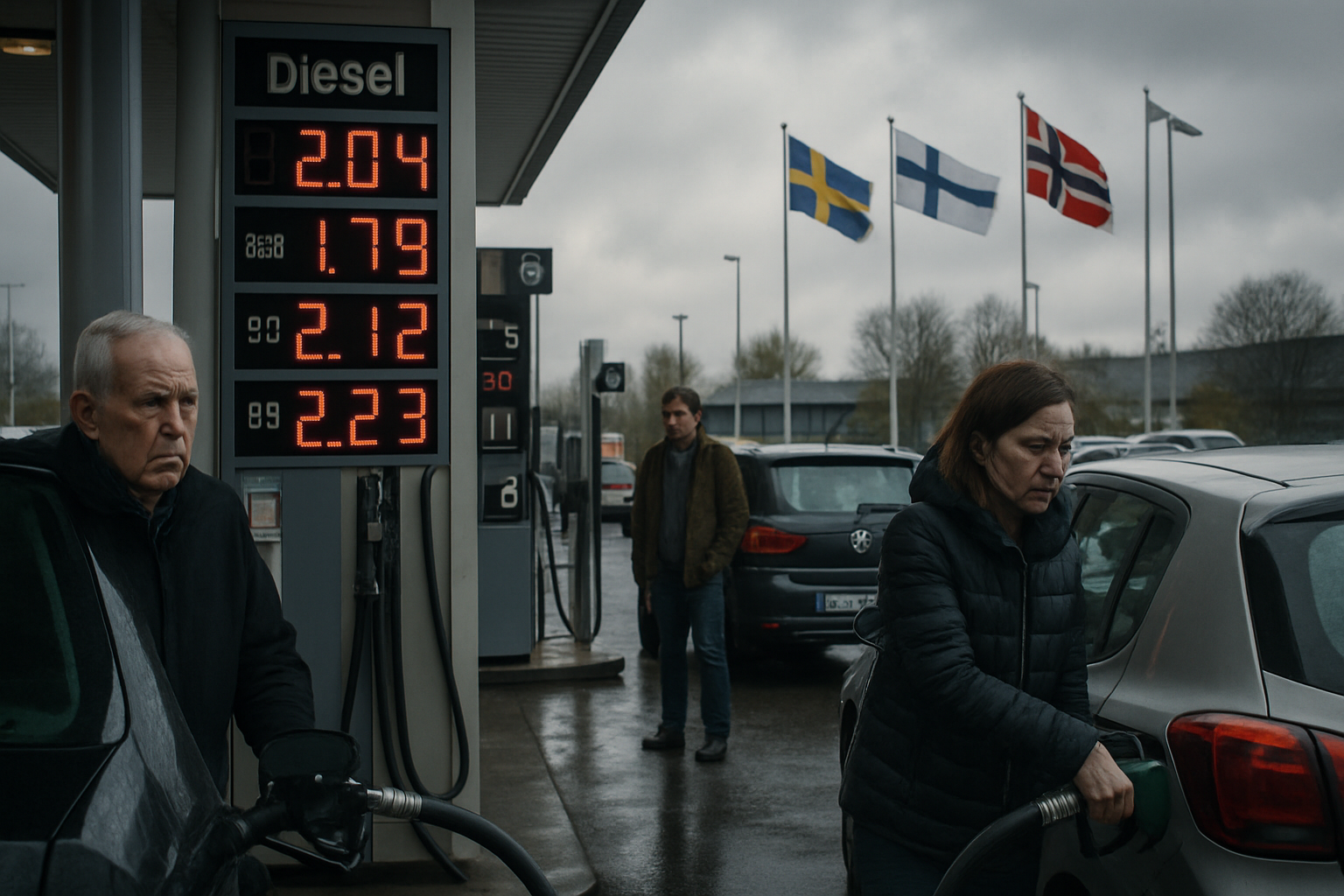
European governments are implementing unprecedented emergency fuel price measures as the ongoing Middle East conflict drives oil prices to their highest levels in years, with Sweden announcing temporary fuel tax reductions and Latvia preparing comprehensive excise tax cuts to shield consumers from soaring energy costs.
The crisis has reached a critical juncture as Iran's Revolutionary Guard maintains its closure of the Strait of Hormuz, effectively blocking 40% of global oil transit and pushing Brent crude to peak at $119.50 per barrel - the highest since 2022. This has prompted coordinated emergency responses across Nordic and Baltic countries, marking the most significant government intervention in fuel markets since the 1970s oil shocks.
Sweden Leads Emergency Response
Swedish Prime Minister Ulf Kristersson announced on March 23rd that his government will temporarily reduce fuel taxes to the EU's minimum levels, offering immediate relief at the pump. The measures will make gasoline approximately one krona cheaper and diesel about 40 öre less expensive for consumers.
"What is happening in the Middle East is putting the Swedish economy to the test,"
— Ulf Kristersson, Swedish Prime Minister
The reform package, costing approximately 1.5 billion kronor according to government estimates, will also introduce electricity subsidies for families facing high energy bills. The measures are proposed to last from May 1st through the end of September, providing critical relief during the summer driving season.
Latvia's Comprehensive Intervention
Latvia's Ministry of Finance is preparing to submit draft legislation to the government on March 24th for a significant reduction in excise tax on diesel fuel by approximately 15%. The fiscally neutral proposal aims to mitigate the impact of rapidly rising fuel costs on both the economy and citizens.
According to sources within the Finance Ministry, the measure represents one of the most substantial interventions in fuel pricing in Latvia's recent history, reflecting the severity of the current energy crisis affecting the Baltic region.
Regional Spillover Effects
The crisis is creating significant regional variations in impact, with southern Sweden's Malmö region identified as particularly vulnerable due to its integration with continental European energy markets. Danish authorities are reportedly preparing similar intervention measures, while Norwegian officials are monitoring cross-border fuel price differentials that could lead to increased smuggling activity.
Finland's government has already indicated its intention to propose gasoline tax reductions, according to Finnish media reports, suggesting a coordinated Nordic response to the energy price surge.
Historical Context and Scale
The current crisis represents the most severe energy emergency since the 1970s oil shocks, triggered by the complete breakdown of US-Iran nuclear negotiations despite previous Geneva breakthrough talks. The International Energy Agency has responded with its largest strategic petroleum reserve release in 50 years - 400 million barrels from 32 countries, more than double the response to the 2022 Ukraine crisis.
The energy disruption has cascaded beyond fuel prices, with natural gas prices exploding 24% in Europe and 78% in the US, reaching €47.32/MWh - the highest levels since February 2025. This has forced governments across Europe to reconsider their approach to energy market intervention.
Consumer Impact Across Europe
The human cost of the crisis is becoming apparent across European capitals. In Ireland, heating oil prices are approaching €2 per liter, with officials describing the increases as "brazen rip-offs." Malta reports that fuel prices would be 45% higher without government subsidies, while Bosnia-Herzegovina has been reduced to just two days of gas reserves.
The crisis has particularly affected transportation-dependent industries, with airlines implementing emergency surcharges as jet fuel costs have soared from $85-90 to $150-200 per barrel - an increase of up to 122%.
Government Coordination Mechanisms
The European response has demonstrated unprecedented coordination in crisis management. EU High Representative Kaja Kallas has activated emergency protocols including state aid programs for energy-intensive industries and enhanced surveillance of fuel price manipulation.
Multiple countries have implemented emergency measures simultaneously: Hungary imposed immediate gasoline and diesel price caps against "war-driven price explosions," France deployed 500 fuel station inspectors to prevent price manipulation, and Romania outlined five scenarios to prevent diesel from exceeding 10 lei per liter.
Long-term Energy Security Implications
The crisis has exposed dangerous vulnerabilities in European energy architecture, with the 21-mile Strait of Hormuz serving as a critical single-point failure for modern logistics. Energy experts warn that the over-dependence on strategic chokepoints requires fundamental restructuring of supply chains.
"This represents the most severe energy security crisis in decades, with single-chokepoint vulnerabilities fully exposed."
— Samuel Ciszuk, Energy Security Analyst
Estonia's renewable energy model, with 88% renewable electricity generation and Europe's largest battery storage system serving 90,000 households, is being studied as a template for energy independence. However, experts note that such transitions require years or decades to implement fully.
Economic and Financial Market Impact
The crisis has triggered significant financial market volatility, with traditional monetary policy tools proving limited in effectiveness against structural geopolitical disruptions. Central banks across Europe are coordinating emergency liquidity measures to prevent broader economic contagion.
The uncertainty has forced companies to reassess expansion plans and supply chain strategies, particularly in energy-intensive industries such as manufacturing, automotive, and electronics sectors that depend on Gulf shipping networks.
Recovery Timeline Uncertain
Unlike weather-related or technical disruptions, the current crisis recovery timeline depends entirely on military operations resolution and diplomatic normalization in the Middle East. Aviation industries report they cannot maintain long-term scheduling while multiple airspaces remain closed, and energy markets continue to experience volatility while critical transit routes remain blocked.
UN Secretary-General António Guterres has called the situation "the greatest test of multilateral cooperation in crisis management in the modern era," emphasizing that the success or failure of diplomatic efforts will have template-setting implications for 21st-century international relations.
Future Policy Implications
The March 2026 energy crisis is establishing new paradigms for European energy security policy that will influence governance approaches for decades to come. The coordination of national responses within EU-wide frameworks is balancing sovereignty needs with collective security requirements.
Success in containing the current crisis could provide a framework for future nuclear crisis resolution, while failure may accelerate military solutions and reshape Middle Eastern geopolitics for generations. The decisions made in the coming weeks will reverberate through international relations, determining whether diplomatic or military approaches become the precedent for 21st-century dispute resolution.
As European governments continue to implement emergency measures to protect their citizens from soaring fuel costs, the crisis serves as a stark reminder of the interconnected nature of global energy systems and the urgent need for diversified, resilient energy infrastructure in an increasingly volatile world.