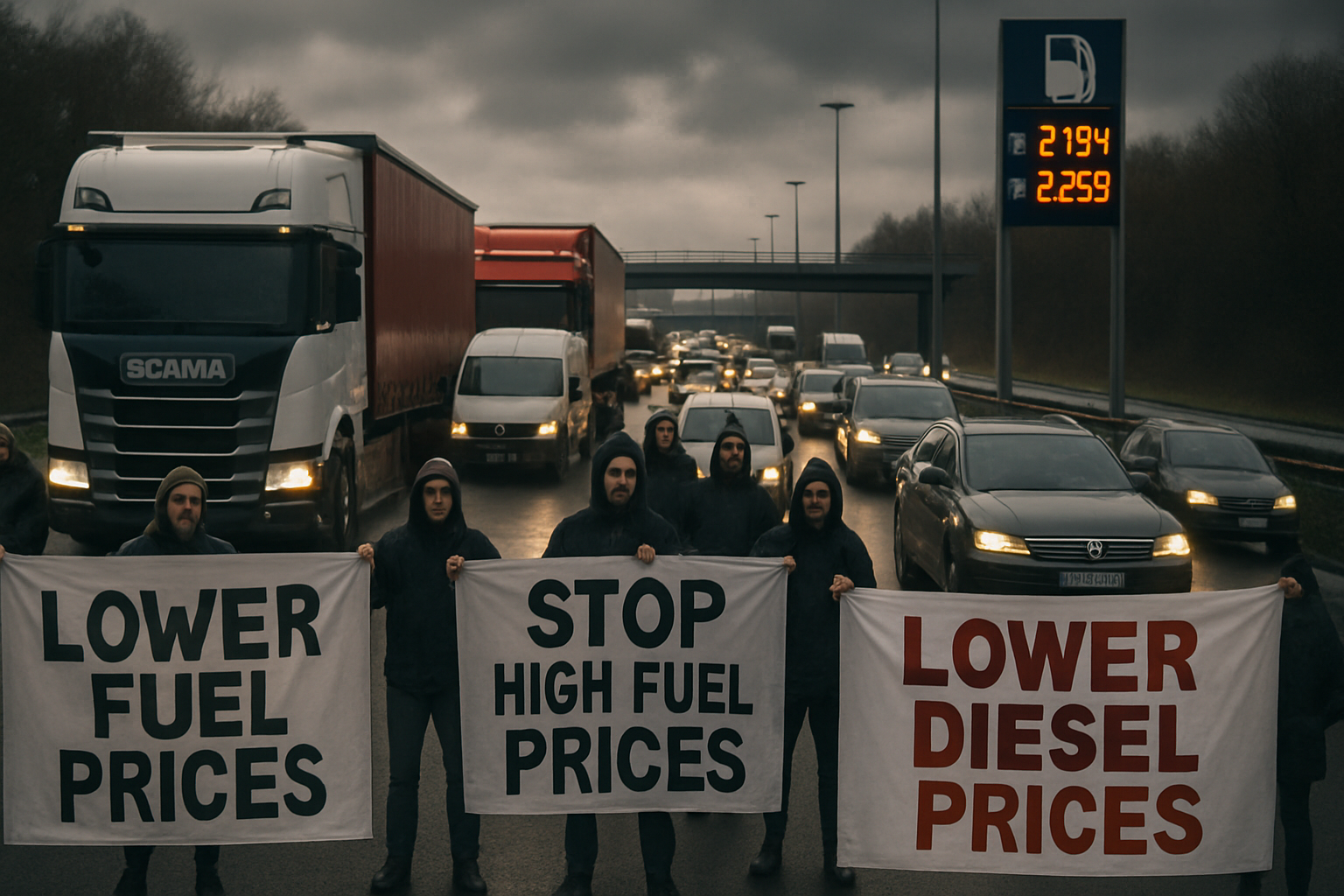
Mass fuel protests have paralyzed major highways across Ireland, Norway, and Serbia as Europe enters the fourth consecutive week of its most severe energy crisis since the 1970s oil shocks, with drivers and farmers demanding immediate government action on fuel prices that have doubled in some regions.
The coordinated demonstrations, dubbed "Dieselbrølet" (The Diesel Roar) in Norway, represent the largest civil unrest related to energy costs in Europe since the implementation of emergency fuel rationing during the oil crisis of 1973-74. Friday's protests brought traffic to a standstill on Ireland's M50, M1, M7, M8, and M18 motorways, while Norwegian truckers attempted to convoy toward Oslo before being intercepted by police.
Ireland Faces Transport Paralysis
In Ireland, the fuel crisis has reached a breaking point as protesters entered their fourth consecutive day of coordinated blockades across the country's major transport arteries. Dublin Bus reported severe delays, while the Luas tram system experienced widespread disruption as petrol stations reported critically low supplies.
The Irish government, which implemented a €235 million emergency package in March cutting diesel excise by 20 cents and petrol by 15 cents, has found itself under mounting pressure as heating oil approaches €2 per liter—levels that protest organizers describe as "brazen rip-offs" targeting vulnerable households.
"The government's March package was a drop in the ocean compared to what working families are facing," said a spokesperson for the Irish Road Haulage Association. "Transport operators are seeing fuel costs rise from €120-130 to €190 per fill, adding €2,000-3,000 to weekly business expenses."
— Irish Road Haulage Association
Despite opposition party calls for engagement with demonstrators, the Irish Cabinet has expressed distrust of protest leaders while maintaining that blockades preventing access to essential services are "wrong" even as they respect the right to peaceful protest.
Norwegian "Diesel Roar" Confronts Authorities
Norwegian authorities intercepted approximately 60 truck convoys on Friday as the "Dieselbrølet" demonstration attempted to reach Oslo, with police providing escorts through the city center for a small number of vehicles. The protests represent a striking paradox—Norway, one of Europe's largest oil producers, is experiencing diesel prices exceeding 30 kroner per liter, demonstrating how the global supply chain crisis transcends domestic production capacity.
The Norwegian protests highlight a fundamental contradiction in European energy security: even countries with significant domestic hydrocarbon production remain vulnerable to global supply shocks when critical transit chokepoints are compromised.
Serbia Reports Escalating Demonstrations
Serbian media reports indicate that fuel protests by farmers and truck drivers have now entered their fourth day, with demonstrations spreading across the country as transport costs threaten agricultural operations and commercial vehicle fleets. The protests reflect the spillover effects of the crisis beyond European Union borders, affecting the broader Balkan region.
Root Cause: The Strait of Hormuz Crisis
The current protests stem from the ongoing closure of the Strait of Hormuz by Iran's Revolutionary Guard, which has blocked 40% of global oil transit through the crucial 21-mile waterway since early March. This single chokepoint failure has created the most severe energy security crisis in decades, with oil prices reaching historic peaks of $119.50 per barrel for Brent crude and $108.15 for West Texas Intermediate—representing an 18.98% record single-day jump.
The International Energy Agency (IEA) has deployed its largest strategic petroleum reserve release in 50-year history, releasing 400 million barrels from 32 countries—more than double the response to the 2022 Ukraine crisis. However, these emergency measures have proven insufficient to address the fundamental supply disruption caused by the closure of the world's most critical energy transit route.
Government Response Strategies Diverge
European governments have implemented increasingly desperate measures to manage the crisis. Hungary imposed immediate price caps on gasoline and diesel to combat "war-driven explosions" in fuel costs. France deployed 500 fuel station inspectors to prevent price manipulation. Romania outlined five emergency scenarios to prevent diesel from exceeding 10 lei per liter, while Slovakia activated strategic petroleum reserves for the first time under current protocols.
Germany has taken the unprecedented step of strengthening antitrust laws to prevent gas station price manipulation—representing the most significant market intervention in modern German energy policy.
Consumer Impact Reaches Crisis Levels
The human cost of the energy crisis continues to mount across Europe. In Sweden, electricity prices have increased by 10-20 öre with gasoline up 1-2 kronor, with the Malmö region identified as most vulnerable due to continental market integration. Bosnia-Herzegovina has been reduced to just two days of gas reserves, while Malta faces fuel prices 45% higher without government subsidies.
The crisis has disproportionately affected lower-income households and essential workers who cannot reduce their fuel consumption. Hospital appointments have been delayed in Ireland due to transport disruptions, creating what officials describe as "unnecessary heartache" for families accessing essential services.
Aviation and Broader Economic Impact
Beyond road transport, the crisis has created unprecedented disruption to aviation, with over 18,000 flights cancelled worldwide—the most extensive cancellations since the COVID-19 pandemic. Dubai International Airport, the world's busiest with 86 million passengers annually, remains closed due to missile damage, while jet fuel prices have surged 122% from $85-90 to $150-200 per barrel.
Financial markets have crashed globally, with Pakistan's KSE-100 index recording its largest single-day decline in history at -8.97%, while South Korea's KOSPI index fell 12% before circuit breakers were triggered. The Korean won has fallen to a 17-year low as foreign capital flees emerging markets.
Expert Analysis and Long-term Implications
Energy security expert Samuel Ciszuk describes the current situation as "the most severe energy security crisis in decades, exposing single-chokepoint vulnerabilities that were assumed away in energy planning." Qatar's Energy Minister Saad Al Kaabi has warned that Gulf states may declare force majeure "within weeks" if the conflict continues, with oil potentially reaching $150 per barrel levels that could "bring down the economies of the world."
UN Secretary-General António Guterres has called the crisis "the greatest test of multilateral cooperation in the modern era," as nuclear risks reach their highest levels in decades with the expiration of the New START treaty and Iran's continued uranium enrichment at 60% purity.
Path Forward Remains Uncertain
The recovery timeline for European fuel markets remains uncertain and depends on military and diplomatic resolution of the Middle East conflict rather than predictable economic factors. Unlike weather-related disruptions, the current crisis affects the fundamental architecture of global energy supply chains.
The protests spreading across Europe represent more than immediate economic hardship—they reflect a broader recognition that the continent's energy architecture requires fundamental transformation to reduce dependence on strategic chokepoints vulnerable to geopolitical volatility. Estonia's renewable energy model, with 88% renewable electricity generation and Europe's largest battery storage capacity serving 90,000 households, provides a template for energy independence, but such transitions require years or decades to implement.
As protesters continue to block major highways from Dublin to Oslo to Belgrade, European leaders face mounting pressure to address not only the immediate fuel price crisis but the underlying structural vulnerabilities that have left the continent exposed to energy blackmail. The events of April 2026 may prove to be a watershed moment that fundamentally reshapes European energy policy for generations to come.