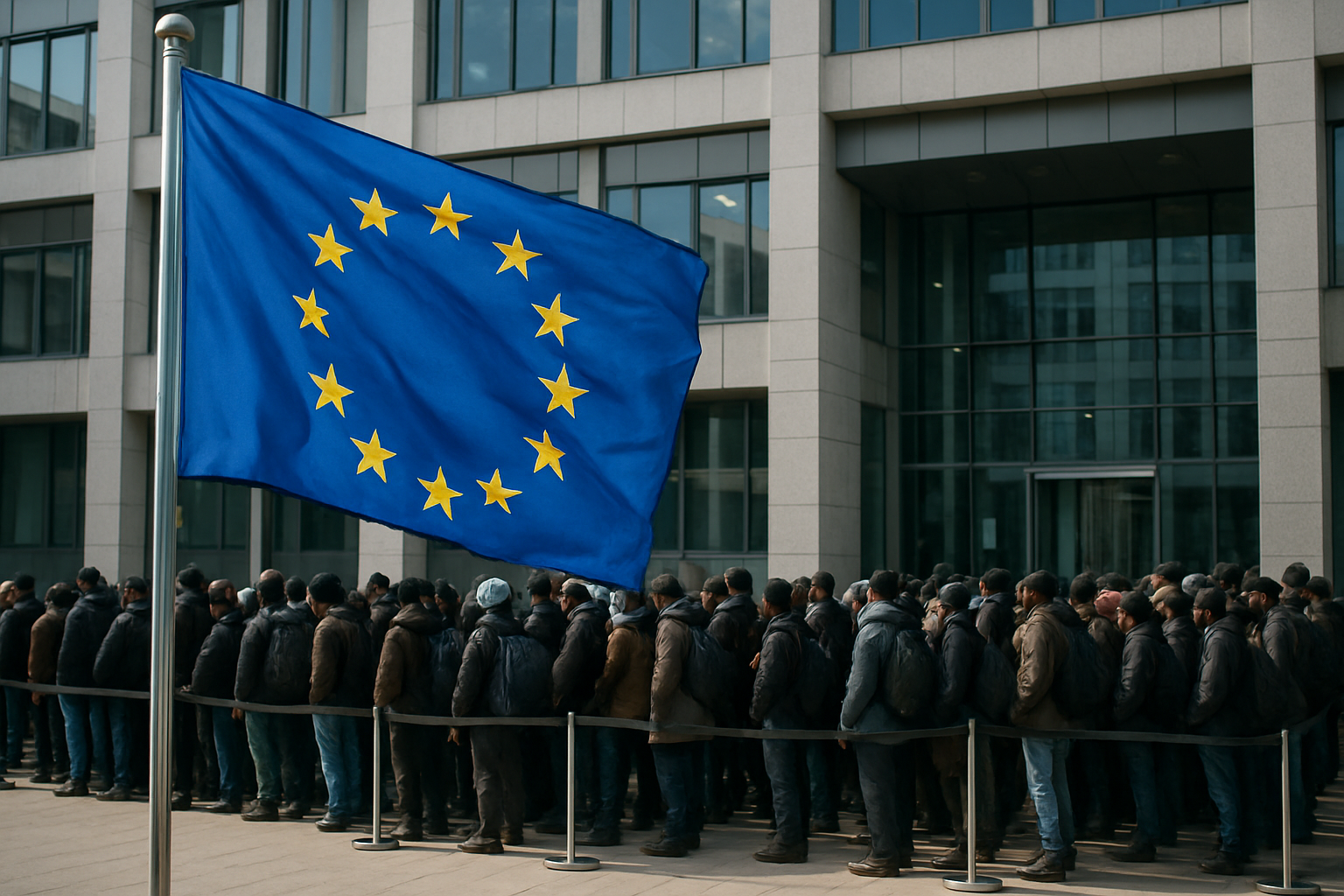
Thousands of migrants are queuing outside consulates and immigration offices across Europe as countries grapple with overwhelmed regularization processes and conflicting approaches to border management, creating a humanitarian and political crisis that exposes deep divisions within EU immigration policy.
The scale of the crisis became starkly visible in Barcelona this week, where immigrants formed long lines outside the Pakistani consulate seeking certificates of antecedents to qualify for Spain's regularization process. The scene reflects a broader European challenge as traditional immigration pathways become increasingly strained under the weight of global migration pressures.
Spain's Regularization Bottleneck
Barcelona has emerged as a focal point of the immigration crisis, with 141,000 Moroccan residents representing the largest North African community in Spain. The city's demographics reflect deliberate policy choices dating back to the Pujol era, when Catalonia's government actively promoted African immigration to facilitate Catalan language immersion.
This contrasts sharply with Madrid, which has consolidated its position as the primary destination for Latin American immigration. The regional variations highlight how local policies have shaped migration patterns, creating distinct challenges for different Spanish cities.
The current regularization process has created unprecedented bureaucratic bottlenecks, with migrants from Pakistan, Morocco, and other countries facing weeks-long waits for essential documentation. Immigration lawyers report that the system is overwhelmed, with processing times extending far beyond normal parameters.
EU Policy Transformation
The current crisis unfolds against the backdrop of historic changes to EU migration policy. In February 2026, the European Parliament approved sweeping asylum procedure changes that allow member states to deport asylum seekers to "safe" third countries regardless of personal connections to those nations.
"This represents a fundamental shift since the 2015-16 refugee crisis, moving toward deterrence over protection principles."
— EU Migration Policy Expert
The legislation, passed through an unprecedented center-right and far-right alliance, includes provisions for accelerated asylum processing, unified "safe country" lists, and frameworks for external deportation centers. Italy's Meloni government is already testing an Albanian model that serves as a template for these new approaches.
Critics argue the measures violate the non-refoulement principle, a cornerstone of international humanitarian law that prohibits returning people to countries where they face persecution. However, supporters contend these deterrent effects are necessary for enhanced border control.
Border Management Strains
European border systems are showing signs of critical strain. The Entry/Exit System (EES), implemented in October 2025, requires biometric data collection from all non-EU citizens entering the Schengen zone. Airlines across Europe have urgently called for EU officials to review the system amid fears of four-hour queues during the upcoming summer travel season.
Industry sources predict "serious disturbances" as the EES struggles with current low-season operations, raising concerns about peak travel capacity. The European Commission has already allowed partial suspension during summer 2026 due to significant delays at airports, ports, and Eurotunnel crossings.
Meanwhile, Estonia temporarily closed two border crossing points with Russia following a "string of border incidents," significantly affecting bus companies and roadside service operators dependent on cross-border traffic. The decision represents a security-driven response to heightened tensions along the EU's eastern frontier.
Regional Disparities and Responses
The immigration crisis reveals stark regional disparities in European responses. While Spain grapples with regularization queues in Barcelona, other countries face different challenges. Cyprus has closed four buildings in old Nicosia due to overcrowding violations, with 131 arrests for illegal residence in the past year.
In contrast, countries like Guyana have succeeded with diaspora reintegration programs, with over 2,000 overseas Guyanese returning in five years under comprehensive support initiatives. This demonstrates that proactive engagement can yield positive results when properly resourced.
The Baltic states present another model, with Estonia, Latvia, and Lithuania taking divergent approaches to migration policy while maintaining coordination on security issues. These variations reflect the complex balance between national sovereignty and European unity.
Humanitarian Concerns
Human rights organizations have expressed alarm at the deteriorating conditions faced by migrants across Europe. The Mediterranean continues to be a deadly crossing route, with recent tragedies highlighting the ongoing humanitarian crisis.
The Qatar-based organization has documented increasing incidents of migrants trapped in bureaucratic limbo, unable to access essential services while awaiting document processing. Healthcare access, education for children, and basic housing remain critical concerns.

Political and Economic Implications
The immigration crisis occurs amid broader European political tensions. Recent Eurobarometer surveys show 89% of Europeans demand greater EU unity, yet Slovakia, Czech Republic, and Hungary have refused to participate in the EU's €90 billion Ukraine loan financing, demonstrating limits to European solidarity.
Economic pressures compound the challenge. Construction industry faces negative profit margins from rising material costs, affecting housing availability for both migrants and citizens. Croatia's program targeting 600,000 empty homes for rental conversion represents one innovative approach to addressing accommodation shortages.
The crisis also intersects with labor market needs. Albania, for example, has welcomed unprecedented immigration with 27,000 foreign nationals, including workers from India, Nepal, and the Philippines, filling shortages in fishing, construction, and tourism sectors.
Technology and Enforcement
European countries are increasingly turning to technology for border management solutions. Digital systems for visa processing, biometric identification, and tracking represent significant investments in immigration infrastructure.
However, technical challenges persist. Real age verification requires biometric authentication, raising surveillance concerns. Cross-border enforcement requires unprecedented international cooperation currently in nascent forms. The global memory crisis, with semiconductor prices surging sixfold, constrains implementation until new facilities come online in 2027.
Future Challenges
The European immigration crisis represents a critical test of the bloc's capacity to balance humanitarian obligations with security concerns and economic realities. The success or failure of current approaches will influence global migration policy for years to come.
Implementation challenges include maintaining EU treaty compliance while ensuring non-discrimination against non-participants and keeping policies open to later joiners. The mechanism represents institutional evolution prioritizing effectiveness over inclusivity amid global security and economic competition pressures.
As climate change continues to drive displacement globally—with January 2026 marking the 18th consecutive month of temperatures exceeding 1.5°C above pre-industrial levels—European policymakers face mounting pressure to develop sustainable, humane approaches to migration management.
The images of migrants queuing outside consulates in Barcelona serve as a stark reminder that behind the policy debates lie individual human stories of people seeking safety, opportunity, and dignity. How Europe responds to this crisis will define not only its approach to migration but its commitment to the values of human rights and international cooperation that have underpinned the European project.