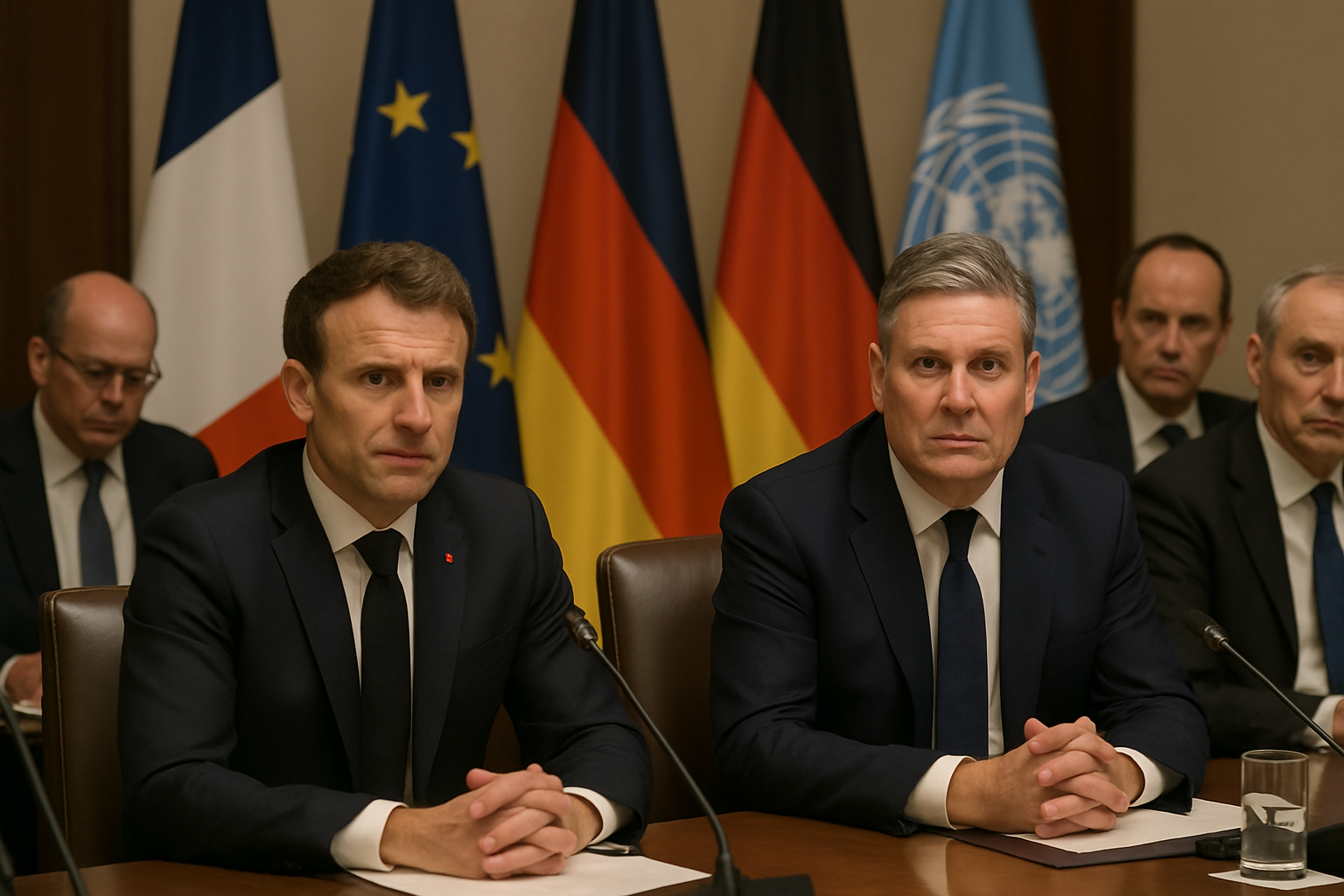
European leaders, including French President Emmanuel Macron and British Prime Minister Keir Starmer, are spearheading an unprecedented multinational security initiative to protect critical maritime waterways, marking the most significant coordinated defensive mission since World War II.
The ambitious security mission, emerging from high-level discussions involving over 40 countries, represents a fundamental shift toward European strategic autonomy in addressing global maritime security challenges. According to diplomatic sources, the initiative focuses on establishing defensive measures to maintain safe passage through strategic shipping corridors that handle nearly half of global maritime trade.
Historic Coalition Formation
Australian Prime Minister Anthony Albanese confirmed his nation's readiness to participate in the defensive mission during a multinational virtual summit, emphasizing the operation's strictly protective nature. "Australia stands ready to contribute to efforts that ensure the safety of international shipping," Albanese stated, reflecting the global scope of support for the European-led initiative.
The coalition's formation represents an evolution from traditional NATO frameworks, with European nations taking primary leadership roles in coordinating maritime security responses. French and British officials have outlined comprehensive plans that include naval escorts, minesweeping capabilities, and advanced reconnaissance systems to protect commercial vessels.
Strategic Context and Regional Tensions
The security mission comes amid heightened tensions in critical maritime chokepoints, where disruptions to shipping lanes have previously triggered global economic crises. Recent events have demonstrated the vulnerability of international trade routes, with oil prices surging past $100 per barrel and aviation networks experiencing unprecedented disruptions affecting over 18,000 flights worldwide.
Italian Prime Minister Giorgia Meloni has confirmed Italy's participation, stating "We will do our part" in supporting the multinational effort. Italian sources indicate plans to deploy at least two mine-clearing vessels, demonstrating the coalition's focus on comprehensive maritime security capabilities.
"Europe must take responsibility for its own security while maintaining our commitment to international partnerships."
— Emmanuel Macron, President of France
Operational Framework and Capabilities
The proposed security mission encompasses multiple layers of protection, including naval vessels from the United Kingdom, France, Germany, Italy, Japan, and the Netherlands. German Chancellor Olaf Scholz has presented concrete proposals during Paris meetings, outlining the deployment of minesweepers, escort vessels, and reconnaissance aircraft.
New Zealand Prime Minister Christopher Luxon participated in virtual consultations with world leaders, discussing strategies for reopening critical maritime passages. The discussions included more than 30 countries, representing the largest maritime security coordination effort since World War II.
Intelligence sharing and technological cooperation form cornerstone elements of the initiative, with advanced satellite tracking systems and AI-powered monitoring capabilities being integrated into the operational framework. These technological enhancements represent a significant evolution in maritime security protocols.
International Response and Diplomatic Implications
The European-led initiative has garnered support from regional powers while avoiding direct involvement of primary antagonists in current conflicts. This approach creates diplomatic space for resolution while maintaining pressure for the restoration of freedom of navigation principles.
French Defense Minister sources have confirmed European mine-clearing capabilities, emphasizing the coalition's preparedness to address complex maritime challenges. The operation's defensive nature distinguishes it from previous military interventions, focusing specifically on protecting civilian shipping and maintaining international trade flows.
Norwegian officials have confirmed their nation's willingness to contribute to maritime security efforts, adding Nordic expertise to the expanding coalition. The broad international support demonstrates widespread concern about maritime security vulnerabilities that affect global economic stability.
Economic and Energy Security Implications
The mission addresses fundamental vulnerabilities in global energy architecture, where single-point failures in strategic waterways can trigger worldwide economic disruption. Recent events have exposed dangerous over-dependence on specific maritime chokepoints, requiring coordinated international responses to ensure supply chain resilience.
Eurogroup President Kyriakos Pierrakakis has warned that extended disruptions to critical shipping routes could create "the largest energy crisis in history." The European security mission aims to prevent such scenarios through proactive protective measures and international coordination.
The International Energy Agency's deployment of strategic petroleum reserves—the largest release in its 50-year history—underscores the critical importance of maintaining stable maritime trade routes for global energy security.
Nuclear Governance and Crisis Management Context
The European initiative emerges amid broader challenges to international security architecture, including the expiration of nuclear arms control treaties and rising geopolitical tensions. The mission represents a template for multilateral cooperation in addressing 21st-century security challenges without escalating to military confrontation.
UN Secretary-General António Guterres has characterized current global tensions as "the greatest test of multilateral cooperation in the modern era," making the European maritime security mission a critical demonstration of international coordination capabilities.
The success of this defensive initiative could provide frameworks for future diplomatic engagement and crisis resolution, offering alternatives to purely military responses to international security challenges.
Looking Forward: Template for Future Security Cooperation
The European-led security mission establishes important precedents for international cooperation in protecting global commons while respecting sovereign rights. The initiative's emphasis on defensive measures and multilateral coordination offers a model for addressing future maritime security challenges.
European officials view the mission as validation of strategic autonomy principles, demonstrating the continent's capacity for independent security action while maintaining alliance relationships. The operation could influence international approaches to territorial sovereignty and conflict resolution for decades to come.
As the mission moves from planning to implementation phases, its success will be measured not only in immediate security outcomes but also in its contribution to establishing new frameworks for international cooperation in an increasingly complex geopolitical environment.