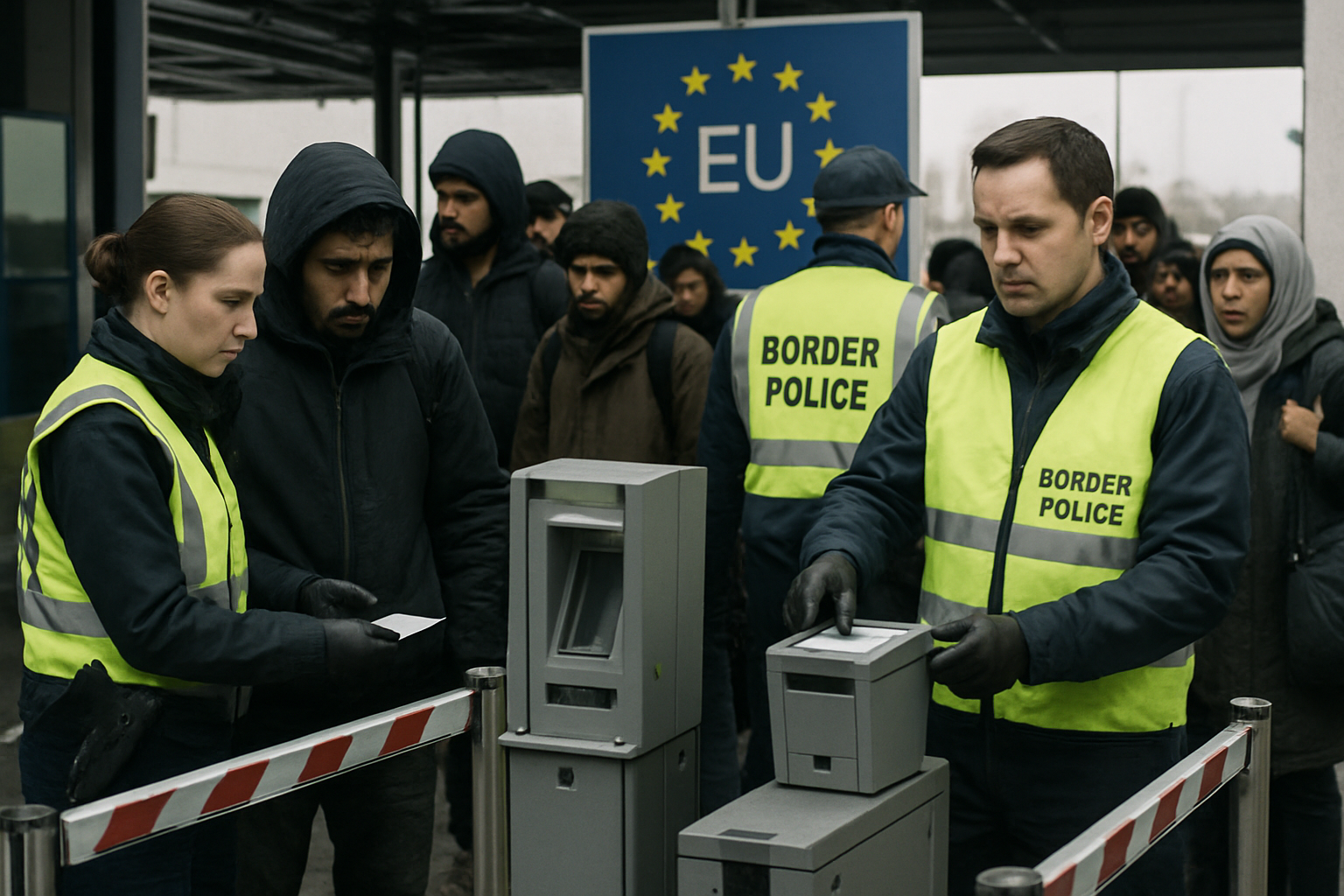
European leaders are issuing urgent warnings about potential new waves of migration from the Middle East while grappling with an expanding border security crisis that has reached the Belgian coast and contributed to far-right electoral gains across the continent.
The crisis has intensified dramatically in March 2026, with Belgian police intercepting nineteen migrants in a small boat attempting to cross to the UK from the hamlet of Klemskerke in De Haan, West Flanders. The emergency services brought the migrants ashore in Ostend after their vessel encountered difficulties during the dangerous Channel crossing.
"We are noticing that the problem is spreading to the entire coast," police sources told Belgian media, highlighting how the small boat crisis has expanded beyond traditional departure points in northern France to encompass the entire Flemish coastline.
Italian-Danish Coalition Calls for EU Coordination
Italian Prime Minister Giorgia Meloni and Danish Prime Minister Mette Frederiksen have jointly called on the European Union to coordinate responses to potential migrants from the Middle East. Speaking at a high-level meeting, Frederiksen expressed fears of a new refugee flow from the Middle East, warning that European borders must be strengthened to "avoid a crisis like 2015."
The Danish leader emphasized the need to "increase support for populations" in origin countries while simultaneously reinforcing European border security measures. This dual approach reflects the complex challenge facing EU leaders as they attempt to balance humanitarian obligations with domestic political pressures for stricter immigration controls.
Dutch Elections Reflect Immigration Tensions
The political impact of migration concerns became evident in Dutch municipal elections, where far-right and local parties appeared to benefit significantly from local resistance to plans for opening asylum shelters in various municipalities. The electoral results demonstrate how immigration policy has become a decisive factor in European politics at all levels of government.
These gains come as the Netherlands joins a broader European shift toward more restrictive asylum policies. The country is participating in enhanced cooperation mechanisms that allow smaller groups of EU member states to advance controversial policies without requiring unanimous consent from all 27 members.
Norwegian Concerns About Middle East Instability
Norwegian officials have expressed growing alarm about potential refugee flows stemming from the ongoing Middle East crisis. The concerns center particularly on the situation in Iran, where recent conflicts have created unprecedented instability that could trigger large-scale population movements.
According to European intelligence assessments, any major escalation in Middle East conflicts could result in refugee flows "without precedent," potentially involving Iran's population of over 84 million people. This scenario would represent a fundamentally different challenge from previous migration waves, given Iran's educated middle class and existing diaspora networks throughout Europe.
Historic Policy Transformation
The current crisis unfolds against the backdrop of the most significant transformation in European migration policy since the 2015-2016 refugee crisis. In February 2026, the European Parliament approved historic asylum procedure changes allowing deportation to "safe" third countries through a center-right and far-right alliance.
"We must prepare for the possibility of unprecedented refugee flows while maintaining our humanitarian commitments and border security effectiveness."
— Senior EU Official, March 2026
These policy changes represent a fundamental shift from protection-based to deterrence-focused asylum principles. Greece is now leading a coalition with Germany, Netherlands, Austria, and Denmark to establish migrant "return centers" outside the European Union, likely in Africa. The facilities would host migrants whose asylum claims have been rejected and whose countries of origin refuse to readmit them.
Implementation Successes and Challenges
The EU Entry/Exit System (EES) has demonstrated effectiveness in its first months of operation, detecting over 4,000 overstayers in its initial four-month period. However, the system has also created significant processing delays, with airlines warning of four-hour queues during summer 2026 that may require European Commission authorization for partial suspension.
Enhanced cooperation mechanisms are enabling smaller member states to advance policies without unanimous EU consent, bypassing traditional safeguards. This approach has allowed countries to circumvent conventional asylum protections through pre-designated "safe" third country transfers, regardless of personal connections migrants may have to those nations.
Public Opinion and Political Pressures
Recent Eurobarometer polling reveals that 89% of Europeans demand greater EU unity on migration issues, while 72% express concerns about border security. This overwhelming public sentiment for coordinated action occurs alongside rising support for parties promising stricter immigration controls.
The tension between public demands for security and humanitarian obligations has created unprecedented challenges for European leaders. Many face the difficult task of maintaining international commitments while responding to domestic political pressures that increasingly favor restrictive approaches.
Economic and Humanitarian Implications
The ongoing migration policy transformation occurs during a period of significant economic constraints. Construction industry negative margins limit housing capacity for new arrivals, while critical material dependencies on China (60% of production, 90% of refining for lithium and rare earth elements) complicate infrastructure development needed to manage migration flows.
Climate displacement continues to intensify pressure on European migration systems, with January 2026 marking the 18th consecutive month of global temperatures above 1.5°C pre-industrial levels. This persistent warming trend suggests that environmental migration will become an increasingly significant component of overall population movements toward Europe.
Looking Ahead: Critical Decisions
European leaders face what senior officials describe as "the greatest test of multilateral cooperation and crisis management in the modern era." The success or failure of current policy approaches will likely determine whether democratic values can be maintained while managing complex migration flows driven by climate change, conflicts, and economic disruption.
The template being established in 2026 will influence international migration management approaches for decades ahead. As one EU diplomat noted, "We are writing the playbook for 21st-century crisis management while the world watches how democratic institutions adapt to preserve European values."
The coming months will prove decisive in determining whether European coordination can effectively address the dual challenges of maintaining humanitarian commitments while achieving the border security objectives demanded by European citizens. The stakes extend far beyond Europe's borders, as the international community monitors whether democratic governance can successfully navigate the complex intersection of security, humanitarian law, and political sustainability in an increasingly volatile global environment.