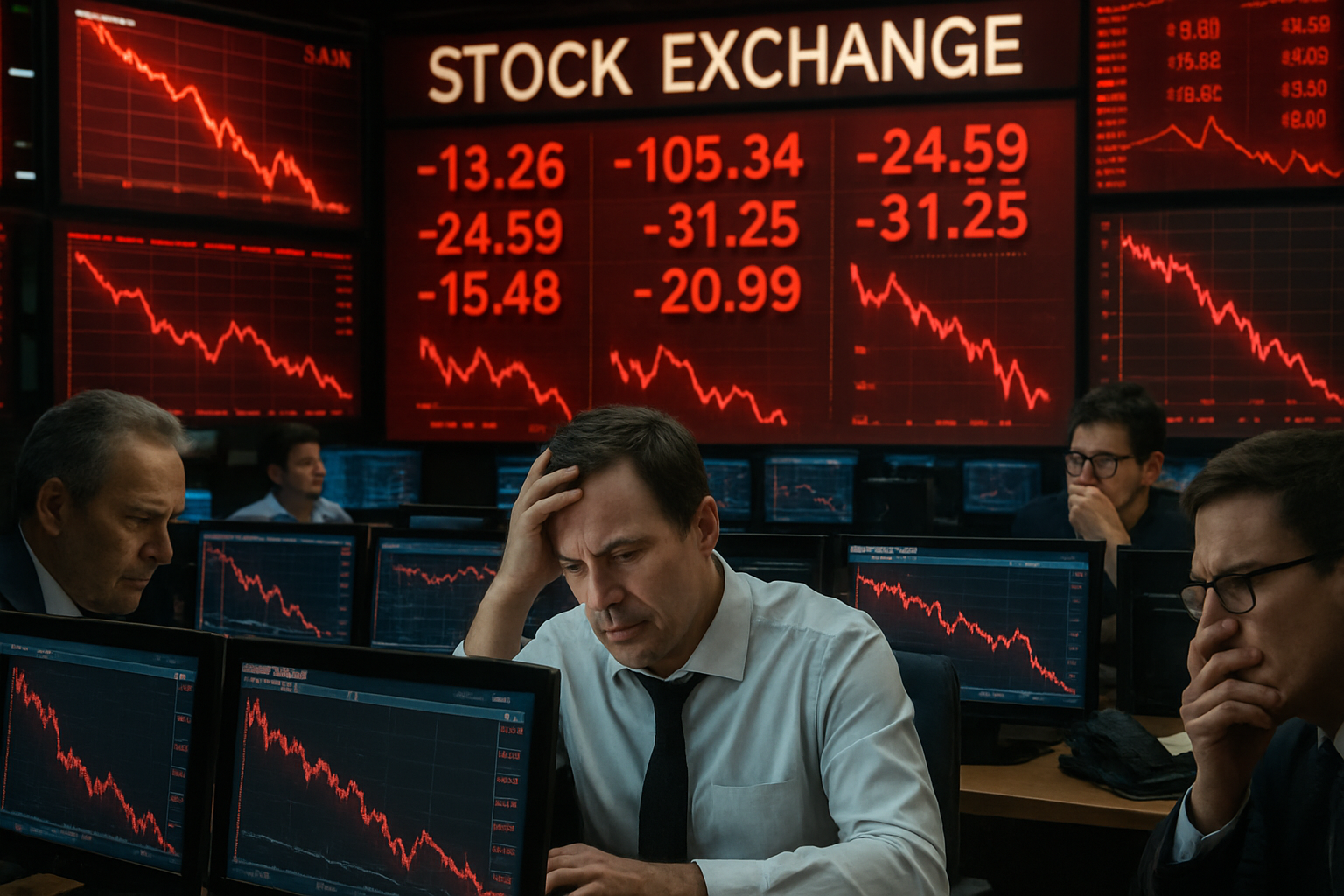
European and Asian stock markets experienced catastrophic declines on March 4, 2026, as escalating Middle East tensions and Iran's effective closure of the Strait of Hormuz triggered the most severe global energy crisis in decades, forcing trading halts and unprecedented circuit breaker activations across major exchanges.
The KOSPI plunged 8 percent during Wednesday trading, extending steep losses from the previous day as the escalating war in the Middle East rattled investor sentiment worldwide. South Korea's stock exchange operator activated circuit breakers on both the KOSPI and KOSDAQ markets, halting trading for 20 minutes as panic selling overwhelmed normal market mechanisms.
Asian markets led the global selloff, with shares in Seoul diving 4 percent in early trading, taking two-day losses beyond 11 percent as fast-money investors and foreign capital fled a market that had previously soared on memory chipmakers' vast AI-driven profits. The dramatic reversal highlights how quickly geopolitical tensions can unravel even the strongest market fundamentals.
Energy Crisis Drives Market Panic
The market collapse stems directly from Iran's declaration that the Strait of Hormuz is "unsafe" for commercial shipping, effectively blocking 40 percent of global seaborne oil transit. This critical chokepoint, just 21 miles wide at its narrowest point, has become the epicenter of a supply chain crisis that extends far beyond energy markets.
Brent crude oil futures surged more than 12 percent for the week to $81.40 per barrel, though prices came off highs after US President Donald Trump ordered an insurance guarantee on Gulf shipping and said the Navy may escort oil tankers through the strategic waterway. Major shipping companies Maersk and MSC have suspended operations in the Persian Gulf, leaving more than 150 oil and LNG tankers stranded and representing billions of dollars in cargo.
Natural gas prices have experienced even more dramatic increases, jumping 24 percent in Europe and a staggering 78 percent in the United States as markets price in potential long-term supply disruptions. European gas prices rocketed 50 percent to €47.32 per megawatt-hour, reaching their highest levels since February 2025.
Aviation Networks Paralyzed
The crisis has created the most extensive global aviation disruption since the COVID-19 pandemic, with over 18,000 flights cancelled worldwide as eight Middle Eastern countries simultaneously closed their airspace. Iran, Iraq, Israel, the UAE, Qatar, Syria, Kuwait, and Bahrain have all grounded civilian aviation, creating an unprecedented regional blackout.
Dubai International Airport, the world's busiest with over 86 million passengers annually, remains completely shut down after sustaining missile damage. Emirates and Etihad Airways face an operational crisis that eliminates critical Europe-Asia hub connections, forcing airlines to implement complex rerouting through alternative corridors at dramatically increased costs.
Major European carriers including Air France-KLM, Wizz Air, and Bulgaria Air have suspended all Middle East operations, affecting hundreds of thousands of passengers globally. The aviation disruption compounds economic pressures as time-sensitive cargo and business travel face indefinite delays.
Regional Economic Spillover
Japan's Nikkei index slid 2.5 percent in its third straight session of losses, as Japan and South Korea's heavy dependence on energy imports makes them particularly vulnerable to Middle East supply disruptions. The selloff dragged the South Korean won to a 17-year low, reflecting broader concerns about energy-dependent economies.
Portfolio strategist Damien Boey noted that "it does look like the conflict is going to go a little longer than what people thought initially," highlighting how markets are repricing the duration and severity of the crisis. Fast-money investors who had piled into Asian technology stocks are now rapidly unwinding positions.
European markets face particular pressure as the continent grapples with energy security concerns. Sweden is already predicting electricity price increases of 10-20 öre per kilowatt-hour and gasoline price rises of 1-2 kronor per liter, while similar warnings emerge from Australia and Mexico about impending fuel price increases.
Diplomatic Breakdown Context
The current crisis represents the catastrophic collapse of what had been the most promising nuclear diplomatic engagement between the US and Iran in years. Geneva talks had achieved "broad agreement on guiding principles" representing the most progress since the JCPOA collapse in 2018, but fundamental scope disagreements proved insurmountable.
Iran excluded ballistic missiles and regional proxies as "red lines," demanding nuclear-only talks, while the US insisted on comprehensive agreements addressing missiles, armed groups, and human rights. This structural obstacle, unchanged for over a decade, ultimately triggered the current military escalation when diplomacy failed.
The unprecedented Saudi Arabia, UAE, Qatar, and Egypt consensus supporting the diplomatic process has been severely strained as Iranian retaliation has directly targeted member territories, with casualties reported in multiple Gulf states.
Circuit Breakers and Trading Halts
South Korea's activation of circuit breakers represents just one example of how global exchanges are struggling to manage unprecedented volatility. The Korean Stock Exchange implemented a 20-minute trading halt as automated systems detected dangerous momentum in sell orders that threatened market stability.
Similar volatility management measures are being considered or implemented across other major exchanges as central banks coordinate emergency liquidity provisions to prevent broader financial contagion. The Bank of Japan and European Central Bank have announced enhanced coordination to support market functioning during the crisis.
The crisis has also forced major corporate decisions, with PayPay's $1.1 billion US IPO postponed indefinitely due to market volatility, and technology companies reassessing international expansion plans amid supply chain uncertainties.
Nuclear Governance Crisis
The current crisis unfolds against the backdrop of a broader nuclear governance breakdown, with the New START treaty having expired on February 5, 2026 - marking the first time in over 50 years without US-Russia nuclear constraints. Combined with China's nuclear expansion and UN Secretary-General Guterres' warning that nuclear risks are at their "highest in decades," the Middle East crisis represents a template-setting moment for 21st-century diplomacy versus military confrontation.
Iran's uranium enrichment at 60 percent purity, approaching the 90 percent threshold needed for weapons-grade material, with over 400 kilograms of enriched uranium sufficient for multiple weapons, adds nuclear dimensions to an already complex crisis.
Long-term Market Implications
Unlike weather disruptions or technical failures, the current crisis depends on military operations resolution and diplomatic normalization, creating uncertain recovery timelines. Aviation industries cannot make long-term scheduling decisions with critical airspace closed, while energy markets face volatility as long as crucial oil transit routes remain blocked.
Traditional monetary policy tools have limited effectiveness against structural infrastructure and geopolitical disruptions. The crisis exposes the vulnerability of global supply chains to single chokepoint failures and demonstrates how regional conflicts can instantly become global economic challenges.
Strategic petroleum reserves provide only temporary buffers against sustained disruptions, accelerating discussions about supply diversification that could require years or decades to implement effectively. The crisis may fundamentally reshape how businesses and governments approach supply chain resilience and energy security planning.
As markets brace for continued volatility, the international community faces its greatest test of multilateral cooperation and crisis management in the modern era, with decisions in the coming days and weeks likely to reverberate through global financial systems for years to come.