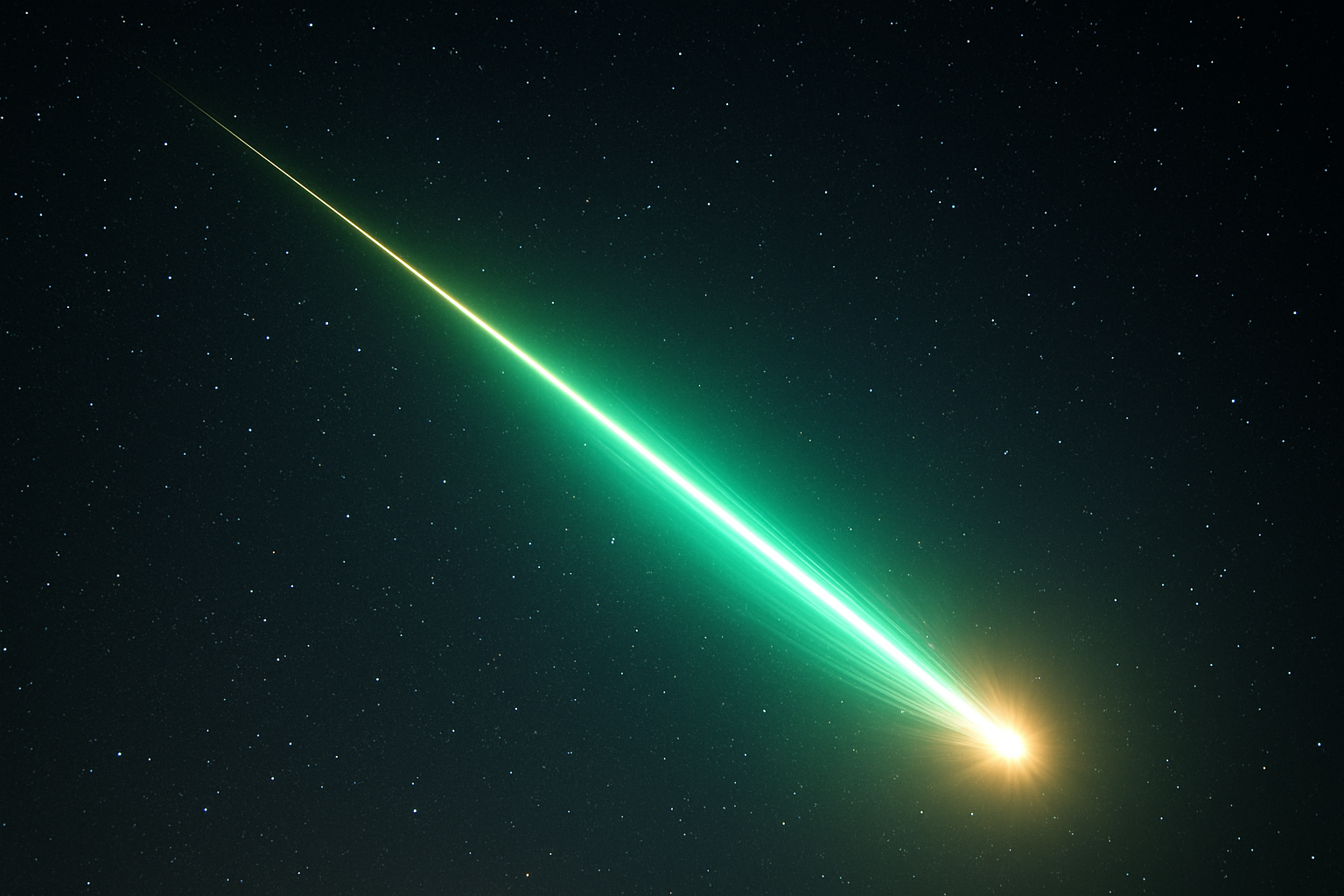
The European Space Agency is conducting a comprehensive analysis of data from a spectacular meteor, measuring several meters in diameter, that disintegrated in Earth's atmosphere above Europe on Sunday evening, creating a brilliant fireball visible across Luxembourg and surrounding regions.
The extraordinary celestial event occurred at approximately 6:55 PM Luxembourg time, when witnesses observed an exceptionally bright meteor traveling from southwest to northeast across the European sky. The object, classified as a bolide due to its exceptional brightness and explosive atmospheric entry, has provided scientists with valuable data about the composition and origins of objects from the outer reaches of our solar system.
Unprecedented Scientific Opportunity
According to ESA researchers, the meteor's trajectory and disintegration pattern offer unique insights into the nature of small celestial bodies that originate beyond the traditional asteroid belt. Initial spectroscopic analysis suggests the object contained unusual mineral compositions that may challenge current understanding of how materials formed in the early solar system.
"This event represents a remarkable opportunity to study pristine material from the outer solar system," explained Dr. Maria Castellanos, ESA's planetary defense coordinator. "The meteor's distinctive characteristics and the comprehensive observational data we've collected provide an invaluable window into the processes that shaped our cosmic neighborhood billions of years ago."
Global Context of Space Discoveries
The Luxembourg meteor analysis occurs during what scientists are calling a "golden age of astronomical observation," marked by unprecedented technological capabilities and international cooperation. Recent months have witnessed a series of groundbreaking discoveries that are reshaping our understanding of planetary formation and cosmic evolution.
February 2026 brought the discovery of comet C/2024 E1 by Polish astronomer Kasper Wierzokesh, whose extraordinary emerald glow has challenged conventional models of solar system formation. The comet's distinctive green luminescence, caused by diatomic carbon concentrations ten times higher than typical comets, along with rare earth elements typically associated with inner solar system formation, suggests that outer solar system objects may be far more complex than previously understood.
"These discoveries are forcing us to revise fundamental assumptions about how our solar system formed and evolved. The Luxembourg meteor, like comet C/2024 E1, appears to contain materials that shouldn't exist together according to our current models."
— Dr. Elena Reyes, Planetary Science Institute
The timing of these discoveries coincides with other paradigm-shifting astronomical revelations, including the identification of "impossible" planetary systems 116 light-years away that violate established gravitational models, and NASA's Juno mission findings that Jupiter is smaller than calculated for over 50 years, forcing textbook revisions across the astronomical community.
Advanced Detection and Analysis Capabilities
The comprehensive analysis of the Luxembourg meteor demonstrates the remarkable advancement in space surveillance and research capabilities. ESA's network of ground-based telescopes, combined with advanced spectroscopic equipment and AI-powered analysis systems, enabled scientists to capture detailed data about the object's composition, trajectory, and atmospheric interaction in real-time.
This technological sophistication represents a dramatic evolution from previous decades, when such events might have been observed but not thoroughly analyzed. The integration of artificial intelligence in astronomical observation, following successful AI-planned Mars rover missions in December 2025, has revolutionized real-time cosmic data analysis and decision-making capabilities.
The meteor's disintegration pattern, captured through multiple observation stations across Europe, provides crucial information about the object's internal structure and composition. Early analysis suggests the presence of materials that formed under different temperature and pressure conditions than typically expected for objects originating from the outer solar system.
International Space Cooperation Framework
The investigation of the Luxembourg meteor exemplifies the international cooperation that characterizes modern space science. Data sharing between ESA member nations, combined with observations from ground-based networks across Europe, has created the most comprehensive analysis of a meteor event in European history.
This collaborative approach reflects broader trends in space exploration, where international partnerships are driving unprecedented scientific discoveries. The current period, transitioning from what scientists describe as the "AI revolution" to the "space economy golden age," has seen remarkable cooperation despite increasing commercial and national competition in space.
Thailand's current chairmanship of the UN Scientific and Technical Subcommittee for space governance demonstrates the global nature of space science coordination, while emerging nations continue gaining space capabilities through international partnerships and educational initiatives.
Implications for Planetary Defense
Beyond its scientific value, the Luxembourg meteor event provides crucial data for planetary defense initiatives. NASA has warned that approximately 15,000 undetected "city-killer" asteroids over 140 meters in diameter remain untracked, representing significant threats to human civilization.
Dr. Kelly Fast, NASA's Planetary Defense Coordination Officer, emphasized the importance of events like the Luxembourg meteor for improving detection and analysis capabilities: "Every meteor we can study in detail adds to our understanding of the populations of objects that could potentially threaten Earth. The more we learn about their composition and behavior, the better we can prepare defensive measures."
The successful tracking and analysis of the Luxembourg meteor validates current detection systems while highlighting the need for continued investment in planetary defense infrastructure. The James Webb Space Telescope's recent confirmation that asteroid 2024 YR4 safely passed Earth demonstrates the improving capabilities of space-based observation systems.
Technological Innovation in Space Science
The analysis of the Luxembourg meteor showcases the remarkable technological capabilities that have emerged in recent years. Advanced spectroscopic analysis, AI-powered data processing, and international observation networks have created unprecedented opportunities for scientific discovery.
These capabilities build upon recent technological breakthroughs, including NASA's DAGGER AI system that can predict geomagnetic storms with 30-minute accuracy, protecting satellite infrastructure worth billions of dollars. The integration of artificial intelligence in space science has enabled autonomous navigation across cosmic distances and sophisticated analysis of astronomical phenomena.
The development of space-based data centers, driven by the global memory crisis with semiconductor prices increasing sixfold, represents another technological frontier that could revolutionize space-based research capabilities. SpaceX's proposed space-based computing infrastructure, potentially cost-effective within 36 months, could provide unlimited expansion for astronomical data analysis.
Future Research Directions
The Luxembourg meteor analysis will inform several ongoing research programs, including the continued study of outer solar system objects and their role in delivering organic compounds to inner planets. The unusual characteristics observed in this meteor, combined with recent discoveries of complex organic molecules in interstellar space, suggest that the building blocks of life may be more widespread throughout the universe than previously understood.
Scientists plan to use the data from this event to refine models of early solar system formation, particularly focusing on the processes that created objects with such unusual material compositions. The research will contribute to broader efforts to understand how planetary systems form and evolve, with implications for the search for potentially habitable worlds around other stars.
The success of this analysis also validates plans for enhanced meteor detection networks across Europe and globally. Proposals for advanced space-based observation systems, including specialized meteor monitoring satellites, could provide even more detailed data about future events.
A New Era of Discovery
The comprehensive analysis of the Luxembourg meteor represents more than a single scientific achievement; it exemplifies humanity's expanding capability to understand and monitor our cosmic environment. As we enter what many scientists describe as a golden age of astronomical observation, events like this meteor provide crucial data for understanding our place in the universe.
The convergence of advanced technology, international cooperation, and sustained scientific curiosity has created unprecedented opportunities for discovery. From the International Space Station, where French astronaut Sophie Adenot is currently conducting record-breaking research on space medicine, to ground-based observatories tracking distant galaxies, humanity's cosmic awareness continues expanding.
As ESA continues analyzing the Luxembourg meteor data, the scientific community anticipates that this event will contribute to fundamental revisions in our understanding of solar system formation and evolution. The meteor's journey from the outer reaches of our cosmic neighborhood to its spectacular finale over European skies represents both an ending and a beginning – the conclusion of a billions-year journey through space, and the start of new insights that will guide humanity's continued exploration of the cosmos.