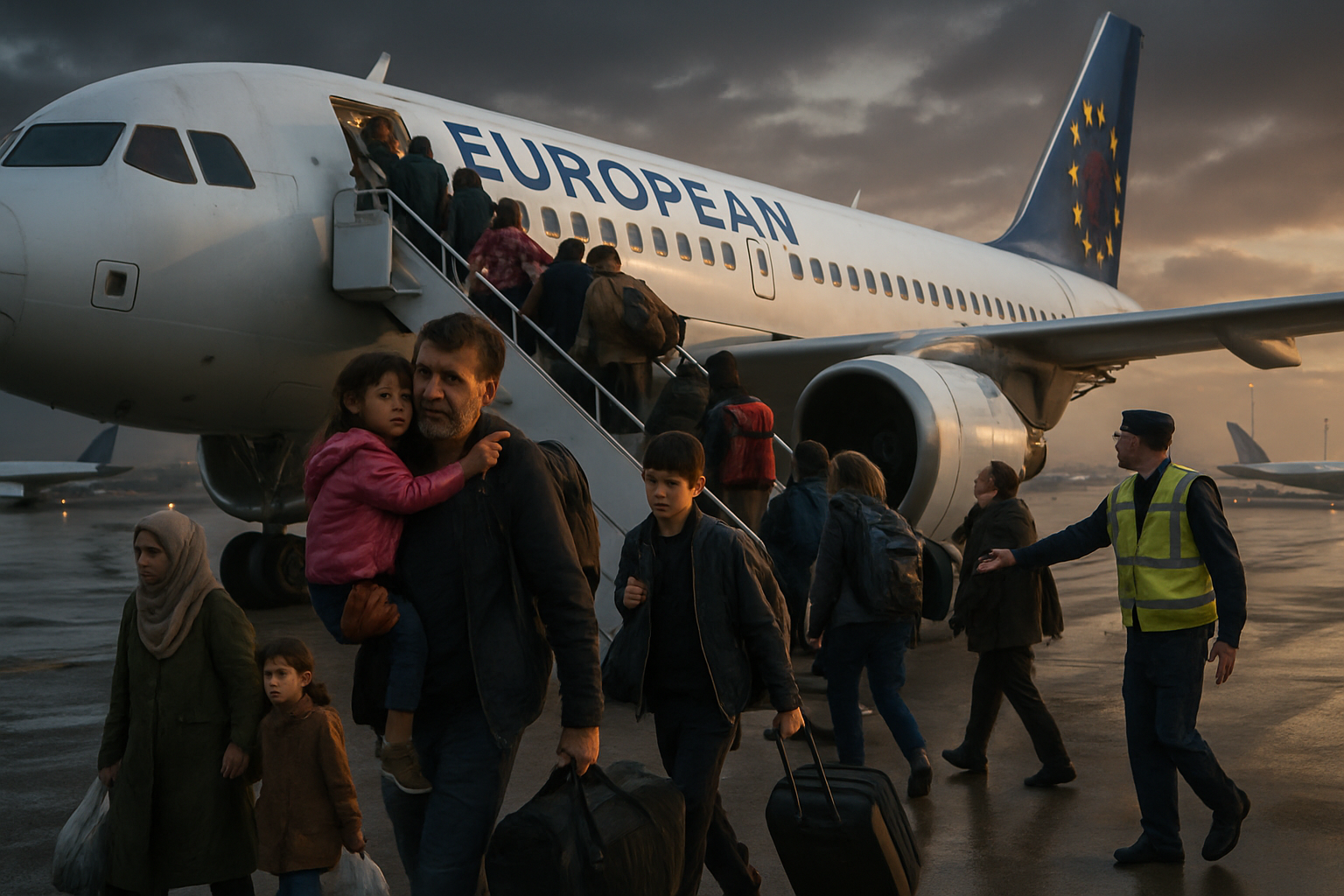
European nations have successfully completed the largest coordinated evacuation operation since the Arab Spring in 2011, repatriating over 2,000 citizens from Middle Eastern conflict zones as Cyprus's ESTIA plan was activated for the first time in history.
The unprecedented European coordination effort has unfolded against the backdrop of the most severe aviation crisis since the COVID-19 pandemic, with over 18,000 flights cancelled worldwide after eight Middle Eastern countries simultaneously closed their airspace following the escalation of the Iran-US-Israel conflict.
Historic ESTIA Plan Activation
Cyprus made history by activating its ESTIA evacuation plan for the first time since its establishment, coordinating the evacuation of over 2,000 EU and third-country nationals from the United Arab Emirates. The successful implementation represents a watershed moment for European Union crisis management capabilities.
According to the Cyprus Ministry of Foreign Affairs, 950 people have been successfully repatriated through six chartered flights from the UAE, with passengers predominantly comprising Cypriot citizens, their family members, permanent residents of the Republic, and citizens of other European Union member states.
"The Ministry will continue to provide consular assistance through its diplomatic missions to Cypriot citizens affected by regional developments. This support extends to those currently in the Middle East and beyond, with the ongoing goal of securing their return to Cyprus."
— Cyprus Ministry of Foreign Affairs
Multi-National Evacuation Operations
The evacuation efforts have extended across multiple European nations, demonstrating unprecedented coordination. Estonia completed its final two repatriation flights on Sunday, with one aircraft landing in Tallinn and another arriving in Riga. Estonia's Foreign Ministry had advised approximately 3,000 nationals to contact authorities for assistance.
Latvia's national airline airBaltic has conducted multiple repatriation flights from Dubai to Riga, with a third flight completed on Sunday morning according to social media announcements. The coordinated Baltic response has been praised as exemplary of European solidarity during crisis situations.
Malta has successfully evacuated 187 nationals from the UAE in operations coordinated by Deputy Prime Minister Ian Borg. Additionally, 26 Maltese citizens or residents were evacuated from Doha, Qatar, to Berlin, Germany, as part of ongoing efforts to assist nationals in the Gulf region.
Slovakia has completed an extensive evacuation program, with Defense Minister confirming the deployment of two special aircraft. The larger Interior Ministry plane headed to Muscat, Oman, to evacuate tourists, while a smaller Defense Ministry aircraft served as a "medical line" in Riyadh, according to official statements.
Aviation Crisis Context
The evacuation operations have taken place amid the most comprehensive aviation disruption since the COVID-19 pandemic. Eight Middle Eastern countries – Iran, Iraq, Israel, UAE, Qatar, Syria, Kuwait, and Bahrain – simultaneously closed their civilian airspace on March 1, 2026.
Dubai International Airport, the world's busiest with over 86 million passengers annually, remains completely shut down after sustaining missile damage during Iranian retaliatory strikes. The closure has eliminated a critical Europe-Asia transit hub, creating cascading effects throughout global aviation networks.
Major carriers including Emirates, Air France-KLM, Wizz Air, and Bulgaria Air have suspended Middle East operations indefinitely, affecting hundreds of thousands of passengers worldwide. The crisis has been described by aviation analysts as the most comprehensive regional airspace closure in modern history.
Diplomatic Background
The current crisis stems from the complete collapse of US-Iran nuclear negotiations despite achieving what diplomats described as "broad agreement on guiding principles" – the most progress since the 2018 JCPOA collapse. The fundamental disagreement proved insurmountable, with Iran excluding ballistic missiles and proxy forces as "red lines" versus US comprehensive demands including missiles, armed groups, and human rights.
The breakdown led to "Operation Epic Fury," described as the largest US-Israeli coordinated military operation since the 2003 Iraq invasion, followed by massive Iranian retaliation designated "Operation True Promise 4."
Energy and Economic Implications
The Middle Eastern conflict has created parallel crises in global energy markets. Iran's declaration that the Strait of Hormuz is "unsafe" for shipping affects 40% of global oil transit, with oil prices surging over 10% to more than $80 per barrel.
Natural gas prices have increased by 24% in Europe and 78% in the United States. Major shipping companies Maersk and MSC have suspended Persian Gulf operations, leaving over 150 tankers stranded with billions of dollars in cargo.
Qatar has halted LNG production at its Ras Laffan and Mesaid facilities, representing approximately 20% of global exports, creating additional pressure on European energy supplies already strained by the ongoing Ukraine conflict.
Individual Stories of Resilience
Behind the evacuation statistics are individual stories of resilience and determination. Estonian tourists who returned to Tallinn described their relief at arriving home safely after a week of uncertainty in the Middle East.
"My plan for today is just sleep. We've been through so much stress this past week, and just being back on Estonian soil feels incredible."
— Estonian Tourist Returning from Middle East
The human cost of the crisis extends beyond European nationals. Reports indicate that travelers from numerous countries have been stranded, with some paying thousands of dollars for alternative routing. Swedish traveler Emily Grosser reportedly paid 6,000 Swedish kronor ($560) for alternative routing from Paris to Australia, highlighting the extreme costs faced by individual passengers.
Unprecedented European Coordination
The success of the evacuation operations has been attributed to unprecedented European coordination mechanisms. The European Union activated crisis response protocols, with member states sharing evacuation schedules and resources in what analysts describe as a template-setting demonstration of European crisis management capabilities.
The coordination extends beyond EU borders, with several European nations offering assistance to third-country nationals. Norway has conducted evacuation flights from Oman to Oslo, prioritizing families, pregnant women, and those with medical needs, charging 12,500 Norwegian kroner for the service.
Germany has organized specialized charter flights from Oman to evacuate its 30,000 stranded tourists, while multiple European governments have coordinated their responses through unprecedented resource-sharing agreements.
Long-Term Implications
The crisis has exposed fundamental vulnerabilities in global transportation networks' over-dependence on Middle Eastern hubs for Europe-Asia connectivity. With Russian and Ukrainian airspace already closed due to the ongoing conflict, the additional closure of Middle Eastern routes has created unprecedented challenges for international aviation.
Aviation industry analysts suggest that the crisis will accelerate discussions about route diversification and enhanced contingency planning to reduce dependency on single regional hubs. The recovery timeline remains uncertain, as it depends on military operations resolution and diplomatic normalization rather than predictable factors like weather disruptions.
The successful activation of Cyprus's ESTIA plan provides a framework for future European crisis responses, demonstrating that prepared frameworks can be effectively implemented during international emergencies. The operation has been praised as showing European solidarity and coordination capabilities in times of crisis.
Ongoing Challenges
Despite the success of evacuation operations, significant challenges remain. The Netherlands has deployed its first military aircraft to bring back "thousands" of Dutch citizens still stranded abroad, according to Defense Minister Dilan Yesilgöz.
Slovakia reports that 180 people remain stranded directly at the embassy in Riyadh, Saudi Arabia, with an additional 140 people awaiting assistance in Qatar. The total number of evacuated persons according to Slovak officials has reached approximately 1,400, but complications continue as the operation encounters various restrictions.
Denmark continues to advise its citizens to leave Lebanon, while seven Danish nationals have chosen to travel by bus from Qatar to Saudi Arabia as alternative transportation options. The Danish Foreign Ministry has received approximately 1,500 emergency calls from stranded travelers.
International Response
The European evacuation operations are part of a broader international response involving nations worldwide. Australia has 115,000 nationals requiring assistance, Germany 30,000 tourists, and multiple other countries have activated emergency protocols.
Ireland has evacuated almost 200 people on a flight chartered by the government from Oman, with "relieved family reunions" reported at Dublin Airport. The coordinated international response has been described as the largest since the Arab Spring of 2011.
Looking Forward
As European nations complete their evacuation operations, attention turns to the longer-term implications of the crisis. The successful coordination demonstrates European capabilities for crisis management, while the ongoing aviation disruptions highlight the need for enhanced resilience planning in an increasingly volatile geopolitical environment.
The crisis has served as a template-setting moment for 21st-century crisis management, with the European response providing a framework that could influence international emergency response protocols for years to come. The cooperation mechanisms developed during this crisis may prove valuable for future international emergencies.
Recovery from the aviation crisis depends on the resolution of the underlying military and diplomatic tensions, making the timeline for normalization uncertain. The crisis has demonstrated how rapidly regional conflicts can become global challenges in an interconnected world, affecting hundreds of thousands of civilians and requiring unprecedented coordination mechanisms for civilian protection.
The successful European response, led by the historic activation of Cyprus's ESTIA plan, represents a significant achievement in international crisis management and European solidarity during one of the most challenging periods in recent memory.