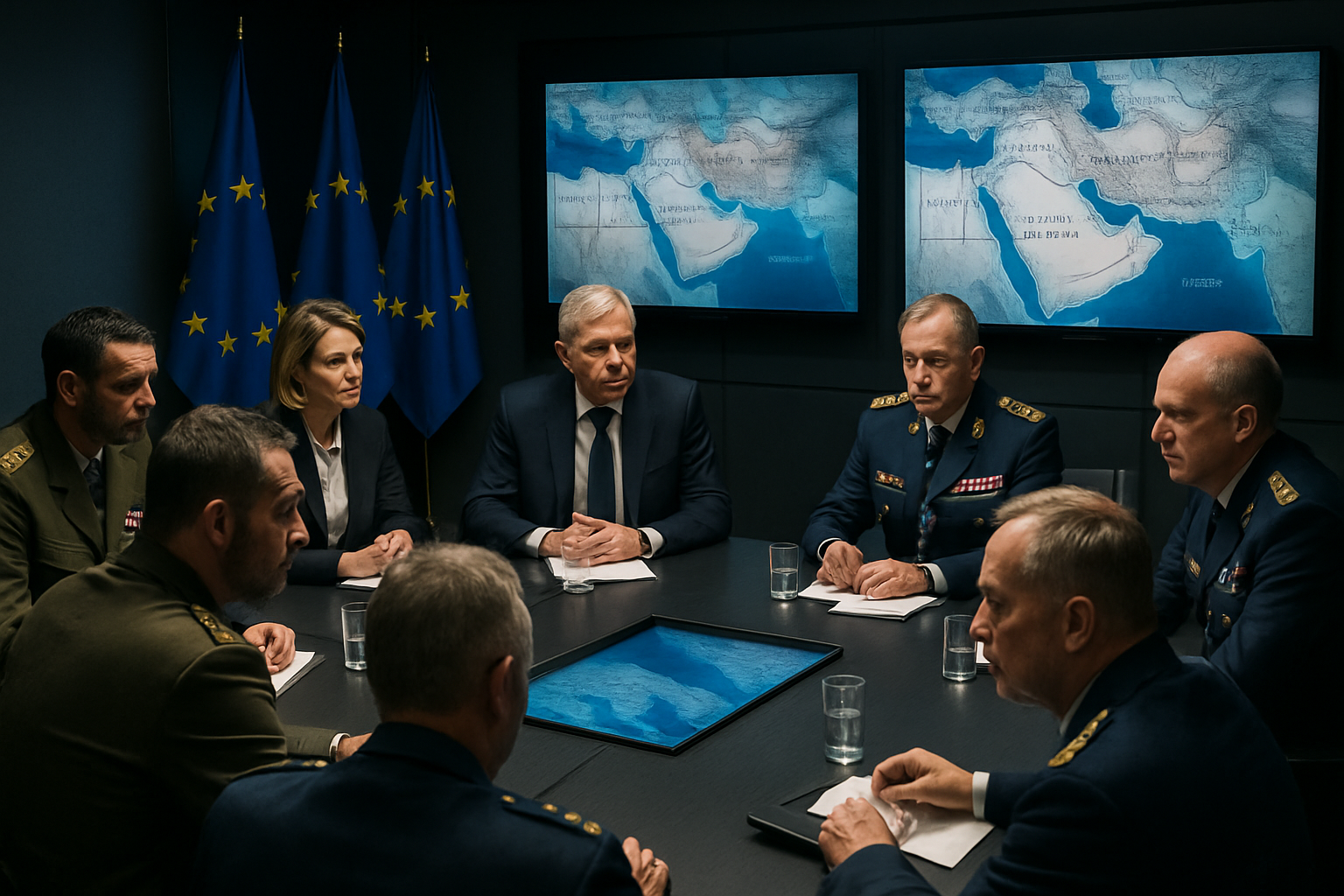
European nations are dramatically expanding military cooperation with Cyprus and Gulf states as Iranian attacks on European territory and regional allies force a fundamental reassessment of continental defense strategy.
Multiple sources across Europe confirm an unprecedented mobilization of military assets and defense partnerships in response to what officials describe as the most serious challenge to European security architecture since World War II. The coordinated response comes as Iran's "Operation True Promise 4" has directly targeted European sovereign territory and key regional partners.
Spain's Strategic Positioning
Spain has emerged as a key player in the evolving security framework, with government sources confirming the country is prepared to provide military support to Cyprus following Iranian drone attacks on British sovereign bases. The Spanish position represents a carefully calibrated approach that distinguishes between supporting EU member states under attack and participating in what Madrid considers unlawful military interventions.
"Spain is willing to give military support to Cyprus in the face of attacks it is suffering from Iran and its Lebanese ally Hezbollah,"
— Spanish Government Sources
The Spanish government has emphasized this support differs fundamentally from the US-led military operations against Iran, which Spain has refused to support from its Rota and Morón bases. Madrid's position reflects a broader European approach of defending EU territory while maintaining independence from controversial military interventions.
Italy's Air Defense Initiative
Italy has announced comprehensive plans to provide air defense assistance to Gulf countries, marking a significant expansion of European military cooperation beyond traditional NATO boundaries. Prime Minister Giorgia Meloni confirmed the initiative in a radio interview, positioning Italy alongside the UK, France, and Germany in providing defensive military aid.
"Like the United Kingdom, France and Germany, Italy intends to send assistance to Gulf countries, specifically in the field of defence and in particular air defence," Meloni stated during a live broadcast on RTL 102.5.
Italian planning extends beyond air defense systems to include naval deployment. According to Il Sole 24 ORE, Italy is considering sending a frigate to the Gulf region in addition to SAMP-T air defense systems. The countries requesting Italian support include the United Arab Emirates, Kuwait, and Qatar – all nations that have faced direct Iranian attacks in recent days.
The Italian commitment is driven by both strategic and humanitarian considerations, with tens of thousands of Italian citizens living in the region and approximately 2,000 Italian troops deployed across Gulf states.
French Leadership in Mediterranean Defense
France has taken perhaps the most dramatic action, with President Emmanuel Macron personally ordering the deployment of advanced military assets to Cyprus. The response includes the aircraft carrier Charles de Gaulle's redeployment from the Baltic Sea to the Mediterranean, alongside the frigate Languedoc and sophisticated anti-missile and anti-drone systems.
The French deployment represents the most significant military mobilization in the Eastern Mediterranean since the 1974 Turkish invasion of Cyprus, demonstrating the gravity with which European powers view the current crisis.
British Sovereign Territory Under Attack
The catalyst for this European defense cooperation was the unprecedented Iranian drone attack on RAF Akrotiri, a British sovereign base in Cyprus. The attack, carried out by Hezbollah-operated Shahed drones launched from Lebanon, marked the first time European sovereign territory has been directly targeted during a Middle East conflict since World War II.
British Prime Minister Keir Starmer responded by deploying HMS Dragon, a Type 45 destroyer equipped with the Sea Viper missile system, along with AW159 Wildcat helicopters featuring counter-drone capabilities. The deployment protects approximately 3,000 UK personnel stationed at RAF Akrotiri and Dhekelia bases.
Greek Military Support
Greece has contributed four F-16 fighter jets and two naval frigates to Cyprus's defense – the most significant Greek military support for Cyprus since 1974. Greek media coverage emphasizes this represents the first coordinated four-nation European military response within hours of an attack, highlighting unprecedented European unity in the face of external threats.
EU Mission Expansion
The crisis has also triggered expansion of existing European military missions. EU High Representative Kaja Kallas announced reinforcement of the EU naval mission Aspides with additional ships responding to maritime security threats. The mission's mandate has been renewed until February 28, 2027, with enhanced focus on protecting commercial shipping in the region.
Cyprus: The New Frontline
Cyprus has found itself at the center of Europe's evolving defense strategy, activating its national ESTIA evacuation plan for the first time while simultaneously hosting an unprecedented concentration of European military assets. The island's strategic position in the Eastern Mediterranean makes it both valuable and vulnerable during regional conflicts.
The Cypriot response has exposed significant gaps in civil defense infrastructure, with only 2,200 registered shelters capable of protecting 30% of the population. This shortfall has accelerated discussions about enhanced European cooperation on civilian protection mechanisms.
German Coordination Role
Germany, while not deploying military assets directly, has taken on a crucial coordination role. Chancellor Friedrich Merz confirmed operational-level military cooperation with Cyprus, with defense ministry contacts focusing on "preventative measures." This coordination function reflects Germany's strategic importance in European defense planning while maintaining its traditional cautious approach to military deployments.
Broader Strategic Implications
The European response represents more than crisis management – it signals a fundamental shift toward enhanced European strategic autonomy in defense matters. The coordinated deployment creates a comprehensive defensive umbrella combining French anti-missile technology, Greek air interceptors, British naval systems, and potential Italian reinforcements.
This development comes against the backdrop of the complete breakdown of US-Iran nuclear diplomacy despite recent Geneva breakthrough talks that had achieved "broad agreement on guiding principles" – the most progress since the 2018 JCPOA collapse. The rapid transition from diplomatic engagement to military confrontation has demonstrated the fragility of crisis management in the current multipolar era.
Regional Coalition Under Strain
The Iranian attacks have severely strained the unprecedented regional coalition that had supported diplomatic solutions to the nuclear crisis. Saudi Arabia, the UAE, Qatar, and Egypt – which had backed negotiations – now find themselves targets of Iranian retaliation, creating difficult choices between alliance obligations and national security.
Egyptian President Abdel Fattah el-Sisi condemned attacks on "sisterly Arab countries," warning of "comprehensive chaos" if the crisis continues to escalate. This reflects the broader challenge facing moderate regional actors caught between US alliance relationships and Iranian pressure.
Energy Security Dimensions
The crisis has exposed critical vulnerabilities in global energy infrastructure, with Iran's closure of the Strait of Hormuz affecting 40% of global oil transit. Natural gas prices have surged 24% in Europe and 78% in the US, while Qatar – a crucial LNG supplier – has halted production due to Iranian attacks on its facilities.
These energy security concerns are driving European interest in enhanced military cooperation with Gulf states, as protection of critical infrastructure becomes a shared priority transcending traditional alliance boundaries.
Historical Precedent and Future Implications
The current European response establishes important precedents for 21st-century continental defense. The successful coordination of military assets from multiple European nations within hours of an attack demonstrates capabilities that could influence future defense planning and alliance structures.
The crisis also highlights how geographic boundaries no longer effectively contain regional conflicts in an interconnected world. European territory can be directly threatened by Middle Eastern conflicts, requiring new approaches to territorial defense and alliance coordination.
Nuclear Governance Context
These developments occur against the backdrop of a broader nuclear governance crisis. The New START treaty expired on February 5, marking the first time in over 50 years without US-Russia nuclear constraints. Combined with Chinese nuclear expansion and Iranian uranium enrichment approaching weapons-grade levels, the current crisis represents what UN Secretary-General António Guterres describes as nuclear risks at their "highest in decades."
Template for Future Crises
The European response to the current crisis is establishing templates that could influence international approaches to conflict resolution for decades. Success in containing the escalation through coordinated defensive measures could provide a framework for future nuclear and territorial disputes. Failure, however, might accelerate the trend toward military solutions over diplomatic engagement, fundamentally reshaping international relations.
The coordinated European defense response represents the most concrete expression of European strategic autonomy in the defense sphere, demonstrating both the necessity and capability for independent European action when continental security is threatened. As the crisis continues to evolve, these partnerships are likely to deepen, potentially reshaping European security architecture for the coming decades.
The current moment represents a watershed in European defense cooperation, with implications extending far beyond the immediate crisis. The ability of European nations to rapidly coordinate military responses while maintaining diplomatic independence suggests a maturing approach to continental security that could define the next phase of European integration and global influence.