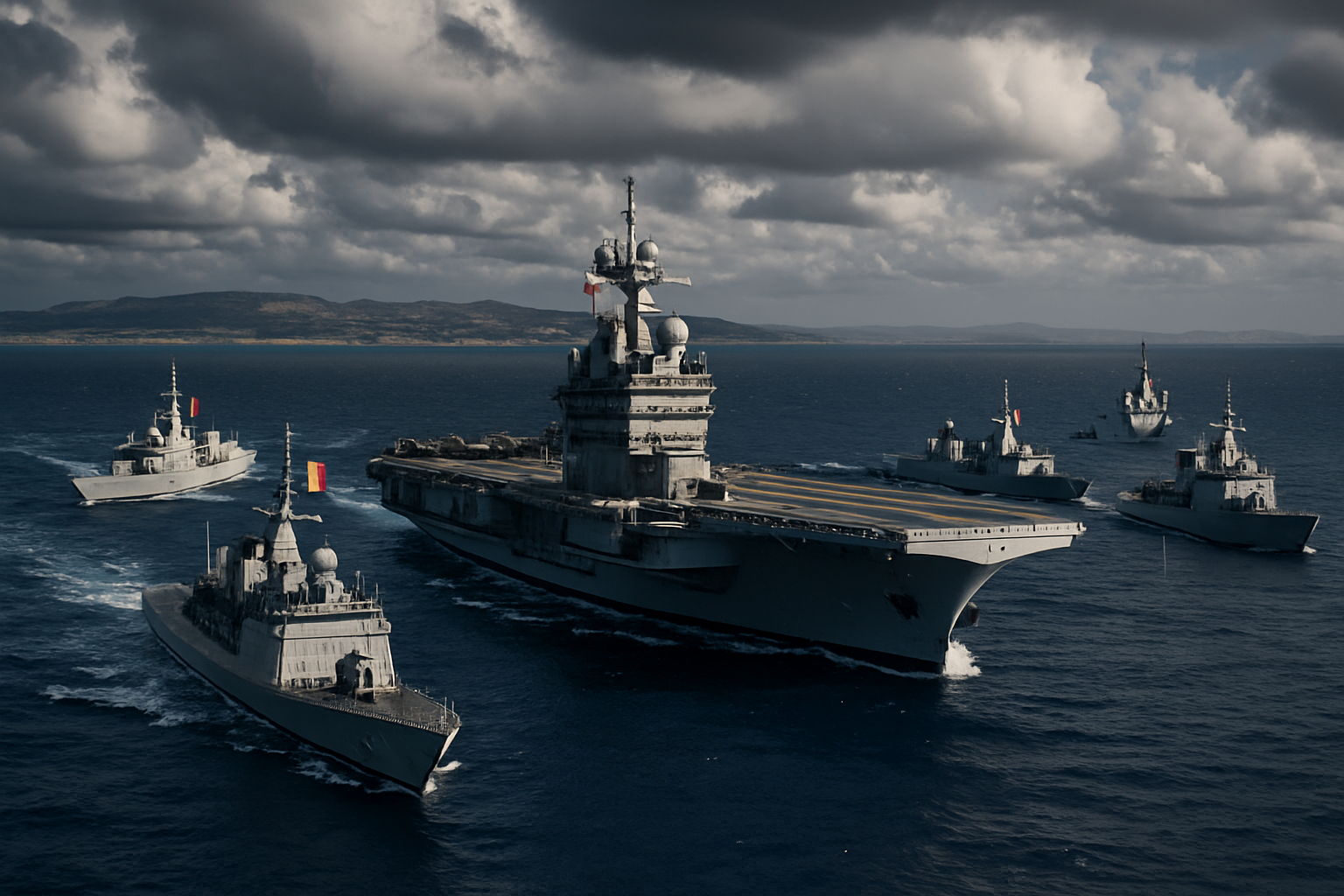
European nations have launched their most significant military deployment to the Eastern Mediterranean in nearly five decades, with France dispatching its flagship aircraft carrier Charles de Gaulle and Britain sending HMS Dragon destroyer to Cyprus following Iranian drone strikes on British sovereign territory.
The coordinated response represents an unprecedented show of European unity in the face of direct Middle Eastern aggression, as France, Britain, Greece, and Germany mobilize substantial military assets to protect Cyprus after Monday's drone attacks on RAF Akrotiri became the first targeting of European territory during the Iran crisis.
French President Emmanuel Macron personally ordered the deployment during a televised address Tuesday evening, announcing the frigate Languedoc had already arrived in Cypriot waters while the nuclear-powered aircraft carrier Charles de Gaulle was en route from the Baltic Sea to the Mediterranean.
Unprecedented European Military Response
The scale of the European response reflects the gravity officials place on the Iranian attacks. Greece has deployed two naval frigates and four F-16 fighter jets to Cyprus—the most significant Greek military support for the island since the 1974 Turkish invasion. Britain dispatched the Type 45 destroyer HMS Dragon along with specialized counter-drone helicopters.
German Chancellor Friedrich Merz confirmed direct military cooperation with Cyprus, with operational-level contacts between the armed forces of both countries to coordinate Germany's defensive assistance. This marks an extraordinary convergence of European military resources in response to what officials describe as the first attack on European sovereign territory by a Middle Eastern power since World War II.
"France will send additional air defense assets to Cyprus, and the frigate Languedoc will arrive off the coast of the Mediterranean island this evening," Macron declared during his address, referencing the strategic partnership signed with Cypriot President Nikos Christodoulides in December.
— Emmanuel Macron, French President
The Iranian attack involved multiple Shahed drones launched from Lebanon by Hezbollah forces, with at least one successfully striking the RAF Akrotiri runway despite interception efforts. The British base hosts approximately 3,000 UK personnel and serves as a critical logistics hub for Western operations in the region.
Cyprus Activates Emergency Protocols
Cyprus implemented its national ESTIA evacuation plan for the first time in the country's history, evacuating the village of Akrotiri and closing all schools in the affected areas of Asomatos, Episcopi, and Trachoni. The activation exposed critical gaps in the island's civil defense infrastructure, with only 2,200 registered shelters capable of protecting approximately 30% of the population.
Cypriot government spokesman Konstantinos Letymbiotis emphasized that "Cyprus was not the target—the target was the British Bases," but acknowledged the unprecedented nature of the security challenge facing the EU member state.
The crisis has highlighted Cyprus's strategic vulnerability as an EU nation hosting Western military assets while maintaining diplomatic independence. The island's position in the Eastern Mediterranean makes it valuable for military operations but also exposes civilian populations during regional conflicts.
Coordinated Air Defense Systems
The European response includes deployment of sophisticated air defense systems designed to create a comprehensive protective umbrella over Cyprus. French forces are installing advanced anti-missile and anti-drone technology, while Greek F-16 fighters provide air superiority capabilities. Britain's HMS Dragon carries the Sea Viper missile system, capable of tracking and engaging multiple aerial targets simultaneously—ideal protection against coordinated drone swarms.
Italian media reports confirm additional radar systems and Rafale fighter jets have been deployed to the region as part of the coordinated European response, though specific details remain classified for operational security reasons.
Historical Context and Strategic Implications
Military experts describe the European deployment as the most significant Eastern Mediterranean mobilization since the 1974 Turkish invasion of Cyprus. The rapid, coordinated response demonstrates unprecedented European unity in defending territorial integrity against extra-regional threats.
The attacks occurred during Iran's "Operation True Promise 4" retaliation campaign following the death of Supreme Leader Ali Khamenei in US-Israeli strikes. Iranian Revolutionary Guard commanders declared "no red lines remain," extending their targeting to include British sovereign installations in Cyprus.
This marks a watershed moment for European security policy, as traditional geographic boundaries containing Middle Eastern conflicts have been permanently breached. European security experts suggest March 2026 represents a potential turning point in post-war international relations.
Broader Regional Implications
The Cyprus deployment occurs amid a broader collapse of diplomatic efforts to contain the Iran crisis. Despite Geneva nuclear talks achieving "broad agreement on guiding principles"—the most progress since the 2018 JCPOA collapse—fundamental disagreements over Iran's ballistic missile program and regional proxies proved insurmountable.
Over 18,000 flights have been cancelled worldwide as Iran, Iraq, Israel, UAE, Qatar, Syria, Kuwait, and Bahrain simultaneously closed their airspace. Dubai International Airport, the world's busiest, remains completely shut down following missile damage.
Energy markets are experiencing severe disruption as Iran threatens closure of the Strait of Hormuz, through which 40% of global oil transits. Natural gas prices have surged 24% in Europe and 78% in the United States.
International Response and Alliance Solidarity
The European deployment has received broad international support, with NATO officials describing it as an exemplary demonstration of Article 5 collective defense principles in practice. The coordination between France, Britain, Greece, and Germany occurred within hours of the Iranian attacks, suggesting pre-existing contingency planning for such scenarios.
EU High Representative Kaja Kallas coordinated the emergency response, with the European Union reinforcing its Aspides naval mission in the Red Sea while member states activated evacuation protocols for citizens across the Middle East.
The nuclear governance crisis context adds urgency to the situation. The New START treaty between the US and Russia expired February 5, 2026—the first time in over 50 years without nuclear constraints between the superpowers. UN Secretary-General António Guterres has warned that nuclear risks are at their "highest level in decades."
Long-term Security Architecture
Security analysts suggest the Cyprus crisis could accelerate European strategic autonomy discussions, particularly regarding nuclear deterrence capabilities. Recent conversations between French President Macron and German Chancellor Merz about expanding France's nuclear umbrella beyond national borders reflect growing European concerns about security guarantee reliability.
The successful coordination of the Cyprus response provides a template for future European defense cooperation, demonstrating the alliance's capacity for rapid, unified action in protecting territorial integrity against asymmetric threats.
Whether this crisis marks renewed Western unity through adaptation or signals continued alliance fragmentation will be determined by the success of the current military deployment and its ability to deter further Iranian aggression against European territories.
The deployment of the Charles de Gaulle carrier group, along with coordinated naval and air assets from multiple European nations, represents the most concrete expression of European defense cooperation in the 21st century—a development that may reshape continental security architecture for decades to come.