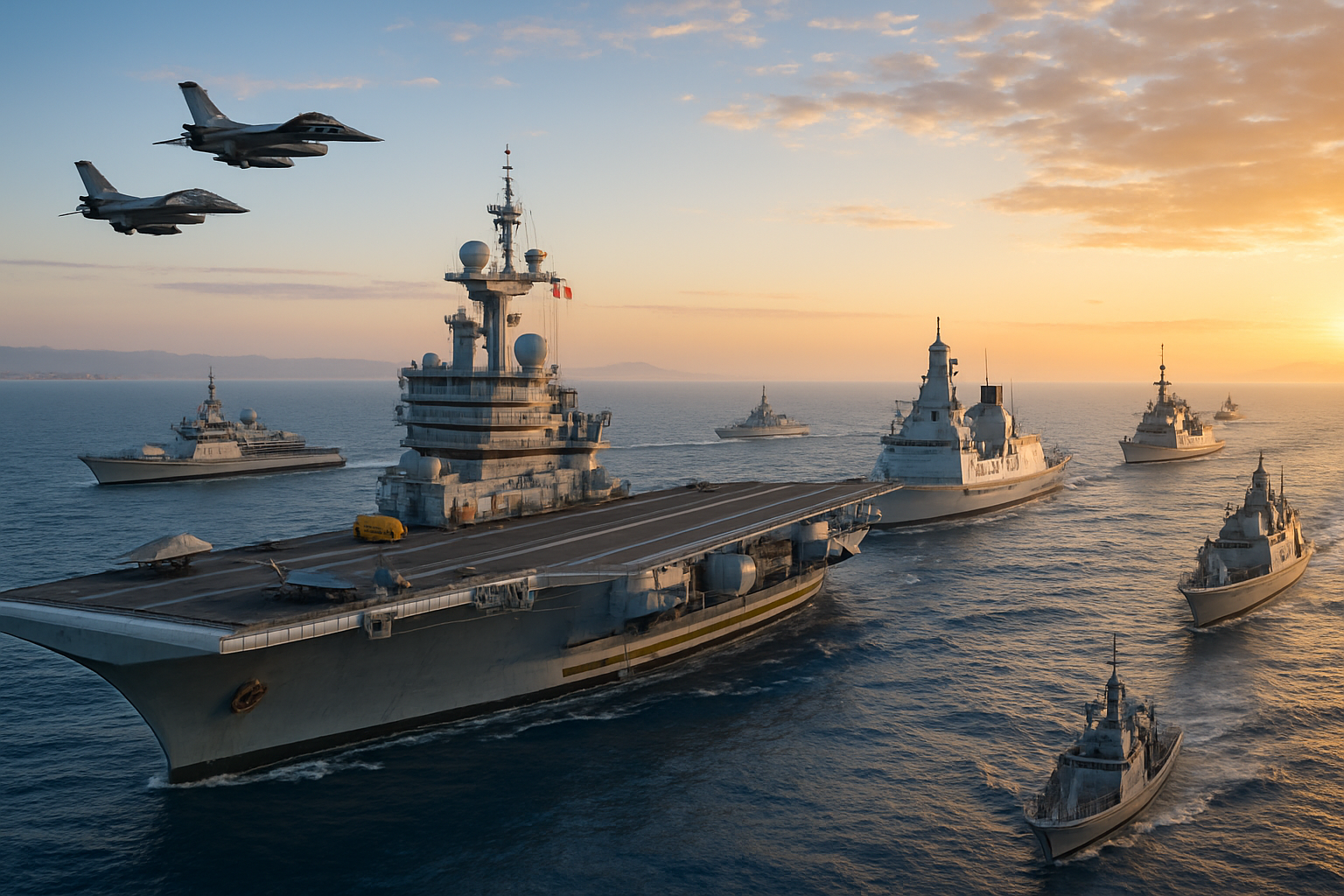
European nations have launched the most significant naval deployment in the Eastern Mediterranean since 1974, with France leading a multinational coalition that includes the aircraft carrier Charles de Gaulle, multiple frigates, and advanced missile defense systems in response to Iranian attacks on European territory.
President Emmanuel Macron announced on March 9 during a historic trilateral summit in Cyprus that France and its allies are preparing a "purely defensive" mission to reopen the critical Strait of Hormuz shipping lane, marking an unprecedented European response to the ongoing Middle East crisis that has seen Iranian forces target British sovereign bases on Cyprus for the first time since World War II.
Historic Naval Coalition Takes Shape
The European response represents a watershed moment in continental defense cooperation, with four major powers coordinating military assets within hours of the Iranian attacks. France has repositioned its flagship aircraft carrier Charles de Gaulle from the Baltic Sea to the Mediterranean, alongside the frigate Languedoc equipped with advanced anti-missile and anti-drone systems.
Greece has deployed its most significant military support to Cyprus since the 1974 Turkish invasion, committing four F-16 fighter jets and two naval frigates, including the advanced frigate Kimon. The Greek vessels are providing both air defense capabilities and symbolic demonstration of European solidarity in the face of external threats.
"An attack on Cyprus is an attack on all of Europe. We are working together to ensure the security of Cyprus means the security of Europe."
— Emmanuel Macron, French President
Britain has deployed HMS Dragon, a Type 45 destroyer equipped with the Sea Viper missile system and AW159 Wildcat helicopters specifically configured for counter-drone operations. The deployment protects approximately 3,000 UK personnel stationed at RAF Akrotiri and Dhekelia sovereign bases.
Strait of Hormuz Mission Planning
The most ambitious component of the European response involves preparations for a naval escort mission in the Strait of Hormuz, the critical waterway through which 40% of global oil transit flows. Iran's Revolutionary Guard has declared the strait "unsafe for shipping," effectively closing this vital chokepoint and driving oil prices above $100 per barrel for the first time since 2022.
According to sources familiar with the planning, the mission would involve the Charles de Gaulle carrier group alongside eight frigates and two amphibious assault ships. The operation would be conducted jointly with allied nations, though Macron declined to specify which countries beyond the current European coalition would participate.
The defensive mission is designed to escort commercial vessels "after the end of the hottest phase of the conflict" to restore the flow of oil and gas supplies that have been severely disrupted by the ongoing warfare between the United States, Israel, and Iran.
Cyprus: Europe's Eastern Frontier Under Attack
The crisis began when Iranian drones, launched by Hezbollah forces from Lebanon, successfully struck RAF Akrotiri on March 2, causing limited runway damage but marking the first attack on European sovereign territory by Middle Eastern forces since World War II. The strikes were part of Iran's "Operation True Promise 4" retaliation following the death of Supreme Leader Ali Khamenei in U.S.-Israeli operations.
Cyprus activated its national ESTIA evacuation plan for the first time in history, evacuating the Akrotiri village and closing schools in surrounding areas including Asomatos, Episcopi, and Trachoni. The crisis exposed significant gaps in Cyprus's civil defense capabilities, with only 2,200 shelters available to protect just 30% of the population.
Government spokesman Konstantinos Letymbiotis coordinated the European response through emergency EU Foreign Affairs Council sessions, managing the evacuation of over 2,000 European nationals from the UAE while maintaining Cyprus's delicate diplomatic balance in the region.
Comprehensive Defense Architecture
The European deployment creates a multi-layered defensive umbrella over Cyprus, combining French anti-missile technology, Greek F-16 interceptors, and British Sea Viper systems. The Netherlands has also committed to coordinate additional maritime assets, while Italy has positioned the missile frigate Federico Martinengo with 160 personnel in the region.
Spain has deployed the air defense frigate Cristóbal Colón, though Prime Minister Pedro Sánchez has carefully distinguished between European territorial defense and participation in offensive operations against Iran, stating: "No to war in Iran, but solidarity with Cyprus, an EU country victim of this war."
Global Crisis Context
The European naval deployment occurs against the backdrop of the most dangerous international crisis since the Cold War. The conflict has already resulted in the cancellation of over 18,000 flights worldwide, the shutdown of Dubai International Airport, and the stranding of more than 150 oil tankers in the Persian Gulf worth billions in cargo.
Natural gas prices have surged 24% in Europe and 78% in the United States, while Qatar has halted LNG production at its major facilities, affecting approximately 20% of global LNG exports. The crisis has exposed the vulnerability of global supply chains to single chokepoint failures, particularly the 21-mile Strait of Hormuz.
"This is about much more than regional security. The closure of critical maritime routes affects the entire global economy and energy security for millions of people."
— High Representative Kaja Kallas, European Union
Strategic Autonomy in Action
The European response represents the most concrete expression of European strategic autonomy in decades, with rapid military coordination occurring independently of traditional NATO frameworks. The successful deployment demonstrates Europe's capacity for independent defense responses when continental security is threatened.
António Costa, President of the European Council, praised the four-nation response as an "example of European autonomy" while warning of the dangers posed by Middle East escalation. The coordination establishes important precedents for future European alliance responses to extra-regional threats.
The crisis has accelerated discussions about European strategic autonomy, with the rapid coordination demonstrating the continent's capability for unified action when its territorial integrity is directly challenged. The template could influence future defense planning and continental security architecture for decades.
Nuclear Diplomacy Collapse
The military escalation follows the complete breakdown of nuclear diplomacy between the United States and Iran, despite achieving what was described as "broad agreement on guiding principles" in Geneva talks – the most progress since the collapse of the JCPOA nuclear deal in 2018.
The diplomatic failure occurred over scope disagreements, with Iran insisting that ballistic missiles and regional proxy forces remain "red lines" in any nuclear-only agreement, while the United States demanded comprehensive negotiations including missiles, armed groups, and human rights issues.
Iran continues uranium enrichment at 60% purity with over 400 kilograms of weapons-grade material, approaching the threshold for multiple nuclear weapons if weaponized. The crisis unfolds amid broader nuclear governance breakdown, with the New START treaty between the United States and Russia having expired in February, creating the first 50-year gap without nuclear constraints between the superpowers.
Regional Coalition Under Strain
The Iranian retaliation has severely strained the regional coalition of Saudi Arabia, UAE, Qatar, and Egypt that had supported diplomatic solutions to the nuclear crisis. Iranian strikes have directly targeted member territories, with casualties reported in the UAE, Kuwait, and Qatar, fundamentally altering the strategic calculations of Gulf states.
Egyptian President Abdel Fattah el-Sisi condemned Iranian attacks on "sisterly countries" and warned of "comprehensive chaos" spreading throughout the region. The fracturing of this coalition represents a significant blow to Middle Eastern stability and complicates efforts to contain the crisis through diplomatic means.
International Implications
The European naval deployment marks a template-setting moment for 21st-century crisis management, demonstrating both the capabilities and limitations of multilateral cooperation in an increasingly volatile world. The success of the coordinated response could provide frameworks for future diplomatic engagement and conflict resolution.
However, failure to contain the escalation risks marginalizing European influence in Middle Eastern developments while encouraging territorial violations elsewhere. The stakes extend far beyond the current crisis, affecting international approaches to conflict resolution, energy security architecture, and nuclear proliferation prevention mechanisms globally.
UN Secretary-General António Guterres has called the situation the "greatest test of multilateral cooperation in crisis management of the modern era," with decisions in the coming days and weeks likely to reverberate through international relations for decades to come.
Looking Forward
As the European naval coalition consolidates its presence in the Eastern Mediterranean, the focus shifts to the planned Strait of Hormuz mission and broader efforts to restore stability to global energy markets. The success of this unprecedented European military cooperation could fundamentally reshape continental defense architecture and establish new templates for responding to extra-regional threats.
The crisis represents a potential turning point in European integration on security matters, with geographic boundaries proving insufficient to contain regional conflicts in an interconnected world. The coming weeks will test whether European strategic autonomy can effectively complement traditional alliance structures in addressing 21st-century security challenges.