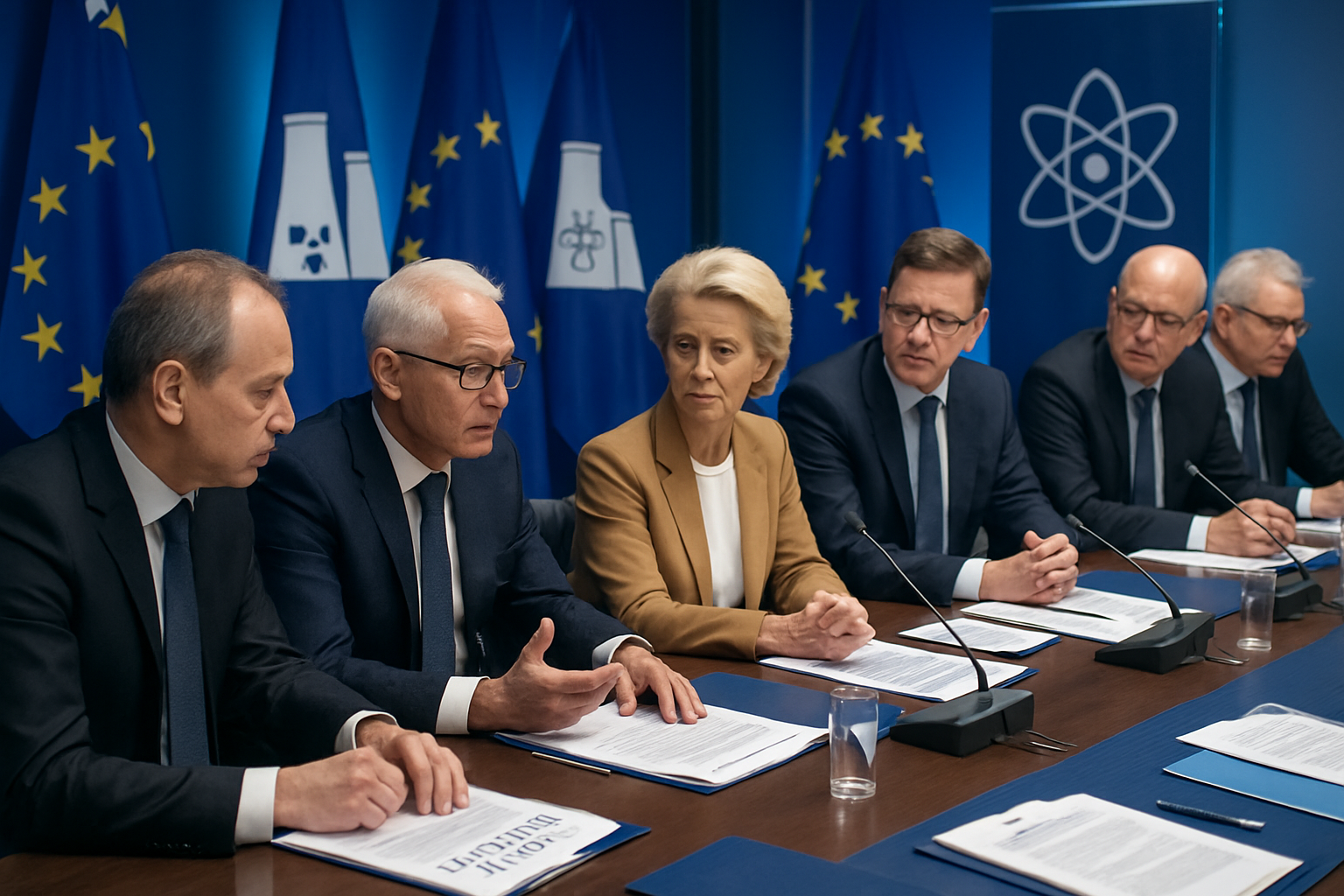
European Commission President Ursula von der Leyen declared that Europe's decision to reduce nuclear power in its energy mix was a "strategic mistake" as the continent grapples with unprecedented energy security challenges triggered by the ongoing Iran crisis and closure of the Strait of Hormuz.
Speaking at a summit in Paris aimed at boosting civilian nuclear energy use, von der Leyen announced a €200 million guarantee for innovative nuclear technologies while the European Union confronts oil prices surging past $90 per barrel and natural gas costs exploding by 24% in Europe following the Iran war's disruption of Middle East energy supplies.
Energy Crisis Catalyst for Nuclear Revival
The dramatic shift in European energy policy comes as the continent faces its most severe energy security crisis in decades. The Iran Revolutionary Guard's declaration that the Strait of Hormuz is "unsafe" has effectively closed the waterway that handles 40% of global seaborne oil transit, while Qatar has halted LNG production at its major facilities representing approximately 20% of global LNG exports.
The crisis reached dangerous new heights with the confirmation of Iranian Supreme Leader Ali Khamenei's death during US-Israeli "Operation Epic Fury" coordinated strikes, leading to massive Iranian retaliation that has stranded over 150 oil and LNG tankers in the Persian Gulf worth billions in cargo value.
"Nuclear power provides reliable energy 24 hours daily versus weather-dependent alternatives. This crisis has shown us the strategic vulnerability of over-dependence on unstable regions and weather-dependent energy sources."
— Ursula von der Leyen, European Commission President
Denmark Moves to Reverse Nuclear Ban
In a parallel development highlighting the shifting nuclear sentiment across Europe, Denmark's center-right coalition announced plans to remove the country's long-standing ban on nuclear power. The "blue bloc" parties have reached consensus on providing guarantees to voters that they will eliminate the atomic energy prohibition, marking a significant reversal in Danish energy policy.
This policy shift comes as Denmark, despite its leadership in renewable energy, recognizes the need for reliable baseload power to complement intermittent wind and solar generation. The country has been closely watching neighboring Estonia, which maintains 88% renewable electricity while exploring nuclear baseload options despite having Europe's largest battery storage system serving 90,000 households.
European Nuclear Projects Gain Momentum
Across the continent, nuclear energy projects are experiencing renewed political and financial support. Hungary's Paks II construction project, representing a €39.1 billion investment through the 22nd century, stands as Europe's largest nuclear undertaking. Romania has positioned itself as a leader in small modular reactor (SMR) technology with advanced safety systems at its Deutschești facility.
Greece has established a ministerial committee to explore SMR deployment as Prime Minister Mitsotakis frames nuclear power as essential for the country's carbon neutrality pathway. Slovakia continues positioning nuclear energy as central to its climate goals, while Latvia addresses capacity warnings and high electricity prices through nuclear considerations.
Technological Innovation Driving Renaissance
The new generation of nuclear technology features significant advances over previous designs. Small modular reactors incorporate digital monitoring systems, automated control mechanisms, and passive safety systems that reduce both costs and construction timelines compared to traditional large nuclear facilities.
Factory manufacturing and modular deployment offer substantial advantages, allowing components to be built in controlled environments and assembled on-site, dramatically reducing the complexity and cost overruns that plagued earlier nuclear construction projects.
Geopolitical Pressures and Strategic Independence
The European nuclear renaissance occurs against a backdrop of intensifying geopolitical competition and supply chain vulnerabilities. China currently controls 60% of critical materials production and 90% of refining for lithium, cobalt, and rare earth elements essential for renewable energy technologies.
The US-EU-Japan Critical Minerals Partnership, involving 55 countries and focusing on seven African alternative suppliers, represents one response to these dependencies. However, the nuclear option provides a pathway to energy independence that reduces reliance on geopolitically sensitive supply chains.
Memory chip shortages have driven sixfold price increases affecting smart grid systems, with recovery not expected until 2027 when new fabrication facilities come online. These technological bottlenecks have highlighted the importance of diversified energy sources that don't rely entirely on complex international supply chains.
Opposition and Environmental Concerns
The nuclear renaissance faces significant opposition from environmental groups and some European leaders. Austria's environment commissioner has criticized the "dangerous path" of nuclear expansion, while Spain has expressed reservations about international legality and environmental protection requirements.
Greenpeace has characterized the nuclear revival as a "betrayal of the European Green Deal," arguing that the focus should remain on renewable energy sources and energy efficiency measures rather than nuclear expansion.
"We cannot solve the climate crisis by creating another environmental crisis. Nuclear waste remains dangerous for thousands of years, and accidents like Chernobyl and Fukushima show the catastrophic risks."
— Environmental Coalition Statement
Global Competition Context
The European nuclear policy shift occurs as global powers compete for technological leadership in next-generation nuclear systems. The United States has approved TerraPower's small modular reactor project in Wyoming, while Japan has restarted the Kashiwazaki-Kariwa facility, the world's largest nuclear power plant.
This international nuclear technology competition adds urgency to European efforts, as leadership in nuclear innovation carries implications for export potential, technological sovereignty, and strategic influence in global energy markets.
Economic and Employment Benefits
Nuclear energy projects promise substantial economic benefits through job creation in specialized, high-paying sectors. The industry offers stable electricity pricing and long-term employment opportunities, with nuclear facilities typically operating for a century or more.
The economic multiplier effects extend beyond direct employment to include research and development, advanced manufacturing, and supporting service industries that develop around nuclear facilities.
Integration with Climate Goals
Proponents argue that nuclear energy provides an essential complement to renewable sources in achieving climate goals. Unlike wind and solar power, nuclear facilities provide consistent baseload electricity regardless of weather conditions, addressing grid stability requirements as renewable penetration increases.
This reliability becomes particularly crucial as extreme weather events increase in frequency and intensity, potentially disrupting both renewable energy generation and electricity demand patterns.
Strategic Implications for European Energy Architecture
Von der Leyen's acknowledgment of past strategic mistakes in nuclear policy represents a fundamental shift in European thinking about energy security and strategic autonomy. The current crisis has demonstrated the risks of over-dependence on energy imports from geopolitically unstable regions.
The success or failure of Europe's nuclear renaissance will determine the continent's energy architecture for decades to come, influencing everything from climate goal achievement to geopolitical independence and economic competitiveness in global markets.
As European leaders navigate between climate commitments and security requirements, the nuclear option has emerged as a potential pathway to achieving both objectives simultaneously. The coming years will test whether this strategic pivot can deliver on its promises while maintaining public acceptance and environmental protection standards.