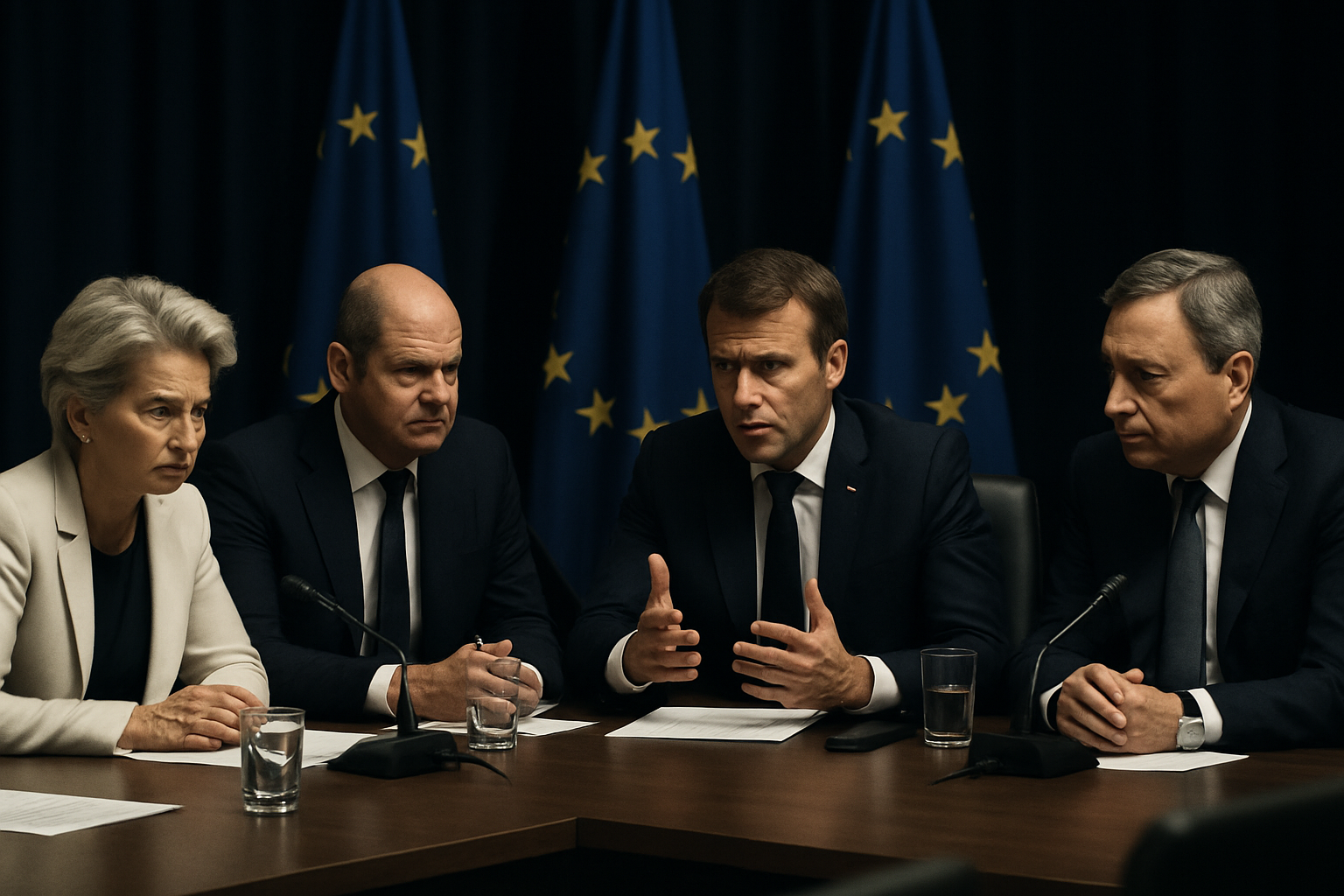
European politics reaches a critical inflection point as Hungary prepares for its most consequential election in over a decade while Germany grapples with coalition instability, creating a continental crisis that threatens the foundations of European integration and democratic governance.
Hungary's Political Earthquake: Orbán's Greatest Challenge
For the first time since Viktor Orbán's return to power in 2010, Fidesz finds itself trailing in opinion polls ahead of April 12, 2026 parliamentary elections. Multiple polling organizations show opposition coalitions led by Péter Magyar's Tisza Party gaining unprecedented momentum, representing a dramatic shift in Hungary's political landscape with far-reaching implications for European unity.
Magyar, a former government insider turned opposition leader, has consolidated anti-Orbán forces behind a comprehensive 240-page electoral program promising wealth taxes, euro adoption, and stronger EU/NATO ties - a stark contrast to Orbán's nationalist sovereignty approach. The opposition's "Greatest National March" in March drew an estimated 500,000 participants, marking the largest demonstration against the government since 2010.
Energy Weaponization and Pipeline Politics
The electoral stakes have been heightened by escalating energy disputes. Hungary maintains its blockade of the EU's historic €90 billion Ukraine aid package over the Druzhba oil pipeline crisis, which has been offline since late January 2026. While Ukraine claims Russian drone attacks damaged the infrastructure requiring repairs, Hungary and Slovakia allege deliberate manipulation as "political blackmail."
Adding to tensions, Serbian authorities discovered sophisticated explosive devices near the Balkan Stream/TurkStream pipeline infrastructure just one week before the Hungarian elections. Opposition leaders dismissed the timing as "election campaign tactical panic-making," while Ukrainian officials characterized it as a "false flag operation" designed to influence the vote.
"The EU cannot become Budapest's hostage."
— Kestutis Budrys, Lithuanian Foreign Minister
Foreign Interference and International Dimensions
The Hungarian election has taken on unprecedented international dimensions with documented dual foreign interference. Investigative reporting by Szabolcs Panyi revealed concrete evidence of Russian operative teams operating in Budapest supporting Fidesz - the first confirmed case of Kremlin agents actively participating in European electoral campaigns.
Simultaneously, the Trump administration has provided explicit political backing through presidential endorsements and diplomatic visits. US Vice President J.D. Vance arrived in Budapest just five days before the election, condemning EU "bureaucrats in Brussels" for "shameless election interference" while declaring Orbán a "model for Europe."
This convergence of Russian operational support and American political endorsement creates an unprecedented situation of dual foreign intervention in an EU member state election, raising fundamental questions about democratic sovereignty and external influence.
German Coalition Crisis Deepens
Germany faces its own political upheaval as coalition mathematics collapse across the federal system. The Free Democratic Party (FDP) announced the resignation of chairman Christian Dürr and the entire federal executive board at the May 2026 conference, following consecutive failures to clear the 5% threshold in state elections.
The Social Democratic Party (SPD) suffered devastating defeats in Rhineland-Palatinate, ending 35 years of rule, while experiencing their worst-ever performance in Baden-Württemberg. Despite these catastrophic losses, party co-chairs Bärbel Bas and Lars Klingbeil have refused to resign, citing a "lack of personnel alternatives."
Slovakia's Political Polarization
Slovakia demonstrates the regional nature of Central European political tensions. Prime Minister Robert Fico received a deeply divided reception during International Women's Day events, with supporters calling him a "national hero" while protesters demanded policy changes. Slovak polling suggests strong cross-border interest in Hungarian politics, with research showing that supporters of the ruling Smer party favor Orbán, while Progressive Slovakia voters support Magyar.
Details emerged of Orbán's private communications with Vladimir Putin, including references to Russian folklore and conversations conducted in Russian, further highlighting the international dimensions of regional politics.
Switzerland's Regional Realignment
Even traditionally stable Switzerland shows signs of political transformation. In Rhineland-Palatinate's neighboring regions, the SPD's Alexander Schweitzer - once seen as a party hopeful - now negotiates the formation of a new government under CDU leadership despite his party's defeat. The CDU is set to take control of the state chancellery in Mainz, even though their candidate lacks government experience.
Russia-US Relations and European Security
The European political crisis unfolds against a backdrop of shifting great power relations. US Vice President Vance's condemnation of EU election interference, while simultaneously supporting Orbán, reflects the Trump administration's preference for bilateral relationships with like-minded nationalist leaders over traditional multilateral European institutional engagement.
This approach has created diplomatic tensions with Brussels and raised concerns about the future of transatlantic cooperation, particularly as Europe seeks to develop greater strategic autonomy in response to global challenges.
Democratic Institutions Under Pressure
Despite unprecedented challenges, European democratic institutions have demonstrated remarkable resilience. Elections continue to be conducted with high integrity standards, constitutional governance has been maintained, and peaceful transitions of power proceed even amid deep political divisions.
However, the convergence of multiple crises - energy weaponization, foreign interference, coalition instability, and cross-border political influence - tests the adaptive capacity of democratic systems designed for more stable circumstances.
Stakes for European Integration
The April 12 Hungarian election represents a template-setting moment for 21st-century democracy under pressure. An opposition victory would likely restore Hungarian-EU alignment, lift the Ukraine aid blockade, and remove Brussels' most persistent internal critic. Orbán's survival with foreign support could embolden similar interference operations continent-wide and force the implementation of enhanced cooperation mechanisms that would fundamentally alter European decision-making structures.
Eurobarometer polling shows 89% of Europeans demand greater EU unity, yet the political reality demonstrates increasing fragmentation and sovereignty assertions - a critical disconnect between public aspirations and institutional capacity.
The Path Forward
As Europe navigates what observers call the "most challenging period for continental democracy since World War II," the coming weeks will be decisive not just for individual nations but for the future trajectory of the European project itself. Success in channeling political tensions through electoral competition while preserving institutional integrity would strengthen the European democratic model globally.
The stakes encompass European security architecture, international law enforcement credibility, and the effectiveness of democratic institutions under authoritarian pressure - with implications extending far beyond Europe's borders to influence global perceptions of democratic resilience in an era of great power competition.
Senior EU officials characterize the current moment as Europe "writing the template for 21st-century crisis management," with the world watching whether democratic institutions can adapt to preserve European values while enabling effective governance in an increasingly complex global environment.