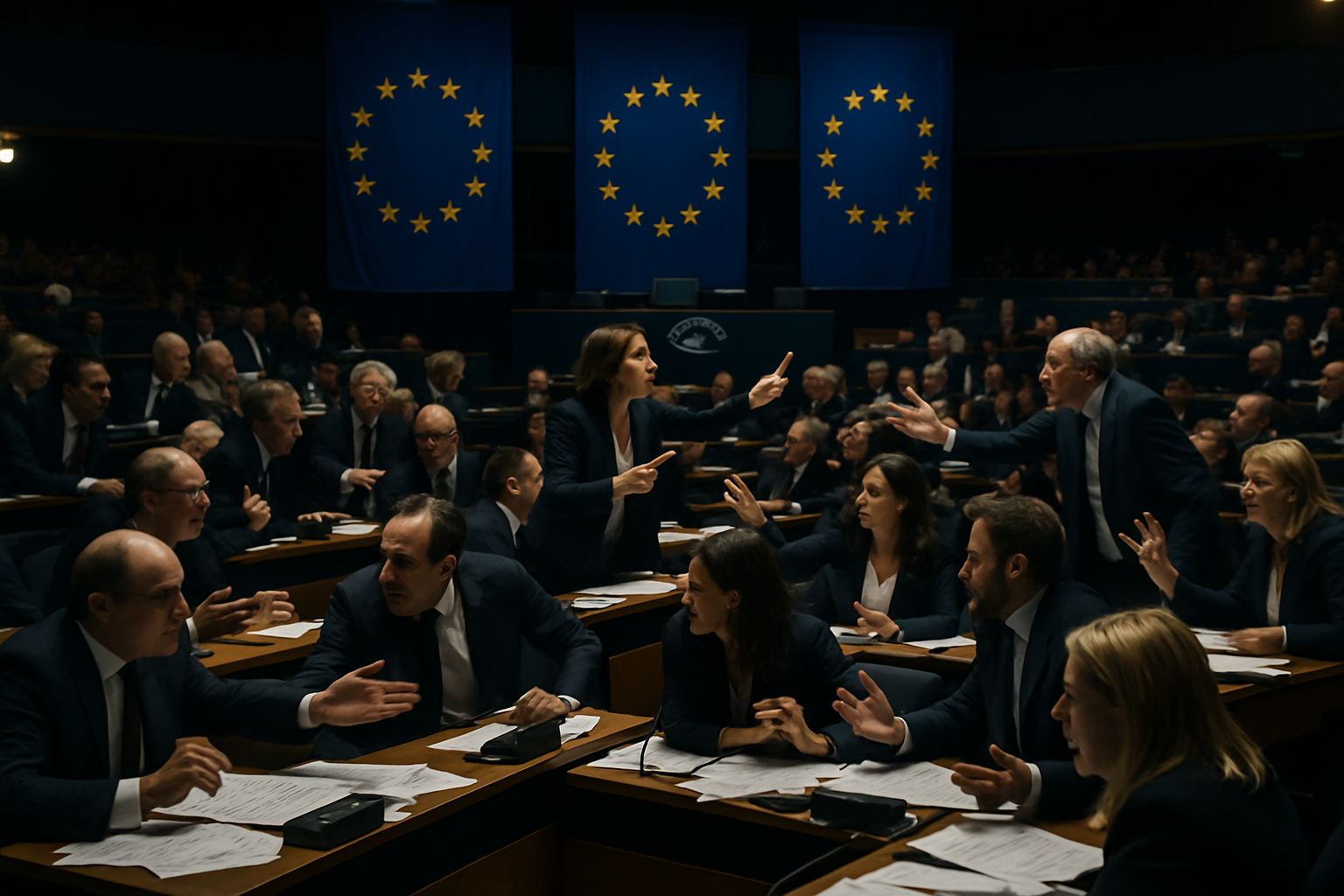
Europe faces its gravest political crisis since World War II as Hungary's Viktor Orbán confronts explosive allegations of pipeline sabotage just six days before crucial elections, while Austria grapples with parliamentary investigative disputes that threaten governmental transparency and accountability.
The continental crisis reached fever pitch on April 6, 2026, when Serbian authorities announced the discovery of sophisticated explosive devices near the Balkan Stream pipeline infrastructure, a critical energy artery serving Hungary and Slovakia. The timing—exactly one week before Hungary's April 12 parliamentary elections—has sparked fierce debate about the incident's authenticity and political motivations.
Pipeline Sabotage Allegations Rock Hungarian Campaign
Serbian President Aleksandar Vučić reported finding explosive devices "of devastating force" near the village of Velebit, close to the Hungarian border. The Balkan Stream pipeline, an extension of Russia's TurkStream project, transports approximately 15.75 billion cubic meters of natural gas annually from Turkey through Bulgaria and Serbia to Hungary.
Prime Minister Viktor Orbán immediately convened an extraordinary National Defense Council session and announced a comprehensive investigation. However, opposition leaders dismissed the incident as "election campaign tactical panic-making," suggesting Orbán is exploiting security fears for political gain during the most challenging electoral contest of his career.
Ukraine's Foreign Ministry categorically denied involvement, with spokesperson Heorhii Tykhyi characterizing the discovery as "most likely a Russian operation under false flag as part of Moscow's large-scale interference in Hungary's elections." This accusation adds another layer to an already complex geopolitical situation.
Orbán's Electoral Vulnerability Exposed
For the first time since returning to power in 2010, Orbán's Fidesz party trails opposition coalitions in polling. Péter Magyar's Tisza Party has organized massive demonstrations, including the "Greatest National March" that drew 500,000 participants—the largest opposition gathering in over a decade.
The pipeline incident provides Orbán an opportunity to reinforce his sovereignty narrative about external threats while potentially deflecting from domestic challenges. The opposition has repeatedly demanded transparency about the discovery circumstances and the government's response, framing the April 12 election as a referendum on Hungary's European future versus continued institutional confrontation.
Adding to the complexity, investigative reports have confirmed Russian interference teams operating in Budapest to support Fidesz, while the Trump administration provides alternative international legitimacy through explicit diplomatic support.
Austria's Parliamentary Deadlock
Simultaneously, Austria faces its own governmental crisis as the Interior Ministry continues to refuse full document disclosure to the Pilnacek investigative committee. The Greens' parliamentary fraction leader Nina Tomaselli has announced defensive measures against what the party characterizes as systematic obstruction of parliamentary oversight.
This transparency dispute reflects broader European tensions between executive power and legislative accountability. The Pilnacek affair has become a test case for Austria's democratic institutions and their capacity to investigate potential governmental misconduct.
Meanwhile, NEOS party leaders, including EU Parliament delegation head Helmut Brandstätter and European spokesman Dominik Oberhofer, are preparing statements on Hungary's parliamentary elections, highlighting the interconnected nature of European democratic challenges.
Energy Security and Geopolitical Implications
The alleged sabotage attempt underscores European energy infrastructure vulnerability amid ongoing geopolitical tensions. Hungary and Slovakia remain the only EU countries dependent on Russian oil under special exemptions, making alternative energy routes crucial for long-term security.
Enhanced security protocols have been implemented along the entire pipeline route, with increased military patrols and surveillance. The investigation's outcome could set precedents for managing future infrastructure security challenges in an increasingly volatile geopolitical environment.
Croatian officials have offered Mediterranean routes as alternatives, though implementation would require months or years of infrastructure development. Ukraine has proposed the Odessa-Brody replacement pipeline, but these solutions provide little immediate crisis relief.
EU Institutional Strain
These developments occur against the backdrop of Hungary's systematic blockade of EU Ukraine aid packages worth €90 billion—the largest single-nation assistance ever proposed by the bloc. Lithuania's Foreign Minister has warned that "the EU cannot become Budapest's hostage," while enhanced cooperation discussions accelerate to bypass unanimity requirements.
The crisis tests fundamental EU institutional mechanisms under extraordinary pressure. Success in maintaining unity while delivering promised aid would strengthen the bloc's global credibility, while failure could signal broader fragmentation under external pressure.
Democratic Resilience Under Test
Despite unprecedented challenges, European democratic institutions continue demonstrating resilience through credible elections, constitutional governance maintenance, and peaceful transitions. The Hungarian elections will serve as a critical test of democratic capacity under foreign interference and institutional manipulation.
Opposition victory would likely restore EU unity and remove Brussels' most persistent internal critic. However, Orbán's survival would entrench the crisis and potentially force enhanced cooperation implementation, fundamentally altering European decision-making structures.
As one senior EU official noted, Europe is "writing the template for 21st-century crisis management" with the world watching whether democratic institutions can adapt while preserving essential values. The stakes extend far beyond individual countries to encompass European security architecture, international law enforcement credibility, and the effectiveness of democratic institutions under authoritarian pressure.
The Path Forward
The coming week will prove decisive for European democracy. Hungarian voters face a choice between continued confrontation with European partners and potential reintegration into mainstream EU cooperation. Austria must resolve its parliamentary oversight crisis to maintain institutional credibility.
The resolution of these crises will establish crucial precedents for democratic governance in complex global environments. Whether Europe successfully navigates these challenges while strengthening institutions will determine the continent's trajectory for decades to come and influence global perceptions of democratic resilience in an era of rising authoritarianism.