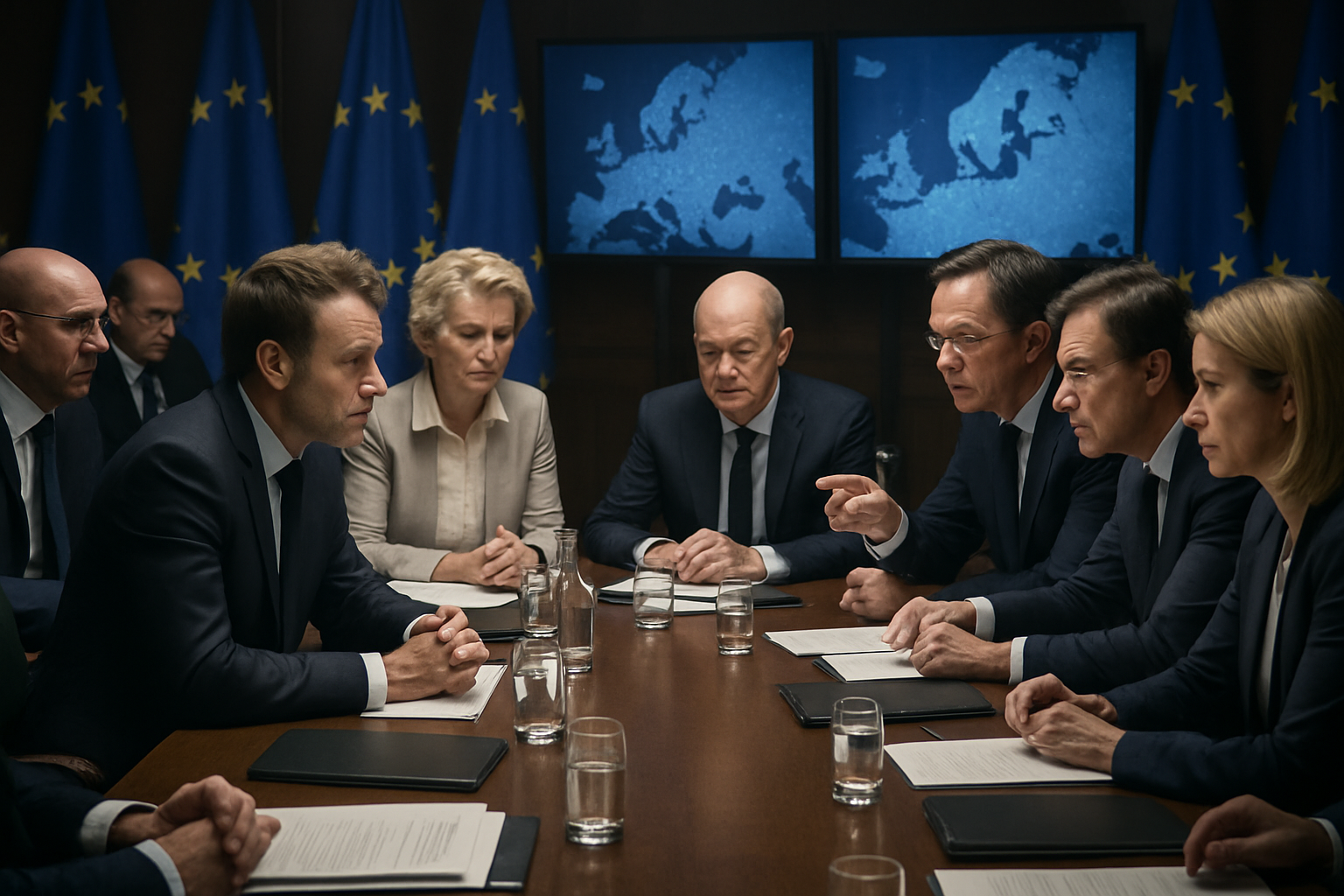
European Union leaders convened in Brussels for emergency discussions as the continent faces its most challenging political period since World War II, with mounting tensions over the escalating Middle East crisis, renewed Cyprus diplomatic efforts, and domestic political upheaval across multiple member states threatening European unity.
The summit, attended by heads of state and government from across the 27-member bloc, comes at a critical juncture as Europe grapples with the spillover effects of the Iran-US-Israel conflict that has now directly impacted European territory for the first time since World War II.
Cyprus Crisis Escalation Drives EU Response
Central to the Brussels discussions was the unprecedented situation in Cyprus, where President Nikos Christodoulides announced significant developments in the longstanding Cyprus problem following his meeting with UN Secretary-General António Guterres. "We must expect developments soon," Christodoulides declared, emphasizing the urgent need for substantive progress before Guterres' term expires at the end of 2026.
The Cyprus issue has gained renewed urgency as the island nation became the first European territory to be directly attacked since World War II when Iranian drones struck the RAF Akrotiri British sovereign base. This attack prompted an unprecedented European naval coalition response, with HMS Dragon, Spanish frigates, and vessels from Italy, France, Netherlands, and Greece deploying to protect Cyprus.
"The substance of the Cyprus problem is where our focus lies," Christodoulides stated, indicating that both he and Guterres share "a common goal" regarding the territorial dispute that has divided the island for over 50 years.
German Leadership Amid Crisis
German Chancellor Friedrich Merz has emerged as a key voice in European crisis management, delivering a significant Bundestag policy statement emphasizing that Europe must no longer "sell itself short." His declaration that "as long as war continues, we will not participate" in certain military operations reflects Germany's careful balance between alliance obligations and sovereign decision-making.
Merz's approach has received cross-party praise for demonstrating "self-assertion against America" while maintaining NATO commitments. This positioning illustrates the delicate diplomatic balance European leaders must navigate as they support Cyprus while avoiding deeper involvement in the broader Middle East conflict.
The Chancellor's meeting with Italian Prime Minister Giorgia Meloni in Brussels on the eve of the EU summit highlighted the intensive diplomatic coordination required to maintain European unity during this crisis period.
Netherlands Election Results Reflect Political Fragmentation
Adding to European political complexity, the Netherlands witnessed a dramatic electoral deadlock in Rotterdam, where left-wing and right-wing parties emerged neck-and-neck with 70% of votes counted. This result exemplifies the political fragmentation occurring across Europe, where traditional coalitions are under unprecedented strain.
The Rotterdam results demonstrate how local politics increasingly reflect broader European tensions over migration, economic policy, and national sovereignty. The close contest between opposing political philosophies mirrors similar divisions evident in other EU member states.
Electoral authorities implemented extended polling hours and enhanced accessibility measures, reflecting efforts to maintain democratic engagement despite rising political polarization across the continent.
Energy and Economic Security Concerns
The Brussels summit addressed mounting economic pressures stemming from the Middle East crisis, which has disrupted global energy markets and supply chains. Oil prices have surged past $100 per barrel as Iran's closure of the Strait of Hormuz affects 40% of global oil transit, while natural gas prices have increased 24% across Europe.
European leaders discussed emergency measures to protect energy security, including potential releases from strategic petroleum reserves and acceleration of renewable energy projects. The crisis has exposed Europe's continued vulnerability to geopolitical shocks despite years of efforts to diversify energy sources.
The economic implications extend beyond energy, with major shipping companies suspending operations in the Persian Gulf, affecting supply chains for automotive, electronics, and textile industries that depend on Gulf logistics networks.
Democratic Resilience Under Pressure
The summit occurred against a backdrop of what observers describe as "the most challenging period for continental democracy since World War II." Despite 89% of Europeans demanding greater EU unity according to Eurobarometer polling, political reality shows increasing fragmentation and rising support for extremist movements.
European leaders face the challenge of maintaining democratic institutions while responding to citizens' concerns about security, migration, and economic stability. The rise of far-right movements across the continent has created new pressures on traditional coalition politics and European integration.
The pattern of "authoritarian innovation" - where extremist movements work within democratic systems while gradually eroding liberal norms - represents a sophisticated challenge to traditional democratic safeguards.
Strategic Autonomy and Security Coordination
The Cyprus attack has accelerated discussions about European strategic autonomy, with the unprecedented four-nation naval coalition representing the most concrete expression of independent European defense coordination in decades. This military cooperation occurred outside traditional NATO frameworks, establishing new precedents for European territorial defense.
Finland's involvement in the broader crisis discussions reflects Nordic countries' growing engagement with Mediterranean security issues, demonstrating how regional conflicts now have continent-wide implications. The Finnish government has contributed operational planning for the Cyprus protection mission while maintaining its own security considerations.
EU High Representative Kaja Kallas described the current situation as a "turning point" that could create new opportunities for different approaches to regional conflicts, while emphasizing the need for European unity in crisis response.
Looking Ahead: Critical Decisions
The Brussels summit represents a watershed moment for European politics, as leaders must balance multiple crises simultaneously. The combination of external security threats, internal political divisions, and economic pressures creates an unprecedented challenge for EU institutions.
Success in navigating this crisis period could strengthen European institutions and demonstrate the bloc's capacity for effective crisis management in a multipolar world. However, failure to maintain unity could accelerate fragmentation and undermine Europe's ability to influence global events.
The coming weeks will be decisive as European leaders implement decisions made at the summit while monitoring developments in Cyprus, the broader Middle East conflict, and domestic political situations across member states. The stakes extend far beyond Europe itself, as the continent's response to these challenges will influence global democratic governance and international stability mechanisms for decades to come.
As one senior EU official noted, "We are writing the template for 21st-century crisis management. The world is watching to see whether democratic institutions can adapt and respond effectively to unprecedented challenges while preserving the values that define European civilization."