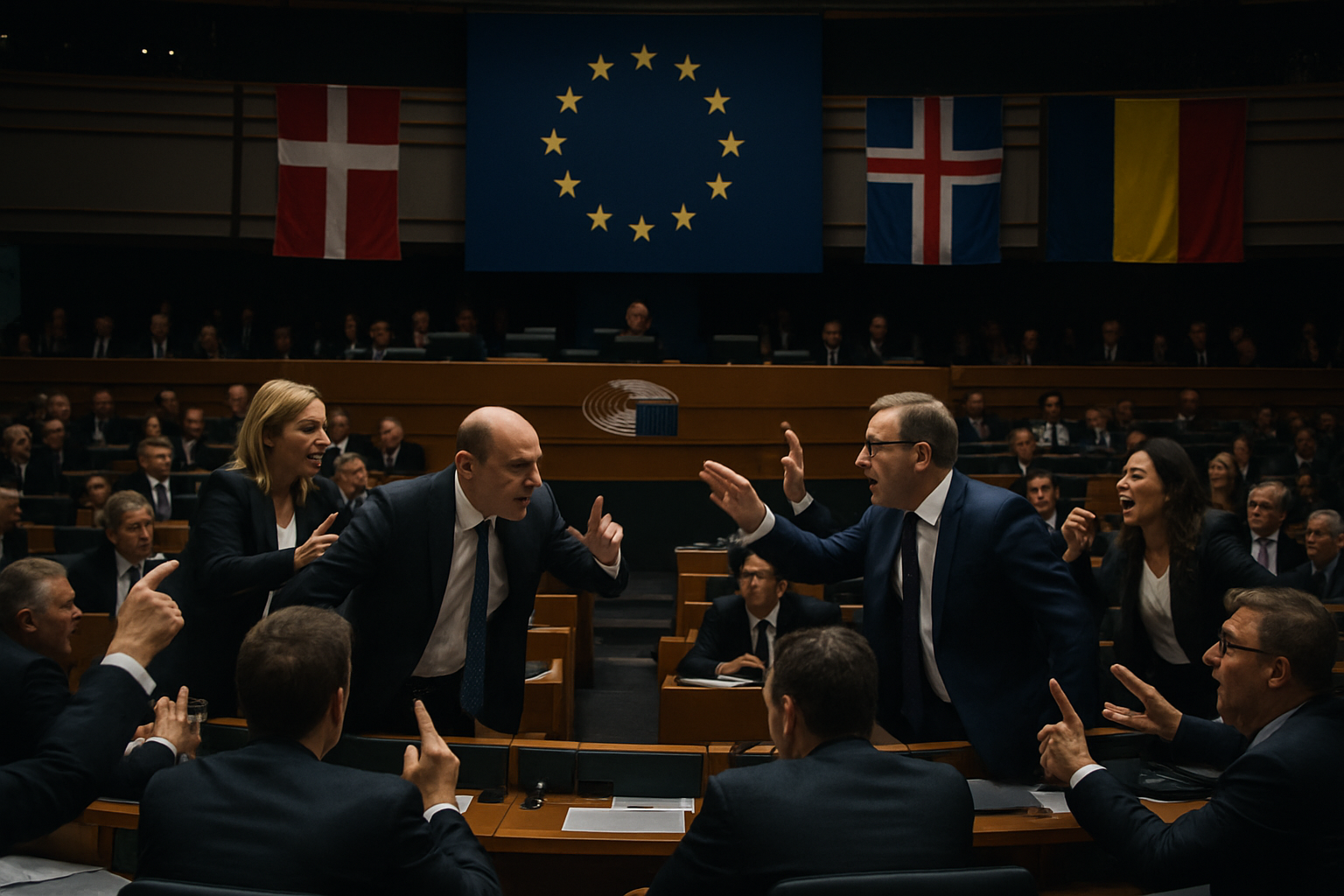
Political upheaval continues to reshape European democracy as Denmark's government formation enters its most critical phase, Iceland witnesses significant partisan shifts, and Romania confronts coalition breakdown, marking what analysts describe as the most challenging period for continental governance since World War II.
The convergence of these crises across multiple European Union member states reflects deeper systemic challenges facing democratic institutions amid foreign interference, economic pressures, and rising political extremism. From Copenhagen's royal chambers to Bucharest's coalition meetings, the foundations of European political stability are being tested like never before.
Denmark's Constitutional Crisis Deepens
Denmark's political landscape has entered uncharted territory as Lars Løkke Rasmussen breaks his public silence for the first time in days, threatening a new round of consultations with King Frederik X. The development signals a dramatic escalation in what has already become the most complex government formation in Danish modern history.
Sources close to the negotiations reveal that Rasmussen's Moderates, holding crucial kingmaker status following March's fragmented election results, have grown increasingly frustrated with the inability of traditional blocs to form stable coalitions. His threat of a "new royal round" indicates potential constitutional intervention rarely seen in Danish politics.
"The political mathematics simply don't work under current arrangements. We're looking at scenarios that would have been unthinkable just months ago."
— Senior Danish Political Analyst
The current impasse stems from Prime Minister Mette Frederiksen's Social Democrats suffering their worst electoral performance since 1903, capturing just 21.9% of the vote despite international acclaim for Denmark's sovereignty defense against territorial pressures. The so-called "Greenland effect" – betting on nationalist sentiment following firm resistance to external threats – failed spectacularly as voters prioritized domestic economic concerns over foreign policy victories.
Iceland's Political Momentum Shift
Meanwhile, Iceland demonstrates how contemporary European politics can rapidly transform traditional party dynamics. The latest Maskína poll reveals significant momentum for both Samfylkingin (Social Democratic Alliance) and Sjálfstæðisflokkurinn (Independence Party), with the Social Democratic Alliance commanding 27.7% support and the Independence Party reaching 18.1% – its highest level since September 2025.
This surge represents a notable departure from Iceland's recent political volatility, with the Independence Party showing its strongest performance in any Maskína poll since September last year. Political analysts attribute this growth to effective coalition positioning and strategic messaging that resonates with Iceland's evolving priorities amid changing Arctic geopolitics.
The party's support has fluctuated between 13.5% and 16.2% since October 2025, making its current 18.1% showing particularly significant for potential coalition mathematics in Iceland's proportional representation system. Samfylkingin has maintained stronger consistency, with support ranging between 25.5% and 29.4% over the same period, indicating a stable core constituency.
Romania's Coalition on the Brink
Romania faces its most serious governmental crisis as coalition tensions reach breaking point. Dan Motreanu, the number two figure in the Liberal Party (PNL), has proposed an internal resolution formally declaring that "the paths of PNL and PSD have separated on this day," according to sources within the party's Extended Political Bureau meeting.
The resolution comes amid fundamental disagreements over budget priorities and European Union fiscal requirements. Political sources describe "systematic crises" that don't emerge suddenly, particularly regarding the Social Democratic Party (PSD), pointing to underlying structural problems within Romania's governing coalition.
Simultaneously, Raluca Turcan, head of PNL's Sibiu organization, has called for the party to pursue a minority government led by Premier Ilie Bolojan while ensuring the "complete entry" of PSD into opposition – from state secretaries to board members of administration councils and other politically appointed positions.
"The decision is clear and strategic – the moment has come to separate ourselves from PSD. We need parliamentary consolidation and transparency about the web of interests within state companies."
— Raluca Turcan, PNL Sibiu Leader
Broader European Context
These developments occur within the broader context of what European analysts characterize as the most challenging period for continental democracy since 1945. Memory records from Planet News analysis show that 89% of Europeans demand greater EU unity according to Eurobarometer polling, yet the political reality demonstrates increasing fragmentation across member states.
The pattern of coalition instability extends beyond these three countries. Recent months have witnessed Germany's coalition facing unprecedented stress, with the FDP experiencing complete organizational collapse and the SPD suffering devastating electoral defeats. Sweden has seen historic political realignments with traditionally moderate parties entering cooperation agreements with far-right movements, fundamentally altering Nordic political consensus.
France continues grappling with the aftermath of political violence in Lyon, while Spain navigates complex coalition mathematics between conservative and far-right parties. This continental crisis reflects what intelligence sources describe as increasingly sophisticated foreign interference operations targeting electoral processes and amplifying existing political divisions.
Democratic Resilience Under Pressure
Despite unprecedented challenges, European democratic institutions have demonstrated fundamental resilience through maintaining constitutional governance, conducting credible elections, and ensuring peaceful transitions of power. The current tests serve as critical precedents for how established democracies navigate political fragmentation while preserving effective governance capabilities.
Political scientists note that traditional mechanisms – parliamentary coalitions, media scrutiny, and civil society opposition – are proving insufficient for containing sophisticated extremist movements that operate within democratic systems while gradually eroding liberal norms. This "authoritarian innovation" represents a more effective challenge than historical revolutionary approaches.
However, the success of institutional adaptation varies significantly across countries. Denmark's constitutional monarchy provides stabilizing mechanisms through royal intervention, while Iceland's proportional representation system forces collaborative governance. Romania's challenges reflect broader post-communist democratization strains exacerbated by contemporary European pressures.
Looking Ahead
The resolution of these concurrent crises will establish crucial templates for 21st-century democratic governance under pressure. Success in channeling political tensions through electoral competition while preserving institutional integrity would strengthen the European democratic model globally. Conversely, failure could accelerate fragmentation trends that undermine the cooperative principles underpinning European integration since 1945.
Coming weeks will prove decisive as Denmark seeks constitutional resolution to its government formation crisis, Iceland's parties position for potential early elections, and Romania's coalition partners determine whether cooperation remains viable. These outcomes will influence not only domestic politics but also European Union decision-making capacity, NATO cohesion, and international cooperation frameworks.
The stakes extend beyond immediate political calculations to fundamental questions about democratic adaptation in an era of technological disruption, economic inequality, migration pressures, and great power competition. European institutions face the challenge of maintaining unity and effectiveness while respecting democratic sovereignty and cultural diversity across member states.
As one senior EU official recently observed, Europe is "writing the template for 21st-century crisis management," with the international community closely watching whether democratic institutions can adapt while preserving European values and governance effectiveness in an increasingly complex global environment.