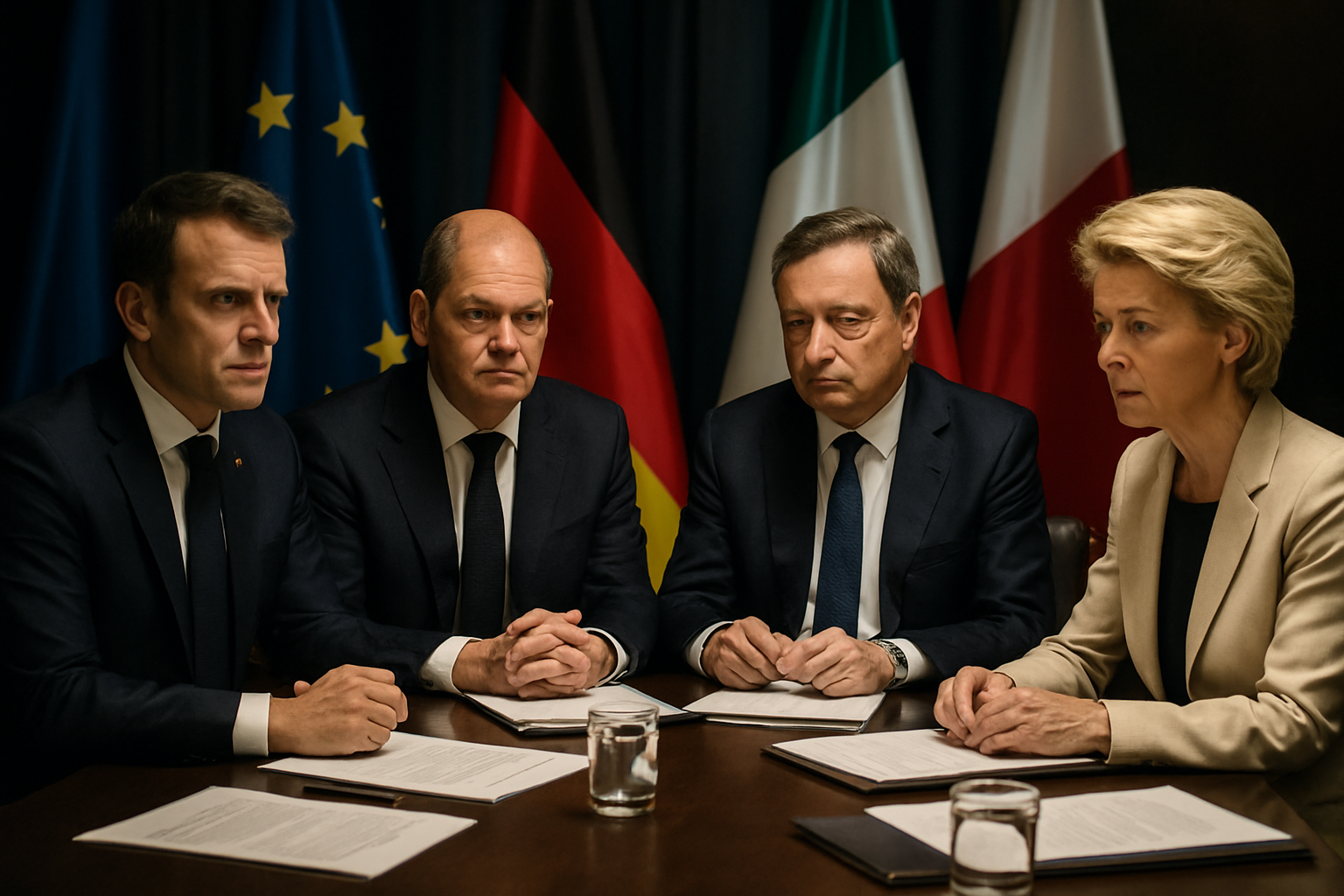
European political stability faced its most severe test in recent memory this week as diplomatic tensions erupted at the G7 foreign ministers meeting while domestic challenges mounted across the continent, creating what analysts describe as the most challenging period for European democracy since World War II.
The crisis reached a flashpoint Friday when EU foreign policy chief Kaja Kallas engaged in sharp exchanges with U.S. Secretary of State Marco Rubio during the G7 meeting in France, highlighting growing transatlantic divisions over Ukraine policy and broader strategic approaches. The confrontation occurred against a backdrop of unprecedented domestic political upheaval across multiple European Union member states.
G7 Diplomatic Crisis Exposes Transatlantic Rift
The heated exchange between Kallas and Rubio represents the most public manifestation of deteriorating U.S.-European relations since the Trump administration's return to power. Sources within the Estonian delegation confirmed that Kallas directly challenged Rubio's approach to Russia, marking a significant departure from traditional diplomatic protocols at such high-level meetings.
The confrontation builds on weeks of mounting tension following Marco Rubio's controversial European tour in February, during which he provided unprecedented support for Hungarian Prime Minister Viktor Orbán ahead of crucial elections. European officials have privately expressed frustration with what they perceive as American interference in EU internal affairs and a fundamental misunderstanding of European democratic principles.
"The Europeans are writing the template for 21st-century crisis management while facing unprecedented pressure from multiple directions."
— Senior EU Official, speaking anonymously
The timing of the diplomatic clash could not be worse, coming as Europe faces its most complex array of simultaneous political crises in decades. The Estonian-led pushback against American positions signals a broader European strategic autonomy movement that has gained momentum since the Munich Security Conference earlier this year.
Germany's Democratic Institutions Under Strain
Meanwhile, German democracy faced a particularly troubling development as the Alternative for Deutschland (AfD) achieved historic breakthroughs in traditionally stable regions. Recent analysis reveals the far-right party has nearly doubled its support to 18% in Baden-Württemberg, becoming the third-largest political force in a state long considered a bastion of moderate politics.
The AfD's success in Baden-Württemberg represents what political scientists term "authoritarian innovation" – sophisticated extremist movements working within democratic systems while gradually eroding liberal norms through electoral success rather than revolutionary violence. This pattern has emerged across Europe, from Sweden's Liberal Party abandoning decades of opposition to cooperation with the Sweden Democrats to Marine Le Pen's National Rally pursuing "urban sophistication" strategies in French municipal elections.
Simultaneously, Germany confronts internal party upheaval as reports emerged of significant leadership tensions within the Alternative for Deutschland Rheinland-Pfalz faction. The party's state leader unexpectedly lost the fractional chairmanship despite recent electoral gains, exposing deep internal divisions that could affect the party's future trajectory in this crucial swing state.
Nordic Political Upheaval
Finland's political establishment faces uncertainty following reports that Juha Mäenpää, a prominent figure within the populist Finns Party (Perussuomalaiset), has taken medical leave. While specific details remain unclear, the development comes at a critical time for Finnish politics as the country navigates complex European integration challenges and adapts to its new NATO membership status.
The timing is particularly sensitive given Finland's elevated role in European security architecture following its NATO accession and the ongoing Arctic Sentry mission, where Finnish operational expertise has proved crucial for alliance planning in extreme northern conditions.
Latvia's Electoral Preparations Amid Regional Tensions
Latvia's political landscape is experiencing significant shifts as the Latvian Farmers' Union (LZS) unveiled an ambitious electoral program ahead of autumn elections. The platform emphasizes economic growth, increased healthcare funding, energy security, and governmental efficiency – priorities that reflect broader European concerns about economic competitiveness and security in an increasingly volatile global environment.
The LZS program includes what party officials describe as "generous promises" spanning multiple policy areas, suggesting an attempt to build a broad coalition capable of addressing Latvia's complex challenges as a Baltic state facing both economic pressures and security concerns related to regional tensions.
Latvia's electoral preparations occur within the context of enhanced Baltic cooperation initiatives, including unprecedented cultural institution partnerships where national libraries have agreed to strengthen cooperation specifically to address geopolitical challenges – representing an innovative approach to democratic resilience through cultural diplomacy.
Hungary's EU Relations Crisis Intensifies
Perhaps the most consequential development involves Hungary's continued obstruction of EU decision-making processes. The European Commission has frozen approximately 19 billion euros in funding to Hungary over rule of law concerns, with analysts suggesting that at least half of this substantial sum may be permanently lost to the Hungarian treasury.
The funding suspension represents one of the largest financial penalties ever imposed by EU institutions on a member state and highlights the growing tension between Brussels' commitment to democratic values and national sovereignty principles. Viktor Orbán's government faces its most challenging electoral environment since returning to power in 2010, with opposition forces gaining unprecedented momentum ahead of crucial spring elections.
The Hungarian crisis extends beyond domestic politics to affect broader EU functionality, as Budapest continues to block critical initiatives including the historic 90 billion euro Ukraine aid package and the 20th sanctions package against Russia. Lithuanian Foreign Minister Kestutis Budrys's warning that "the EU cannot become Budapest's hostage" reflects growing frustration among member states with Hungary's systematic abuse of unanimity requirements.
Institutional Resilience Under Pressure
Despite these mounting challenges, European democratic institutions have demonstrated remarkable resilience. The peaceful conduct of elections, maintenance of constitutional governance, and continued EU cooperation mechanisms suggest fundamental institutional strength even amid unprecedented external and internal pressures.
The crisis has accelerated discussions about enhanced cooperation mechanisms that would allow willing member states to proceed with important initiatives without requiring unanimity. Such arrangements could fundamentally alter EU decision-making processes while preserving the union's core democratic principles.

Economic Pressures Compound Political Stress
The political upheaval occurs against a backdrop of significant economic pressures that compound governmental challenges. Recent energy price spikes, supply chain disruptions, and inflationary pressures have created an environment where political leaders face unprecedented demands from citizens while operating under severe fiscal constraints.
Estonia's success in maintaining 88% renewable electricity generation and operating continental Europe's largest battery storage system (serving 90,000 households) provides a template for economic resilience that other European nations are studying closely. However, the technical expertise and financial investment required for such transformations remain substantial barriers for many member states.
International Implications and Strategic Outlook
The convergence of these political developments carries significant implications for European integration, transatlantic relations, and global democratic governance. The success or failure of European institutions in managing this multifaceted crisis will establish crucial precedents for democratic resilience in the 21st century.
European polling continues to show that 89% of Europeans demand greater EU unity, while 86% want a stronger global voice for Europe. This public support provides a democratic mandate for enhanced integration, even as political reality demonstrates increasing fragmentation and sovereignty assertions across multiple member states.
The resolution of current crises will determine whether Europe navigates this challenging period while strengthening democratic institutions through adaptive governance or experiences continued fragmentation that could undermine the foundational cooperation principles that have underpinned European success since 1945.
Looking Ahead: Critical Decisions Pending
Coming weeks will prove decisive as multiple European nations face critical decisions that will shape the continent's trajectory for decades. The handling of current challenges will establish templates for democratic governance under pressure that will influence political development far beyond Europe's borders.
The stakes encompass not only immediate policy outcomes but also the broader credibility of democratic governance in an era of rising authoritarianism, technological disruption, and climate-related challenges that require unprecedented international cooperation and institutional innovation.
As European leaders grapple with these converging pressures, their success in maintaining unity while preserving democratic principles will determine whether the current crisis strengthens European integration through demonstrated resilience or marks a turning point toward fragmentation that could reshape the global balance of democratic and authoritarian governance models.