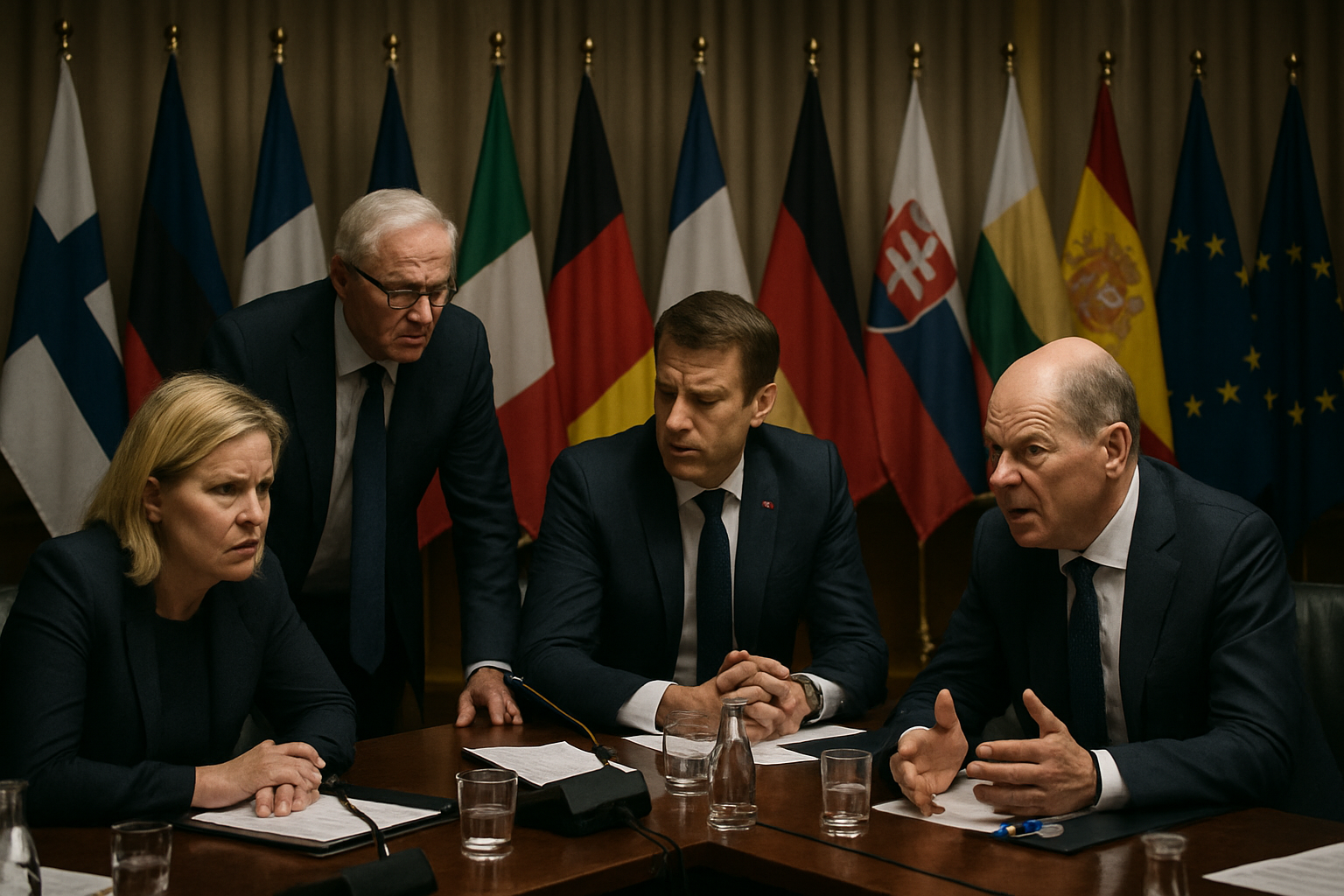
Europe is experiencing its most severe political crisis since World War II, with democratic institutions across the continent facing unprecedented strain as traditional coalition governments collapse, far-right parties achieve historic breakthroughs, and established political norms crumble under populist pressure.
The political upheaval spans from Scandinavia to Southern Europe, marking a fundamental shift in the European political landscape that threatens decades of democratic stability and cooperation.
Sweden's Historic Far-Right Breakthrough
Sweden has witnessed the most dramatic political realignment in modern Nordic history as the Liberal Party (Liberalerna) under Simona Mohamsson formally abandoned decades of opposition to cooperation with the far-right Sweden Democrats (SD). This historic decision breaks the last barrier preventing a party with white nationalist roots from entering formal government.
"With five months left until the election, the Tidö parties have several challenges. The distance to the opposition is large while the Liberals are clearly under the parliamentary threshold,"
— Per Söderpalm, Opinion Chief at Verian
The Liberal Party's polling has stagnated at just 2.2 percent despite their strategic pivot toward the Sweden Democrats, raising questions about the electoral viability of mainstream parties accommodating far-right positions. The internal crisis within the party reached a boiling point as ministers Nina Larsson and Johan Britz threatened mass resignations if the SD cooperation proceeds.
Meanwhile, tensions within the governing coalition have intensified, with Christian Democrat leader Ebba Busch openly criticizing SD leader Jimmie Åkesson's work capacity, stating: "Comparing our calendars during this mandate period, he doesn't work as much as I or many others work."
German Coalition Instability and AfD Gains
Germany faces its own democratic challenges as the Alternative for Deutschland (AfD) achieved unprecedented success in traditionally stable regions. In Baden-Württemberg, the far-right party nearly doubled its support to 18 percent, becoming the third-largest political force in a state that has historically resisted extremist movements.
The coalition dynamics in Germany reflect broader European trends of political fragmentation. In Rhineland-Palatinate, the CDU ended 35 years of SPD rule, while the AfD demonstrated sophisticated campaigning capabilities that extend far beyond their traditional eastern German strongholds.
Brandenburg's Minister-President Dietmar Woidke defended his party's approach to coalition building, particularly regarding the failed alliance with the Sahra Wagenknecht Alliance (BSW), arguing that "the experiment could have worked" despite its ultimate collapse.
Spanish Coalition Arithmetic Breakdown
Spain's political landscape has been transformed by the growing influence of the far-right Vox party, which has become an essential partner for conservative governance across multiple regions. The Popular Party (PP) under Alberto Núñez Feijóo faces mounting pressure to finalize government agreements with Vox in Extremadura, Aragón, and Castilla y León.
The coalition negotiations have stalled repeatedly, with Vox demanding key ministerial positions and substantial policy concessions. In Castilla y León, the PP-Vox coalition maintains a 47-seat majority, but the enhanced negotiating position of the far-right party reflects a broader European pattern of mainstream conservatives becoming dependent on extremist partners.
Simultaneously, Podemos has been attempting to court Catalan Republican Left (ERC) spokesman Gabriel Rufián for a potential alliance in upcoming general elections, though Rufián has remained cautious about committing to any formal cooperation.
French Municipal Elections and Political Violence
France's political system has been shaken by violent confrontations and administrative controversies that have reshaped the electoral landscape. The death of Quentin Deranque during political violence in Lyon fundamentally altered the atmosphere surrounding municipal elections, with seven suspects charged including Jacques-Elie Favrot, a parliamentary assistant to a La France Insoumise deputy.
The Interior Ministry's controversial reclassification of La France Insoumise from "left" to "extreme left" for electoral purposes triggered legal challenges at the Council of State, raising concerns about administrative manipulation of democratic processes. This bureaucratic intervention represents a new form of political weaponization that extends beyond traditional partisan competition.
Eastern European Sovereignty Challenges
Ukraine's President Volodymyr Zelensky has called for EU expansion as a security strategy, arguing that the European Union in its "current form" would be insufficient to guarantee European security without American support. This statement reflects growing concerns about European strategic autonomy amid shifting global power dynamics.
Romania faces internal governance challenges as political parties navigate between EU fiscal requirements and domestic spending pressures, exposing fundamental disagreements within ruling coalitions about economic priorities and international obligations.
The Authoritarian Innovation Challenge
Political scientists describe the current phenomenon as "authoritarian innovation" – sophisticated far-right movements operating within democratic systems while gradually eroding liberal norms through electoral success rather than revolutionary violence. This approach has proven more effective than traditional extremist strategies because it maintains democratic legitimacy while systematically undermining institutional safeguards.
The pattern extends beyond individual countries to represent a continental challenge to democratic governance. Traditional mechanisms such as parliamentary coalitions, media scrutiny, and civil society opposition have proven insufficient to contain movements that adapt their messaging for mainstream consumption while maintaining radical agendas.
Democratic Resilience Under Pressure
Despite the unprecedented challenges, European democratic institutions have demonstrated fundamental resilience through the maintenance of free and fair elections, constitutional governance, and peaceful power transitions. International observers have noted that even amid political violence and foreign interference allegations, European democracies have continued to function within established legal frameworks.
The crisis has also accelerated discussions about enhanced cooperation mechanisms within the EU, allowing willing member states to proceed with integration without requiring unanimous consent. This development could fundamentally alter European decision-making processes and provide new tools for addressing institutional challenges.
Stakes for European Integration
The current political upheaval represents a template-setting moment for 21st-century democratic governance under pressure. Success in channeling political tensions through electoral competition while preserving institutional integrity would strengthen the European model globally. Failure could accelerate fragmentation and undermine the foundational cooperation principles that have underpinned European success since 1945.
"Europe is writing the template for 21st-century crisis management, with the world watching whether democratic institutions can adapt while preserving European values,"
— Senior EU Official
The coming months will be decisive for the continental trajectory, as multiple member states navigate coalition negotiations, electoral campaigns, and policy implementations that will determine whether European democracy emerges stronger or more fragmented from this historic period of challenge.
The ultimate test lies in whether European democracies can address the underlying drivers of extremism – inequality, immigration concerns, and sovereignty questions – while maintaining the institutional frameworks that have enabled effective governance in an increasingly complex global environment. The stakes extend far beyond individual national politics to encompass European security architecture, international cooperation credibility, and the future of democratic governance itself.