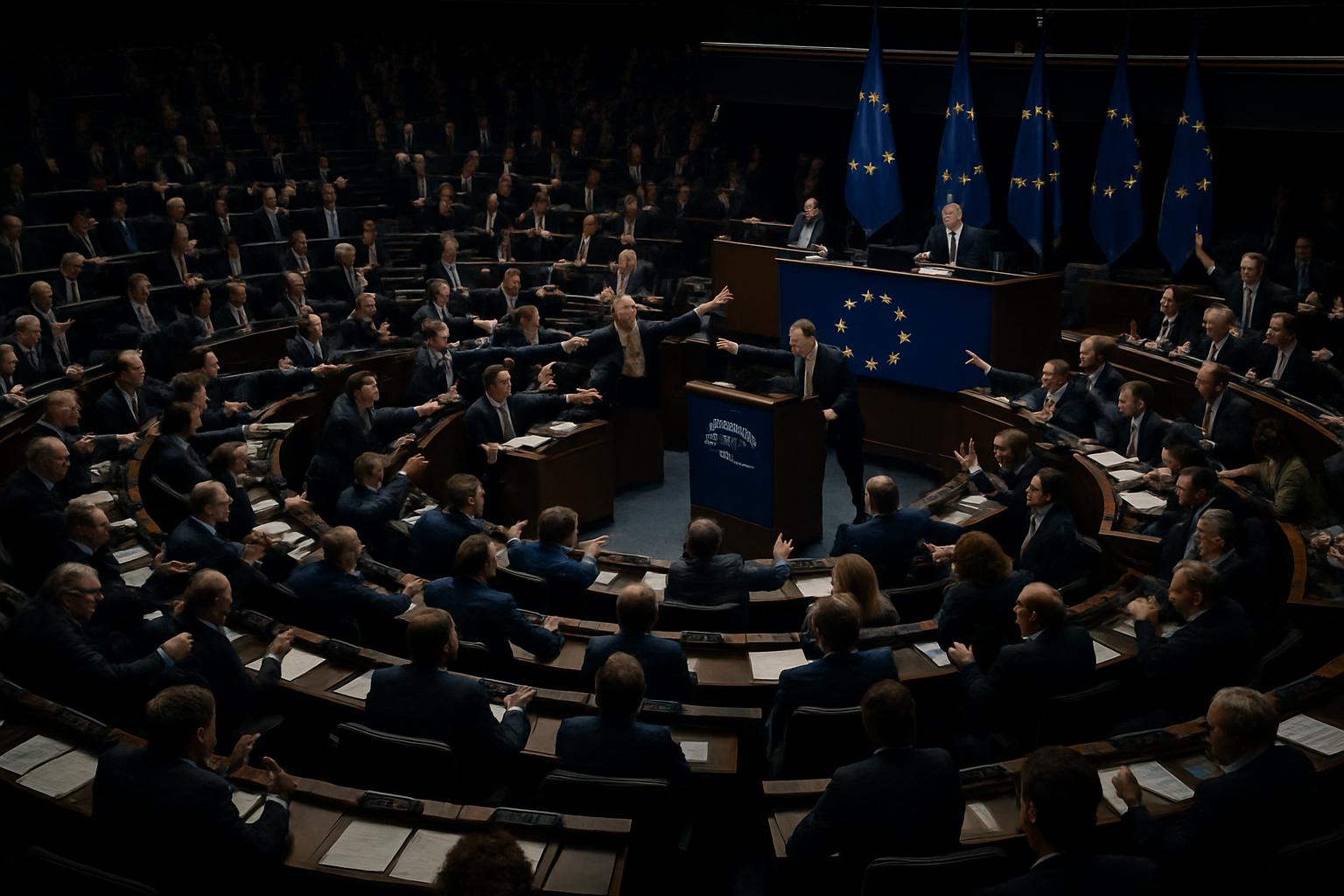
Europe faces its most severe political crisis since World War II as Hungarian Prime Minister Viktor Orban confronts the greatest electoral challenge of his career, while coalition governments fracture across the continent amid rising far-right influence and unprecedented foreign interference in democratic processes.
With just days remaining before Hungary's critical April 12, 2026 parliamentary elections, Orban's ruling Fidesz party finds itself trailing in polls for the first time since 2010, creating genuine uncertainty about the future of one of Europe's most controversial leaders. The electoral upheaval comes as multiple European nations grapple with coalition instability, energy crises, and what observers describe as the most challenging period for continental democracy since the Second World War.
Hungary's Democratic Crossroads
Opposition leader Péter Magyar's Tisza Party has organized what observers call the "Greatest National March" in Budapest, drawing an estimated 500,000 participants in the largest anti-government demonstration since 2010. The march, symbolically timed on Hungary's national holiday commemorating the 1848 revolution, signals a dramatic shift in Hungarian political dynamics.
"In 1848 and 1956, our revolutions continued in blood. The Russians came, but they could never defeat us. Orbán cannot do this either, who in his final desperation has called upon the KGB tsar," Magyar declared to the massive crowd, directly referencing allegations of foreign interference in Hungary's electoral process.
The opposition has consolidated behind Magyar's pro-European platform, which promises wealth taxes, euro adoption, and stronger EU and NATO ties—a stark contrast to Orban's nationalist sovereignty approach that has defined Hungarian politics for over a decade.
Unprecedented Foreign Interference
Investigative journalist Szabolcs Panyi, through VSquare reporting, has revealed concrete evidence of Russian interference teams operating in Budapest to support Fidesz. This represents the first documented case of Kremlin operatives actively participating in European electoral campaigns, raising unprecedented concerns about democratic sovereignty.
Simultaneously, the Trump administration has provided explicit political backing to Orban through presidential endorsements and high-profile diplomatic visits. US Vice President JD Vance's recent two-day Budapest visit, just five days before the election, saw him condemn EU "bureaucrats in Brussels" for "shameless election interference" while declaring Orban a "model for Europe."
Ukrainian Foreign Ministry spokesperson Heorhii Tykhyi characterized recent pipeline sabotage allegations as "most likely Russian operation under false flag as part of Moscow's large-scale interference in Hungary's elections," highlighting the international dimensions of the domestic political contest.
Continental Coalition Collapse
Germany's coalition government faces its most severe crisis since the Merkel era, with consecutive devastating electoral defeats for the Social Democratic Party (SPD) in Rhineland-Palatinate, ending 35 years of rule, and Baden-Württemberg, where the party recorded its worst-ever state result. The Free Democratic Party (FDP) has announced complete collapse, with party chair Christian Dürr and the entire federal executive board resigning following failures to clear the 5% electoral threshold.
The instability has inadvertently strengthened extremist forces, with the Alternative for Deutschland (AfD) achieving historic breakthroughs in western German regions, nearly doubling support to 18% in traditionally stable Baden-Württemberg.
Sweden has witnessed perhaps the most dramatic political realignment in Nordic history, with the Liberal Party abandoning decades of opposition to Sweden Democrats cooperation, signing a 15-point "Sverigelöftet" (Sweden Promise) agreement that allows the far-right party with white nationalist roots into formal government for the first time.
Energy Weaponization and EU Crisis
Hungary continues to block the EU's historic €90 billion Ukraine aid package over the Druzhba oil pipeline dispute, creating the deepest institutional crisis since the EU's formation. The pipeline has been offline since January 27, 2026, with Hungary claiming Ukraine deliberately halted Russian oil transit as "political blackmail," while Ukraine maintains the pipeline was damaged in Russian drone attacks.
Lithuanian Foreign Minister Kestutis Budrys warned that the "EU cannot become Budapest's hostage," as enhanced cooperation discussions accelerate to bypass unanimity requirements—a fundamental departure from consensus decision-making that could permanently alter European institutional structures.
The crisis has exposed critical vulnerabilities in European energy architecture, with Hungary and Slovakia remaining the only EU countries still dependent on Russian oil under special exemptions. Natural gas prices have surged 24% across Europe, reaching €47.32/MWh, the highest levels since February 2025.
Democratic Resilience Under Pressure
Despite unprecedented challenges, European institutions have demonstrated fundamental resilience through maintaining credible elections, constitutional governance, and peaceful transitions. High voter turnout in recent elections across multiple countries, smooth electoral operations, and continued international cooperation suggest democratic norms retain strength under pressure.
However, traditional mechanisms such as parliamentary coalitions, media scrutiny, and civil society opposition are proving insufficient to contain movements that have adapted their messaging for mainstream consumption while maintaining radical agendas. The "authoritarian innovation" pattern—sophisticated far-right movements operating within democratic systems while gradually eroding liberal norms—has emerged as perhaps the most serious threat to European democracy since the 1930s.
Regional Implications and Global Stakes
Latvia's political observers express concerns about democratic backsliding among neighboring EU members, with Latvian officials closely monitoring Hungarian developments. Slovakia faces its own pressures, with cross-border political influence evident as polling shows Smer supporters favoring Orban while Progressive Slovakia voters support Magyar.
The European Commission has frozen approximately €19 billion in Hungarian funding over rule of law concerns, representing one of the largest financial penalties ever imposed on an EU member state. Intelligence restrictions have been imposed following allegations that Hungarian Foreign Minister Péter Szijjártó leaked EU Council details to Russian Foreign Minister Sergei Lavrov.
Austria's political landscape reflects broader continental trends, with the far-right FPÖ gaining strength through its "Phoenix Plan" promising restoration of an "Island of the Blessed," while coalition harmony fractures under policy disagreements and what observers describe as rebellious actors exposing structural governmental weaknesses.
The April 12 Watershed Moment
The Hungarian elections represent what observers characterize as a template-setting moment for 21st-century democracy under foreign interference and institutional pressure. An opposition victory would likely restore Hungary's EU alignment, lift the aid blockade, and remove Brussels' most persistent critic. Conversely, an Orban victory achieved with foreign backing could embolden similar interference operations continent-wide and accelerate enhanced cooperation implementation, fundamentally altering European structures.
As one senior EU official noted, Europe is "writing the template for 21st-century crisis management, with the world watching whether democratic institutions can adapt while preserving European values." The stakes encompass not only Hungarian domestic politics but the broader credibility of democratic governance under authoritarian pressure, European security architecture, and international law enforcement in an era of great power competition.
With 89% of Europeans demanding greater EU unity according to recent Eurobarometer polling, yet political reality showing increasing fragmentation, the coming weeks will be decisive not just for individual nations but for the future trajectory of the European project itself. Success in channeling political tensions through electoral competition while preserving institutional integrity would strengthen the European democratic model globally, while failure could accelerate fragmentation and undermine the foundational cooperation principles that have underpinned European success since 1945.