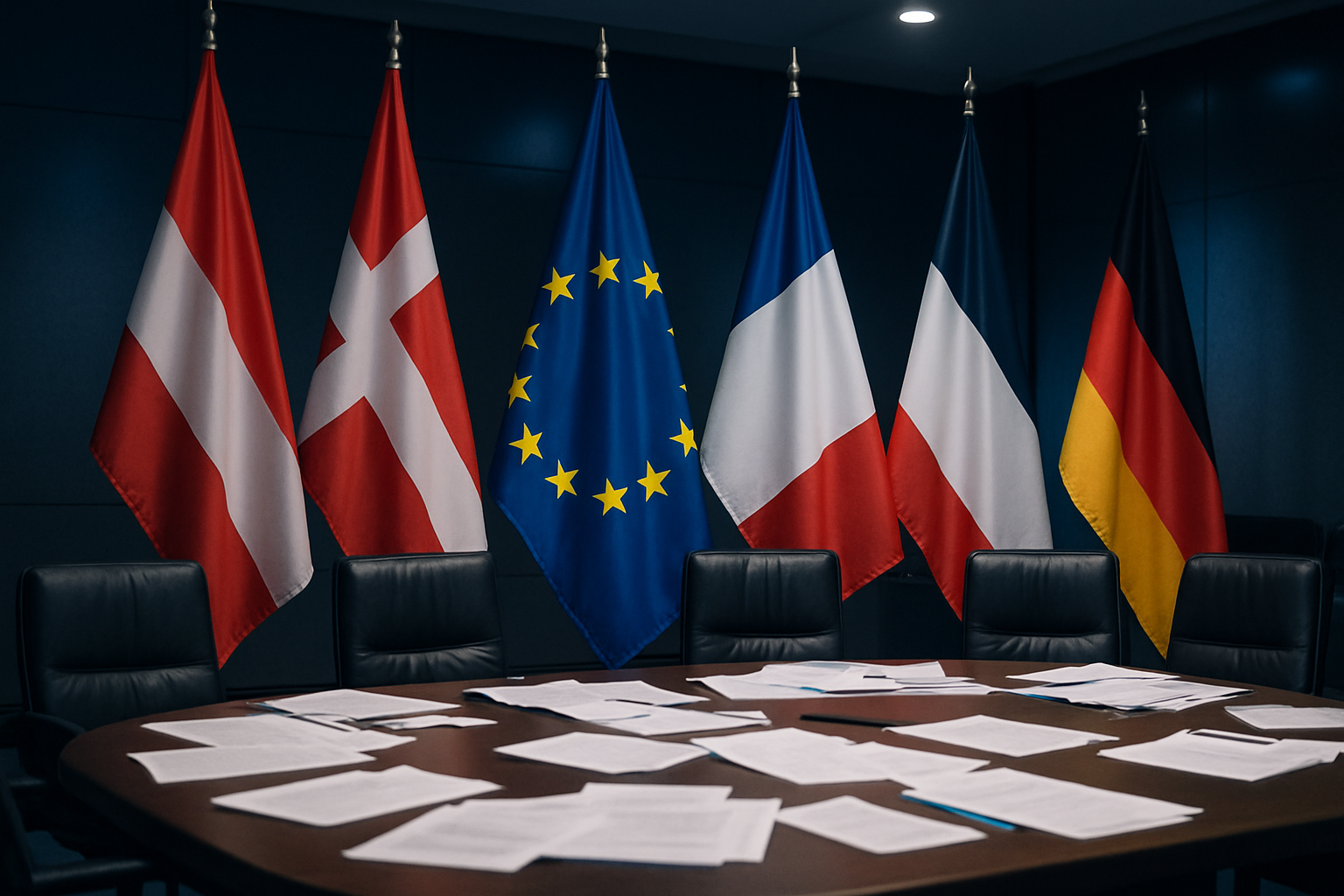
Europe finds itself navigating the most severe political crisis since World War II, as democratic institutions across the continent buckle under unprecedented strain from rising extremism, foreign interference, and internal fragmentation that threatens the very foundations of European unity.
The current crisis encompasses multiple simultaneous challenges across member states, with Austria grappling with stability pact negotiations, France conducting crisis-laden municipal elections, Slovenia's contested parliamentary results marred by foreign interference allegations, and Denmark preparing for snap elections amid sovereignty tensions. This convergence of political upheaval marks a critical inflection point for European democracy.
Austria: Coalition Tensions and Stability Debates
Austria's political landscape reflects the broader European struggle between pragmatic governance and ideological positions. The Social Democratic Party (SPÖ) under Andreas Babler has emerged from internal leadership consolidation with an 81.51% mandate, positioning itself as a credible federal government alternative while the far-right Freedom Party (FPÖ) under Herbert Kickl intensifies its rhetoric.
Christian Deutsch of the SPÖ emphasized the importance of Austria's stability pact, stating it "creates clear rules and secures future room for maneuver." This approach contrasts sharply with the FPÖ's increasingly aggressive positioning, which includes unprecedented personal attacks and the unveiling of a "Phoenix Plan" promising restoration of an "Island of the Blessed."
"The Austrian stability pact creates clear rules and secures future room for maneuver in an uncertain political climate."
— Christian Deutsch, SPÖ
The Austrian situation exemplifies the broader European challenge of maintaining institutional stability while addressing populist pressures that have been building across the continent since the multiple crises of recent years.
France: Municipal Elections Amid Political Violence
France's municipal elections have been overshadowed by the February death of 23-year-old far-right activist Quentin Deranque in Lyon, marking a dangerous escalation in political violence. The Socialist Party declared a "definitive break" with La France Insoumise (LFI) following the incident, with party leaders stating they "cannot fight for democracy with friends of tyrants in our ranks."
The Interior Ministry's controversial reclassification of LFI from "left" to "extreme left" for electoral purposes has triggered Council of State challenges, raising serious concerns about administrative neutrality in democratic processes. This bureaucratic manipulation comes as Marine Le Pen's National Rally pursues what analysts term "authoritarian innovation" – a sophisticated evolution from rural populism to competitive urban campaigning.
The elections serve as a critical preview for the 2027 presidential race, with Emmanuel Macron constitutionally barred from seeking a third term. The fragmentation of traditional alliances and the normalization of political violence represent existential challenges to French democratic traditions.
Slovenia: Foreign Interference Allegations Rock Elections
Slovenia's March 22 parliamentary elections were conducted under the shadow of explosive allegations involving Israeli private security firm interference favoring conservative candidate Janez Janša. Despite these unprecedented foreign meddling claims, Prime Minister Robert Golob's Freedom Movement secured a narrow victory with 29.9% versus Janša's SDS with 27.5% – the tightest margin in the country's democratic history.
The election represented a stark choice between Golob's pro-European Union liberal agenda and Janša's nationalist conservative platform, which critics compared to Viktor Orbán's Hungarian model. International observers provided unprecedented oversight amid what intelligence sources describe as increasingly sophisticated operations targeting electoral processes across Europe.
Slovenia's strategic Alpine location between Austria and the Balkans makes political stability crucial for regional security and EU enlargement processes. The successful conduct of credible elections despite external pressures provides a template for democratic resilience, though the narrow margin ensures continued political tension requiring careful coalition management.
Denmark: Sovereignty Crisis and Electoral Gambit
Denmark faces a unique challenge as Prime Minister Mette Frederiksen called snap elections for March 24, betting that her firm stance against territorial ambitions for Greenland will secure a third term. The "Greenland effect" has provided a nationalist sentiment boost, with voters viewing external territorial claims as sovereignty attacks.
The Danish case represents a critical test of how small democratic states can resist major power pressure in the 21st century. International solidarity has been demonstrated through coordinated diplomatic support, with France and Canada opening consulates in Greenland's capital Nuuk, and NATO launching the Arctic Sentry mission as a European-led initiative.
"Greenland is neither for sale nor for purchase – this position has strengthened our democratic mandate."
— Mette Frederiksen, Danish Prime Minister
Opinion polls suggest the Social Democrats may achieve their weakest result since World War II despite international crisis management success, as domestic concerns about cost-of-living and housing costs dominate voter priorities.
Broader European Democratic Crisis
These national crises occur within the context of what observers term the "most challenging period for continental democracy since World War II." Sweden's Liberal Party has abandoned decades of opposition to cooperation with the far-right Sweden Democrats, signing a 15-point "Sweden Promise" that breaks the Nordic political consensus of marginalizing extremist movements.
Germany's Baden-Württemberg saw the far-right Alternative for Germany (AfD) nearly double to 18% in a traditionally stable state, while Spain's Vox party surged 55% in Aragón. This reflects the "authoritarian innovation" pattern where sophisticated far-right movements operate within democratic systems while gradually eroding liberal norms.
The crisis extends beyond individual nations to European Union institutional capacity. Despite Eurobarometer polling showing 89% of Europeans demanding greater EU unity, political reality demonstrates increasing fragmentation with sovereignty assertions and institutional friction creating a dangerous disconnect between public aspirations and political capacity.
Foreign Interference and Information Warfare
Intelligence sources report increasingly sophisticated foreign interference operations targeting electoral processes, political parties, and media environments. These operations exploit domestic divisions and amplify polarization rather than creating artificial conflicts, proving particularly effective during electoral periods with heightened political tensions.
The Slovenia case represents the most explicit allegations of direct electoral interference, but similar concerns have been raised across multiple European democracies. Traditional mechanisms of parliamentary coalitions, media scrutiny, and civil society opposition are proving insufficient to contain movements that have adapted their messaging for mainstream consumption while maintaining radical agendas.
Economic Pressures and Social Tensions
The political crisis unfolds against a backdrop of significant economic challenges, including energy security concerns, inflation pressures, and the ongoing transition to renewable energy systems. Austria's renewable energy political debates, where parties oppose wind power development while complaining about high electricity prices, exemplify the "transition valley of death" political paradox facing European democracies.
These economic pressures intersect with social tensions around immigration, national identity, and European integration, creating a volatile political environment that extremist movements exploit effectively. Traditional center-left and center-right parties struggle to articulate compelling visions addressing voter concerns about economic security, cultural change, and democratic representation.
Implications for European Integration
The convergence of multiple simultaneous political crises tests European integration mechanisms designed for isolated challenges rather than widespread institutional instability. Brussels acknowledges that EU democracy support mechanisms are inadequate for addressing multiple simultaneous member state institutional challenges.
The success or failure of democratic adaptation in these key countries will influence European integration for decades. Hungary's Viktor Orbán has already demonstrated how systematic undermining of rule of law, press freedom, and judicial independence can occur while maintaining democratic facades. The normalization of similar approaches in historically stable democracies like Sweden and France could accelerate continental democratic backsliding.
Democratic Resilience and Institutional Adaptation
Despite unprecedented challenges, European democratic institutions have shown fundamental resilience in conducting credible elections and maintaining constitutional governance. Slovenia's successful election conduct despite foreign interference allegations, France's ability to channel political tensions through electoral processes rather than extra-legal means, and Denmark's constitutional response to sovereignty challenges demonstrate institutional strength.
The critical test remains whether European democracies can address the underlying concerns fueling political extremism – economic inequality, immigration pressures, sovereignty questions – while maintaining the institutional frameworks that have underpinned European success since 1945.
Looking Ahead: Critical Decisions
The coming months will be decisive for European democracy. French municipal second-round results on March 22, Danish snap elections on March 24, and ongoing coalition negotiations in Slovenia will establish templates for democratic governance under pressure. These outcomes carry implications extending far beyond local governance to Europe's role as a global democratic leader.
The stakes could not be higher. Success in managing political extremism, foreign interference, and institutional strain could strengthen European integration through demonstrated resilience. Failure risks accelerating fragmentation trends that threaten the foundational principles of European cooperation.
As one senior EU official noted, Europe is "writing the template for 21st-century crisis management" that will determine the continent's trajectory for decades ahead. The current period represents both the greatest challenge and the most significant opportunity for European democratic innovation since the post-war reconstruction.
The ultimate question remains whether European democratic institutions can adapt to 21st-century pressures while preserving the fundamental values and institutional frameworks that have made European integration one of history's most successful peace and prosperity projects. The answer will shape not only Europe's future but global democratic development for generations to come.