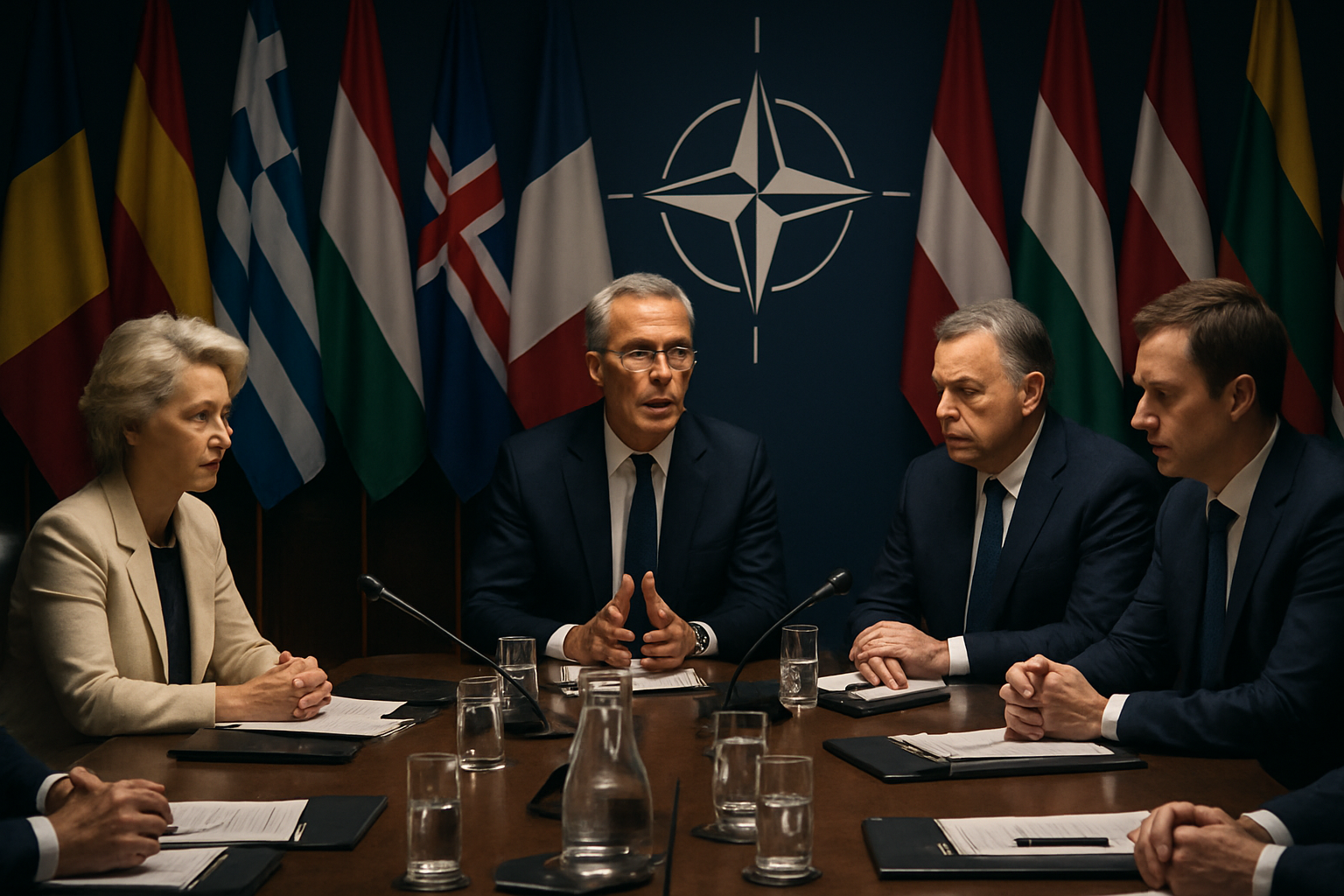
European leaders are grappling with rising security tensions and unprecedented challenges to NATO unity as disagreements over defense policies and alliance obligations reach their most serious point since the organization's founding in 1949.
The crisis has deepened following a series of confrontational exchanges between the Trump administration and European allies over burden-sharing, military support, and strategic autonomy. Estonian politicians remain divided over Trump's recent statements about potentially withdrawing from NATO, with some viewing them as serious signals while others dismiss them as negotiating tactics.
Trump's NATO Withdrawal Threats Escalate
President Trump has intensified his criticism of the alliance, calling NATO a "paper tiger" and declaring he is "seriously considering" U.S. withdrawal after European allies rejected American requests for military support in the Middle East. The unprecedented public rebuke has exposed what security analysts describe as the deepest alliance fractures since World War II.
According to Estonian security researcher Marek Kohv from the International Center for Defense and Security, while Trump cannot unilaterally withdraw from NATO, the White House retains sufficient means to "paralyze the alliance's activities and reduce the U.S. military presence in Europe." This assessment has prompted European leaders to accelerate discussions about strategic autonomy and independent defense capabilities.
European Strategic Response
Lithuanian President Gitanas Nausėda acknowledged that "tensions within the Alliance have been rising recently," while expressing continued trust in NATO's collective defense framework. His comments reflect the delicate balance European leaders must maintain between expressing loyalty to the alliance and addressing legitimate security concerns.
Polish Prime Minister Donald Tusk has been particularly vocal, criticizing recent geopolitical developments as Russian President Vladimir Putin's "dream plan." Tusk's warnings about NATO breaking up have resonated across European capitals, where officials worry about the alliance's future stability under continued American pressure.
"NATO breaking up is Putin's dream plan. We cannot allow internal divisions to weaken our collective defense when external threats continue to grow."
— Donald Tusk, Polish Prime Minister
Congressional and International Reactions
Despite Trump's threats, bipartisan support for NATO membership remains strong in the U.S. Senate. Senators from both Democratic and Republican parties have issued statements supporting continued American participation in the alliance, providing some reassurance to European partners concerned about long-term U.S. commitment.
The transatlantic relationship has deteriorated to what Swedish analysts describe as "a new bottennivå" (bottom level) following Trump's Middle East policies and confrontational approach with European leaders. Rather than offering concessions, European leaders have increasingly chosen to resist American pressure on issues they view as matters of principle.
Defense Burden-Sharing Evolution
The alliance achieved a historic milestone in 2024 when all 32 member nations reached the 2% GDP defense spending target for the first time in NATO's 75-year history. However, Trump has proposed raising this target to 5% GDP, which would require massive fiscal adjustments from European allies and fundamentally alter alliance dynamics.
European nations have responded by launching independent initiatives like NATO's Arctic Sentry mission, where the UK is doubling its troop presence in Norway to 2,000 personnel, while Sweden deploys Gripen jets for Greenland exercises. These European-led operations demonstrate burden-sharing evolution while maintaining alliance frameworks.
Nuclear Deterrence Discussions
Perhaps most significantly, European capitals have begun their first serious nuclear deterrence discussions since the Cold War's end. German Chancellor Friedrich Merz has confirmed direct negotiations with French President Emmanuel Macron about expanding France's nuclear deterrent beyond national scope, with Germany, Poland, and Finland engaging in preliminary conversations about extended deterrence arrangements.
This nuclear renaissance reflects deep concerns about U.S. security guarantee reliability, particularly following the expiration of the New START Treaty in February 2026, which eliminated nuclear constraints between superpowers for the first time in over 50 years.
Regional Security Challenges
The security discussions occur against a backdrop of multiple regional challenges, including the ongoing conflict in Ukraine, increased Russian Arctic military activity, and tensions over Greenland's sovereignty. European allies have demonstrated their capability for independent action through coordinated responses to these challenges while maintaining alliance coordination.
France and Canada's decision to open consulates in Nuuk, Greenland, represents a coordinated diplomatic response supporting Danish sovereignty against external pressure. Similarly, the unprecedented naval coalition response to Iranian attacks on European territory in Cyprus demonstrated European unity in defending member nation territories.
Economic and Political Implications
The alliance tensions have economic implications as well, with potential trade disruptions affecting defense industrial cooperation and technology sharing agreements. European nations are accelerating defense industrial independence initiatives, with Germany emerging as the world's fourth-largest weapons exporter as part of broader strategic autonomy efforts.
The European Union has activated enhanced cooperation mechanisms to advance policies without unanimous consent, allowing groups of member states to move forward on defense initiatives even when some nations refuse participation, as seen with the historic €90 billion Ukraine support package.
Future Trajectory
Security experts describe the current period as a "template-setting moment" for 21st-century alliance relationships. The success or failure of institutional adaptation will determine whether NATO can accommodate fundamental restructuring while maintaining democratic principles and unity, or whether the alliance faces its most serious existential crisis since the 1956 Suez Crisis.
UN Secretary-General António Guterres has characterized the situation as the "greatest test of multilateral cooperation in the modern era," with implications extending far beyond immediate alliance concerns to fundamental questions about international order and conflict resolution in an increasingly multipolar world.
As European leaders continue to navigate these unprecedented challenges, their choices between strategic autonomy and alliance solidarity will shape not only the future of NATO but the broader architecture of Western security cooperation for decades to come.