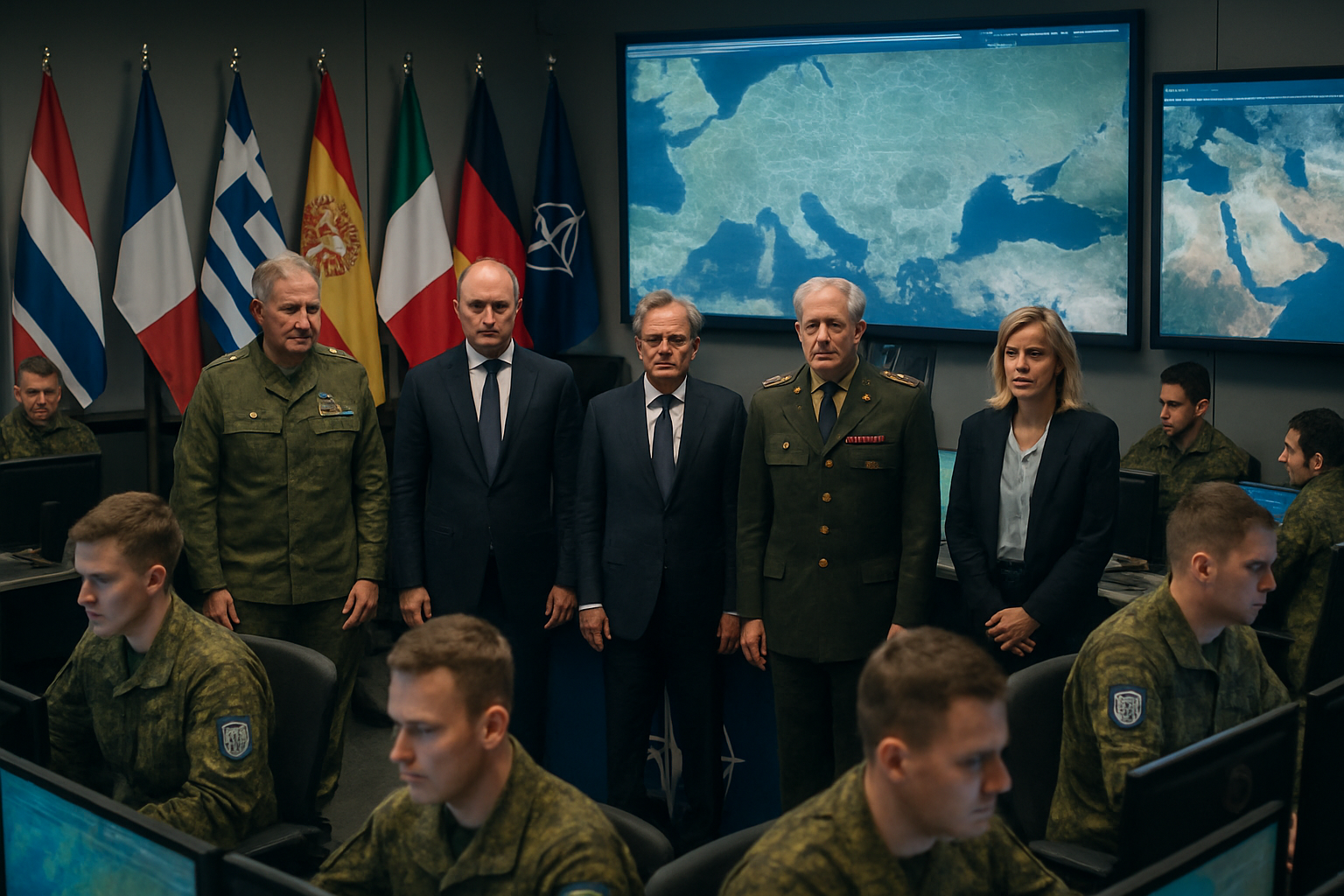
European nations have launched their most comprehensive coordinated military response since the Cold War, deploying forces to Cyprus following Iranian attacks on British territory while simultaneously advancing historic discussions on expanded nuclear deterrence cooperation that could fundamentally reshape continental security.
The multi-faceted European response demonstrates an unprecedented level of defense coordination, with France, Britain, Greece, Spain, and Italy moving beyond traditional NATO frameworks to establish new templates for continental security in an increasingly volatile global environment.
Immediate Military Response to Middle East Crisis
The catalyst for this historic European mobilization came with Iranian drone attacks on British sovereign bases in Cyprus - the first strikes on European territory during the current Middle East conflict. The coordinated response has been swift and comprehensive.
President Emmanuel Macron personally ordered the deployment of anti-missile systems, anti-drone technology, and naval frigates to Cyprus, working directly with Cypriot President Nikos Christodoulides. This French commitment represents the most significant Eastern Mediterranean deployment since the 1974 Turkish invasion.
Greece deployed four F-16 fighter jets plus two naval frigates - the most substantial Greek military support for Cyprus since 1974. British Prime Minister Keir Starmer announced the deployment of HMS Dragon Type 45 destroyer equipped with Sea Viper missiles, plus two AW159 Wildcat helicopters with counter-drone capabilities to protect 3,000 UK personnel at RAF Akrotiri and Dhekelia bases.
The coordinated response creates a comprehensive defensive umbrella combining French anti-missile technology, Greek F-16 interceptors, and British Sea Viper systems. This represents the first time European forces have deployed to defend against Middle Eastern attacks on sovereign territory since World War II.
Expanding Nuclear Deterrence Cooperation
Beyond the immediate military response, European leaders are advancing unprecedented discussions on nuclear deterrence cooperation. France has invited multiple European nations, including Romania, to participate in discussions about nuclear umbrella protection and hosting elements of a "nuclear shield."
Romanian Foreign Minister Oana Țoiu confirmed that France has extended invitations for nuclear protection discussions, with decisions to be made by Romania's Supreme Defense Council. This represents an expansion of French President Macron's "forward deterrence" strategy beyond the initial eight-country framework.
German Chancellor Friedrich Merz has confirmed direct negotiations with Macron about nuclear cooperation - the first serious such discussions since the Cold War ended. Sweden's willingness to host nuclear weapons during wartime marks a dramatic departure from its historically nuclear-free policy.
The nuclear cooperation discussions gain urgency from the February 5, 2026 expiration of the New START Treaty - the first time in over 50 years without US-Russia nuclear constraints. UN Secretary-General António Guterres has warned that nuclear risks are at their "highest in decades."
Intelligence and Security Coordination
The security response extends beyond military deployment to unprecedented intelligence cooperation. MI6 Chief Blaise Metreweli - the first woman to lead British foreign intelligence - is meeting with Cypriot President Christodoulides as Cyprus intensifies high-level security consultations.
Belgian security officials, including former OCAD head Paul Van Tigchelt, have raised concerns about increased terrorist attack risks in Western Europe as a result of the Middle East war, highlighting the interconnected nature of regional conflicts.
The Netherlands has shown openness to French nuclear cooperation discussions, with coalition parties expressing willingness to participate in talks about nuclear deterrence arrangements. Norwegian Conservative Party leader Ine Eriksen Søreide has similarly indicated support for nuclear cooperation, emphasizing the need to "think differently about deterrence."
Strategic Context and Historical Significance
These developments occur against the backdrop of the most serious challenges to European security since World War II. The February 2026 Munich Security Conference declared the "post-war order no longer exists," emphasizing the need for European strategic autonomy.
The coordination represents a template for European alliance responses to extra-regional threats, establishing precedents for how European forces can defend continental territory from attacks originating outside Europe. The success of this coordinated approach will influence future defense planning and continental security architecture.
"Europe must become a geopolitical power providing its own security while maintaining alliance relationships."
— Emmanuel Macron, French President
The German Bundestag's recent approval of a friendship treaty with Britain further strengthens bilateral cooperation frameworks that support these broader European defense initiatives.
Nuclear Deterrence Revolution
The nuclear discussions represent the most significant shift in European nuclear strategy since France developed its independent deterrent in the 1960s. The current French nuclear force of approximately 290 warheads would require substantial expansion and doctrinal modifications to provide extended deterrence for multiple European nations.
President Macron announced that France will expand its nuclear arsenal for the first time in decades and establish "forward deterrence" allowing temporary deployment of French nuclear-armed aircraft to allied European territories. This revolutionary approach maintains French sole decision-making while extending deterrence benefits to European allies.
Eight European countries have agreed to participate in joint nuclear deterrence exercises: Germany, Britain, Poland, Netherlands, Belgium, Greece, Sweden, and Denmark. The framework is designed to be "distinct but complementary to NATO," avoiding competing authorities while providing additional deterrence options.
Geopolitical Implications
The European response occurs as traditional alliance structures face unprecedented strain. Spain's recent refusal to allow US military base access for Iran operations, resulting in threats of trade cutoffs from President Trump, demonstrates the complex dynamics European nations must navigate.
Romania's President emphasized that Romania is already protected by NATO's "nuclear umbrella" when asked about French nuclear protection offers, illustrating the delicate balance between existing alliance commitments and new European initiatives.
The coordinated European response to the Cyprus crisis establishes a critical precedent: attacks on one European territory generate unified response from multiple nations, even outside formal alliance frameworks. This represents a fundamental shift in how European security threats are addressed.
Implementation Challenges
The nuclear cooperation initiatives face substantial technical, legal, and political obstacles. Implementation requires new legal frameworks, parliamentary approvals across participating nations, hundreds of billions of euros in investment, and complex coordination mechanisms.
European Parliament and national legislative authorization will be needed for any formal nuclear arrangements. Full operational capability would require years of development, with officials acknowledging that even preliminary frameworks could take years to establish.
The immediate military response to the Cyprus crisis, however, demonstrates that European nations can coordinate rapidly when continental security is threatened, providing a template for future crisis management.
Regional and Global Impact
The European initiatives are being closely watched by other regions facing security challenges. The template of coordinated regional response outside traditional superpower-dependent frameworks could influence security arrangements in other parts of the world.
The success or failure of European strategic autonomy in both its immediate military response and longer-term nuclear cooperation will determine whether European nations can maintain effective deterrence in an increasingly unpredictable global security environment.
These developments represent Europe's determination to assume greater security responsibility in a multipolar world, with implications extending far beyond the continent's borders. The stakes are maximum: success could establish Europe as a credible strategic actor, while failure might fragment Western alliance structures during a critical period of global power competition.
Looking Forward
The March 2026 developments mark a watershed moment in European defense cooperation, establishing precedents that will shape continental security for decades. The combination of immediate crisis response and long-term strategic planning demonstrates European commitment to adapting security frameworks to 21st-century challenges.
As geographic boundaries no longer contain regional conflicts, the European response provides a template for how democratic nations can coordinate defense of territorial integrity while maintaining international law compliance. The success of these initiatives will influence not only European security but global approaches to collective defense and strategic autonomy in an era of great power competition.