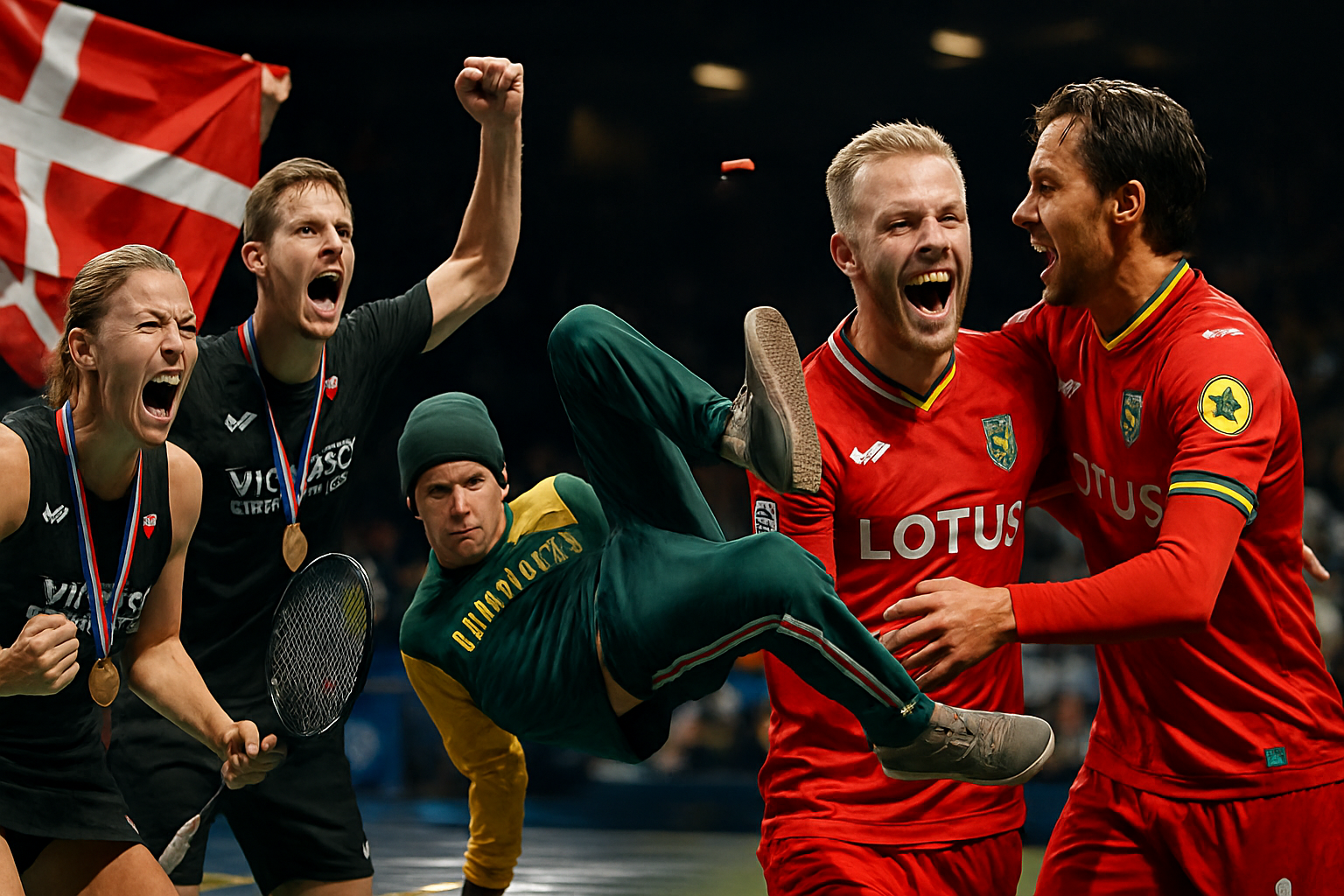
European sports continue their remarkable renaissance as Danish badminton champions and a Lithuanian breakdancing star demonstrate the continent's expanding athletic excellence across traditional and emerging disciplines during April 2026 competitions.
Danish Badminton Breakthrough at European Championships
Rasmus Espersen and Amalie Cecilie Kudsk showcased exceptional resilience at the European Badminton Championships, overcoming significant second-set challenges to secure their advancement in the prestigious continental tournament. The Danish mixed doubles pair demonstrated the tactical awareness and mental fortitude that has characterized Denmark's emergence as a badminton powerhouse on the European stage.
Despite encountering difficulties during the second set against their Estonian opponents, Espersen and Kudsk maintained their composure to deliver a commanding performance that reflected months of systematic preparation. Their victory represents not only individual achievement but also Denmark's broader investment in badminton infrastructure and coaching development programs that have elevated the nation's competitive standing across multiple sporting disciplines.
Lithuania's Historic Breakdancing Victory
Dominika Banevič, competing under the stage name Bgirl Nicka, achieved a breakthrough victory at the "Nanterious Break World Final" in France, marking a significant milestone for Lithuanian representation in the rapidly growing breakdancing scene. Her triumph at this international competition positions Lithuania as an emerging force in urban athletics and demonstrates the global democratization of sporting excellence beyond traditional powerhouses.
The victory comes at a crucial time as breakdancing prepares for its Olympic debut, with Banevič's success providing inspiration for the next generation of Lithuanian athletes exploring alternative sporting pathways. Her achievement reflects the broader trend of smaller European nations achieving international recognition through strategic investment in emerging sports and youth development programs.
Danish Football Excellence in England
The Danish sporting success extended to English football, where Pelle Mattsson continued his impressive scoring streak with his third consecutive goal, while Oscar Schwartau emerged as the decisive figure in Norwich City's crucial 2-1 victory over second-placed Millwall. The away triumph demonstrated the tactical sophistication and individual brilliance that Danish players continue to contribute to English football at the highest competitive levels.
Schwartau's match-winning performance exemplified the technical excellence and mental strength that have become hallmarks of Danish football development. His ability to deliver under pressure in a high-stakes Championship match reinforces Denmark's reputation for producing players capable of thriving in Europe's most competitive leagues.
European Sports Democratization Continues
These achievements occur within the broader context of European sports democratization that has accelerated following the revolutionary Milano-Cortina 2026 Winter Olympics. The successful dual-city hosting model, combined with technological innovations including AI integration and sustainable venue management, has established new paradigms for sporting excellence that transcend traditional geographic and economic boundaries.
The success stories from Denmark and Lithuania demonstrate how systematic investment in coaching education, infrastructure development, and youth programs can enable nations of all sizes to compete at the highest international levels. This trend builds on earlier 2026 achievements including Portugal's first Rugby Europe Championship victory, Croatia's remarkable swimming feats, and Latvia's historic biathlon success.
Technology and Innovation in Modern Athletics
Modern European sports benefit from unprecedented technological integration that enhances both athlete development and competitive analysis. Advanced performance analytics, biomechanical assessment tools, and strategic preparation methods pioneered during major international competitions are now becoming standard across continental sporting programs.
These innovations have created more level playing fields while raising overall performance standards, enabling athletes from diverse backgrounds to compete with traditional powerhouses. The democratization of elite training methodologies through technology transfer and international cooperation has fundamentally transformed the European sporting landscape.
Cultural and Economic Impact
The sporting achievements generate significant cultural moments and economic activity while inspiring future generations across Europe. Denmark's success in both traditional sports like badminton and modern football demonstrates the country's comprehensive approach to athletic development, while Lithuania's breakdancing breakthrough opens new possibilities for urban sports investment and cultural exchange.
These victories contribute to broader European sporting identity that celebrates diversity, innovation, and excellence across multiple disciplines. They reflect the continent's capacity to nurture talent in both established and emerging sports while maintaining competitive standards that challenge global powerhouses.
Strategic Development and International Cooperation
The achievements highlight the effectiveness of strategic sporting development programs that balance international competitiveness with grassroots participation. European nations increasingly demonstrate sophisticated approaches to athlete pathway development, combining traditional coaching methods with modern sports science and performance analysis.
International cooperation frameworks, enhanced by successful major event hosting experiences, enable smaller nations to access elite-level coaching, training facilities, and competitive opportunities previously limited to traditional sporting powers. This collaborative approach has created unprecedented opportunities for athletic achievement across the continent.
Future Implications for European Sports
As European sports enter an era of unprecedented global competitiveness, the continued success of diverse nations across multiple disciplines suggests a fundamental shift in international athletics. Traditional hierarchies face ongoing challenges from systematically developed programs that prioritize sustainable excellence over short-term results.
The template established by Danish and Lithuanian achievements provides practical frameworks for other European nations seeking to enhance their international sporting capabilities. Success depends on sustained political commitment, strategic resource allocation, and continued embrace of technological innovation while maintaining cultural authenticity and community engagement.
Looking ahead, European sports are positioned to maintain their leadership in global athletic innovation while demonstrating that sporting excellence transcends traditional boundaries through dedication, preparation, and strategic development. The April 2026 achievements represent another chapter in Europe's ongoing sporting renaissance that continues to inspire athletes and nations worldwide.