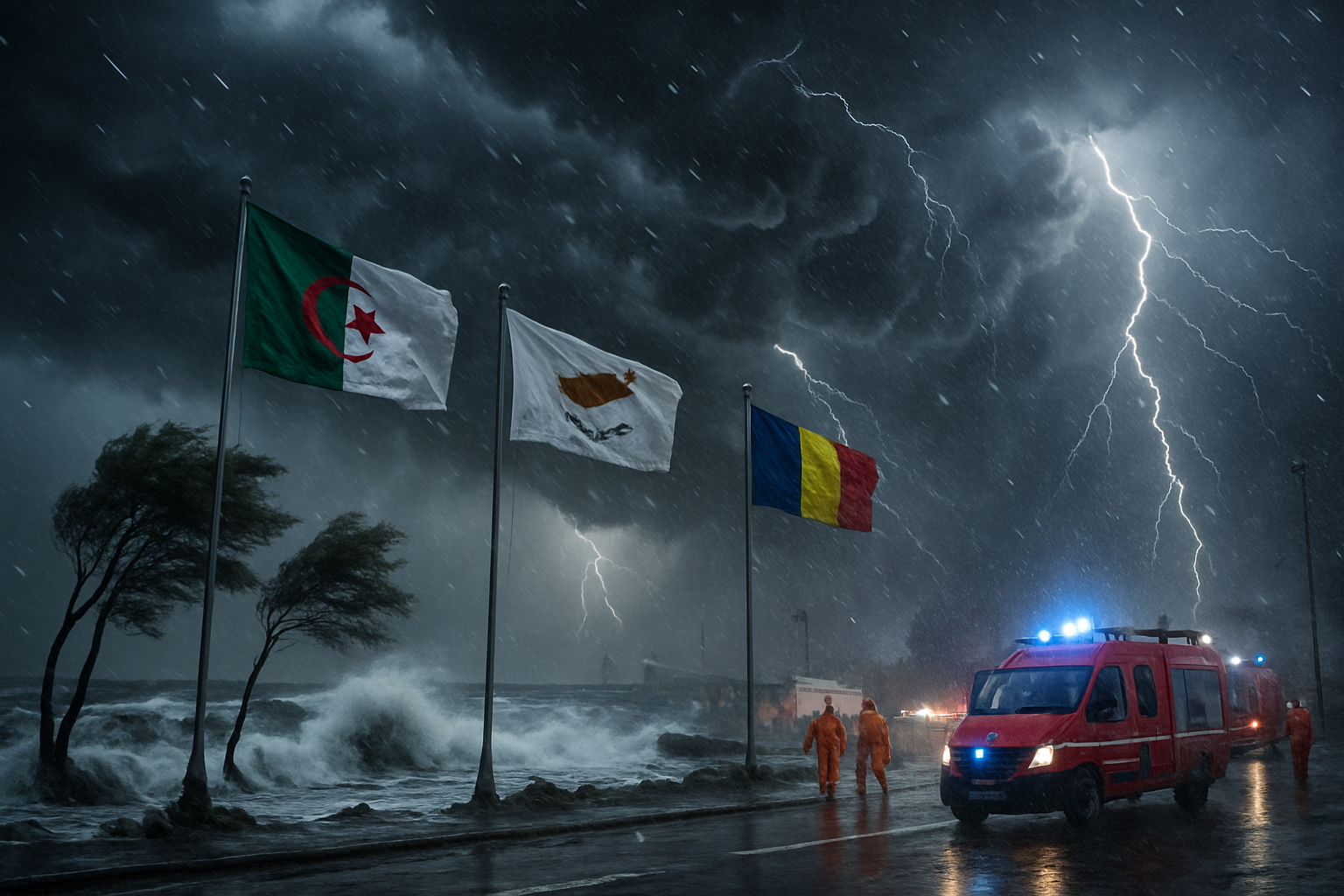
Multiple dangerous storm systems are converging across European regions this week, bringing a deadly combination of hurricane-force winds, heavy rainfall, and significant snowfall that threatens millions of residents and strains emergency services to their limits.
Algeria's meteorological services issued urgent warnings Monday for extremely powerful winds exceeding 90-100 km/h across multiple provinces, including El Djelfa, M'Sila, Ouled Djellal, El Meghaier, and Touggourt. The dangerous winds are expected to persist until 6 PM Monday, with authorities warning of dust storms that pose serious respiratory hazards to vulnerable populations.
In a separate alert, Algeria's National Meteorological Office warned of additional severe weather affecting Biskra, Batna, Khenchela, and Tebessa provinces, where wind speeds are forecast to exceed 90 km/h through Tuesday at noon. The warnings come as the region faces a triple threat of severe weather conditions that meteorologists describe as exceptionally dangerous.
Heavy Snowfall Hits Mediterranean and Mountain Regions
Algeria's eastern and central mountain regions are experiencing intense snowfall affecting 15 provinces, including Skikda, Jijel, Bejaia, Tizi Ouzou, Bouira, Bordj Bou Arreridj, Setif, and Batna. The snow accumulation is creating hazardous travel conditions and threatening power infrastructure across the mountainous terrain.
The meteorological services report that snow depths are reaching significant levels in areas above 1,100 meters elevation, with some regions recording accumulations of 15-20 centimeters within hours. The combination of heavy snow and powerful winds is creating blizzard-like conditions that have forced the closure of several mountain passes.
Cyprus Faces Unprecedented Storm Damage
Cyprus experienced severe weather Sunday that left widespread destruction across the Larnaca and free Famagusta districts. Emergency services received dozens of calls for fallen trees and collapsed solar water heaters as winds swept through the island nation with unprecedented intensity.
The Cyprus Fire Service reported that trees fell onto two vehicles in Larnaca city, while roads were completely blocked in Ormideia, Xylofagou, Ayia Napa, and Paralimni. The Electricity Authority of Cyprus (EAC) confirmed extensive damage to power cables, causing outages across multiple communities.
Local authorities report significant damage to agricultural areas, with the famous "Big Potato" landmark flattened by the storms. Beaches along the eastern coast suffered severe erosion, and crop damage is expected to reach millions of euros as the island's agricultural sector assesses the full extent of the destruction.
Romania Prepares for Extended Weather Pattern
Romania's National Meteorological Administration (ANM) issued comprehensive forecasts for the next two weeks, valid from March 16-29, warning of continued atmospheric instability across the country. Meteorologists predict temperatures will remain near seasonal norms, with maximum values between 8-17°C, while nighttime temperatures are expected to rise gradually.
The forecast indicates heightened precipitation probability on March 18, 22, and 25, suggesting that Romania's weather pattern will remain unsettled through the remainder of March. Regional meteorological stations are closely monitoring atmospheric conditions as the country prepares for potential flooding and infrastructure challenges.
Historical Context of European Weather Extremes
These current storm systems are occurring against the backdrop of Europe's most challenging weather period in recent history. The continent has endured an unprecedented succession of severe storms throughout early 2026, including the devastating Atlantic storm series Kristin-Leonardo-Marta-Nils-Pedro that claimed more than 35 lives across Portugal, Spain, and France.
The February 2026 crisis required Portugal to deploy 26,500 emergency personnel in the largest peacetime rescue operation in the nation's history, involving 1,975 military personnel and 30 naval vessels. The European Union's Civil Protection Mechanism was activated, with Sweden and Denmark providing €246 million in assistance - the largest coordinated European weather response on record.
Climate scientists note that January 2026 marked the 20th consecutive month that global temperatures exceeded 1.5°C above pre-industrial levels, the longest sustained warming period in recorded human history. This warming trend is creating atmospheric conditions that enable increasingly severe regional weather events, even as global temperatures rise.
Infrastructure Under Extreme Pressure
The current storm systems are testing infrastructure across multiple countries simultaneously, exposing vulnerabilities in systems designed for historical rather than current climate conditions. Transportation networks, power grids, and communication systems are operating beyond their original design parameters as extreme weather events exceed operational thresholds.
Emergency services across the affected regions report reaching capacity limits, with traditional mutual aid mechanisms strained by the simultaneous nature of these disasters. Unlike historical weather patterns where regions could assist each other during isolated emergencies, the current crisis affects multiple countries concurrently, preventing the usual resource sharing.
In Algeria, emergency crews are working around the clock to restore power to thousands of households affected by wind damage. Cyprus municipal teams continue clearing debris and fallen trees, while Romanian authorities are positioning additional resources in anticipation of flooding risks later this month.
Economic and Social Impact
The economic toll of these ongoing weather emergencies is mounting rapidly across all affected regions. Agricultural sectors face billions in losses from damaged crops and disrupted supply chains, while tourism industries grapple with extended cancellations and infrastructure damage during what should be peak revenue periods.
Mental health services report increased demand as communities cope with repeated extreme weather trauma. Families across the region face the psychological burden of unprecedented environmental volatility, with many losing generational homes and businesses confronting extinction-level threats.
The cumulative impact extends beyond immediate damage, as recovery timelines have shifted from weeks to months or years, representing a fundamental change in disaster response and preparation approaches. Communities are increasingly adopting "build back better" strategies, focusing on climate-resilient infrastructure designed for future rather than historical weather patterns.
International Cooperation and Response
The scale and simultaneity of these weather emergencies have necessitated unprecedented international cooperation. Environmental challenges transcend national boundaries, with atmospheric systems and ocean currents carrying climate effects across continents regardless of political borders.
The European Union's Civil Protection Mechanism has been activated repeatedly throughout 2026, coordinating resources and expertise across member states. However, the traditional bilateral aid frameworks, designed for sequential regional emergencies, prove inadequate when multiple continents face simultaneous disasters.
Emergency management experts emphasize that response strategies must be fundamentally restructured for a "permanent climate volatility era." This requires enhanced emergency response capabilities, climate-resilient infrastructure, and new international cooperation frameworks specifically designed for simultaneous global disasters.
Adaptation Imperatives and Future Preparedness
March 2026 represents a watershed moment in global climate preparedness, forcing a choice between reactive crisis management and proactive climate resilience building. Scientists warn that current conditions provide a preview of routine circumstances expected in the 2030s without comprehensive climate adaptation investment.
The convergence of extreme weather, infrastructure vulnerabilities, and emergency response limitations underscores the urgent need for coordinated international action. European experiences are providing valuable lessons for other regions preparing for similar challenges, demonstrating both the vulnerabilities of systems designed for historical patterns and the potential for innovative adaptation strategies.
Infrastructure systems require fundamental reassessment for a "new normal" characterized by extreme weather volatility, where traditional seasonal patterns are no longer reliable planning frameworks. The window for effective climate action is narrowing rapidly, with adaptation and inaction costs escalating as extreme weather frequency and intensity increase beyond current response capabilities.
Immediate Outlook and Public Safety
Authorities across all affected regions maintain high alert levels and advise residents to avoid unnecessary travel during peak storm conditions. Emergency services recommend securing outdoor objects, maintaining emergency supplies, and monitoring official weather warnings closely.
Additional Atlantic weather systems are developing, suggesting that crisis conditions may persist for several more weeks. This establishes what meteorologists are calling a "new normal" of extreme weather frequency that challenges traditional emergency response frameworks on a permanent basis.
The choices made in the coming months regarding emergency response approaches and climate adaptation strategies will be decisive for Europe's ability to maintain prosperity and security while providing global templates for climate adaptation strategies that will affect generations to come.