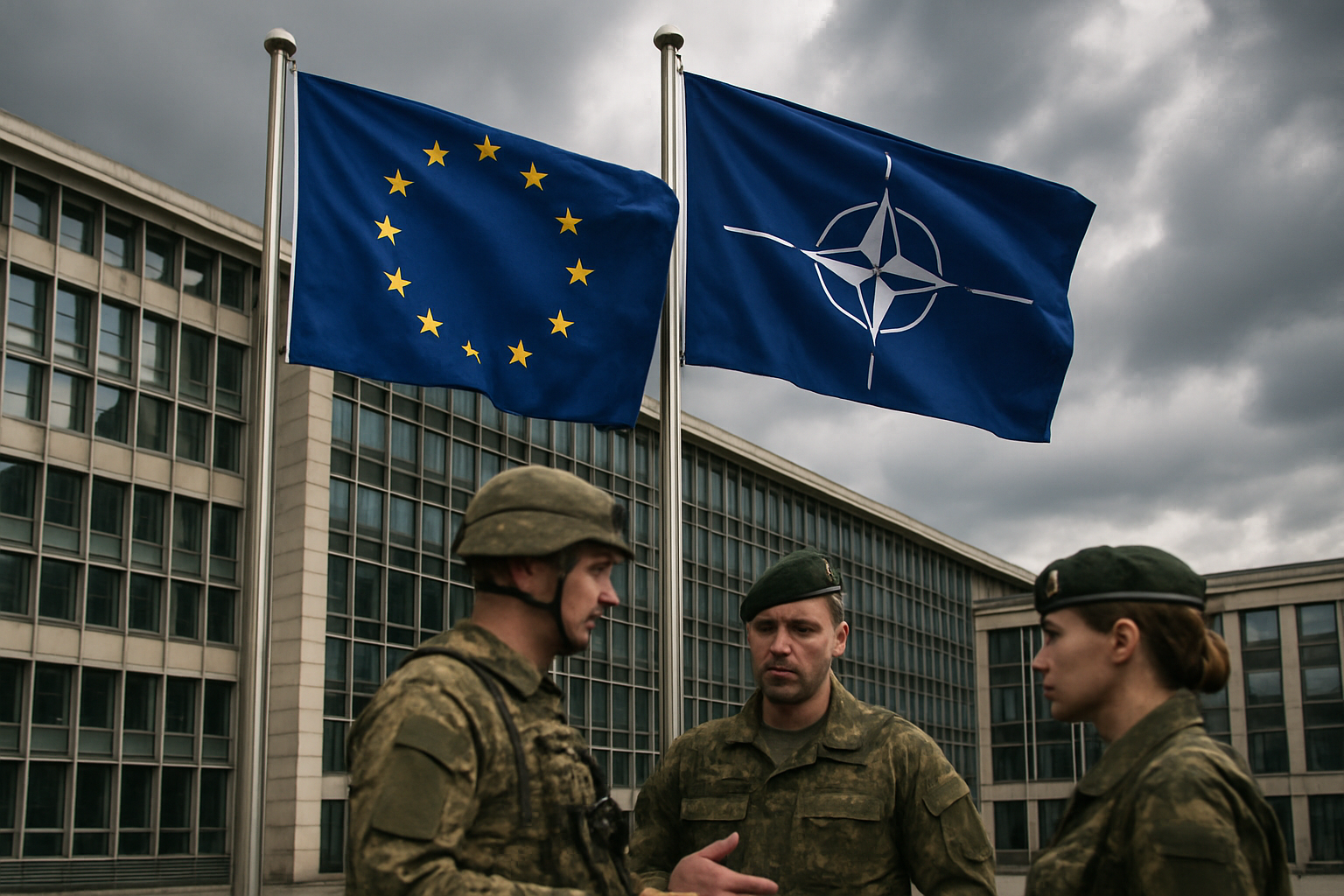
European leaders are engaging in their most serious discussions about strategic autonomy since the Cold War, with unprecedented conversations about nuclear deterrence arrangements emerging as the continent reassesses its security architecture amid changing relationships with the United States and mounting threats from Russia.
At the 62nd Munich Security Conference, held under the sobering theme "The Era of Disruptive Politics: Challenges to International Order," European Commission President Ursula von der Leyen declared that "Europe must take on its responsibilities," marking a fundamental shift in the continent's approach to defense and security.
Nuclear Deterrence Discussions Break New Ground
For the first time since the end of the Cold War, European capitals are quietly exploring alternative nuclear deterrence arrangements. German Chancellor Friedrich Merz confirmed direct talks with French President Emmanuel Macron about nuclear cooperation, representing the most significant development in European defense thinking in decades.
Sources indicate that Germany, Poland, and Finland are participating in preliminary conversations with France about expanding the French nuclear deterrent's role beyond national scope. These discussions reflect growing concerns about the reliability of American NATO Article 5 commitments under changing geopolitical circumstances.
"Without Europeans, there will be no peace," Macron emphasized in his closing remarks, declaring that Europe must become "a geopolitical power providing its own security."
— Emmanuel Macron, President of France
The French nuclear force, comprising approximately 290 warheads, has historically been viewed as insufficient for extended deterrence covering multiple European nations. Any expansion would require significant modifications to French nuclear doctrine, new legal frameworks, parliamentary approvals, and careful consideration of NATO compliance requirements.
Transatlantic Relations Under Strain
The Munich conference highlighted the deepest transatlantic strain since the Cold War. US Secretary of State Marco Rubio attempted a diplomatic reset, declaring America and Europe "made to be together" exactly one year after JD Vance's controversial remarks severely damaged relations.
However, Rubio's absence from a critical Ukraine supporters meeting with German, French, and Polish leaders was interpreted by European officials as declining American interest in European-led initiatives. This perceived disengagement has accelerated European discussions about strategic autonomy.
NATO Secretary-General Mark Rutte addressed these concerns directly, stating that NATO is "strong enough that Russia wouldn't seek to attack a member country now," but emphasized the need to ensure this remains true "in two, four, six years' time."
European Defense Spending and Capabilities
The push for strategic autonomy comes with significant financial and operational commitments. The European Union has approved a historic €90 billion loan package for Ukraine – the largest ever for a single nation – demonstrating European willingness to invest substantially in continental security.
Key defense initiatives include:
- NATO's Arctic Sentry mission, led by European allies with the UK doubling its Norway troop presence
- Sweden-Denmark providing €246 million in air defense systems to Ukraine
- Enhanced European defense industrial cooperation to reduce dependence on US military equipment
- Critical materials partnerships challenging Chinese dominance in defense supply chains
Christine Lagarde, President of the European Central Bank, recommended that Europe transition toward greater "strategic autonomy" in supply chains, emphasizing that trade is not merely an economic issue but also a matter of security.
Nuclear Governance Crisis Context
These discussions occur against the backdrop of a nuclear governance crisis. The New START treaty between the US and Russia expired on February 5, 2026, marking the first time in over 50 years without nuclear arms control constraints between the superpowers.
UN Secretary-General António Guterres warned of a "grave turning point" with nuclear weapon risks "higher than at any time in decades." This vacuum in nuclear governance has provided additional impetus for European alternative deterrence discussions.
Divergent European Approaches
European responses to nuclear and security questions reveal significant divisions. Spanish Prime Minister Pedro Sánchez classified nuclear rearmament as a "historic error" and called on international powers to prevent a new arms race. He argued that increasing military spending to 5% of GDP would increase dependence on American defense industry.
In contrast, other European leaders see enhanced military capabilities as essential for credible deterrence. Romanian Defense Minister emphasized that the EU must produce more defense capabilities internally, while agricultural Commissioner Christophe Hansen warned at Munich that food security could become a weapon of hybrid warfare.
"We cannot build a continent with an empty stomach. Food can become a weapon of war."
— Christophe Hansen, European Commissioner for Agriculture
Ukraine Context Driving Change
The ongoing conflict in Ukraine continues to shape European security thinking. Despite diplomatic breakthroughs including prisoner exchanges and restored US-Russia military communications, Russian territorial gains have accelerated, capturing 481 square kilometers in January 2026 compared to 260 square kilometers in December 2025.
The systematic targeting of civilian infrastructure, particularly energy systems during extreme winter conditions, has demonstrated the vulnerability of European security architecture and the need for more robust defense mechanisms.
Challenges and Implementation
The path toward European strategic autonomy faces formidable obstacles:
- Technical challenges in expanding nuclear deterrent capabilities
- Legal frameworks requiring complex international agreements
- Significant financial investments estimated in hundreds of billions of euros
- Political coordination across 27 EU members with varying security priorities
- Balancing strategic autonomy with existing NATO obligations
Eastern European nations express particular interest in additional deterrent arrangements due to direct Russian threats, while Western European countries weigh the implications for broader international stability.
Global Implications
The European push for strategic autonomy represents a fundamental shift in post-Cold War security architecture. For the first time since NATO's founding, European leaders are seriously considering nuclear deterrence arrangements that don't depend primarily on American guarantees.
Success in developing credible European defense capabilities could provide a template for other regions facing similar security challenges. However, failure might lead to fragmentation of the Western alliance at a critical moment when authoritarian challenges, technological disruption, and climate security intersection demand coordinated responses.
Looking Forward
The Munich Security Conference established unprecedented precedents for European nuclear deterrence discussions while demonstrating alliance strain despite diplomatic reset attempts. Whether this marks renewed Western unity through adaptation or continued fragmentation remains pivotal for international relations trajectory.
The coming months will test whether European strategic autonomy can develop within existing alliance frameworks or will require fundamental restructuring of transatlantic relationships. The stakes extend far beyond European borders, potentially reshaping global security architecture for the 21st century.
As European leaders navigate these complex challenges, their decisions will determine whether the continent can achieve genuine strategic autonomy while maintaining the democratic values and international law principles that have underpinned Western security since World War II.