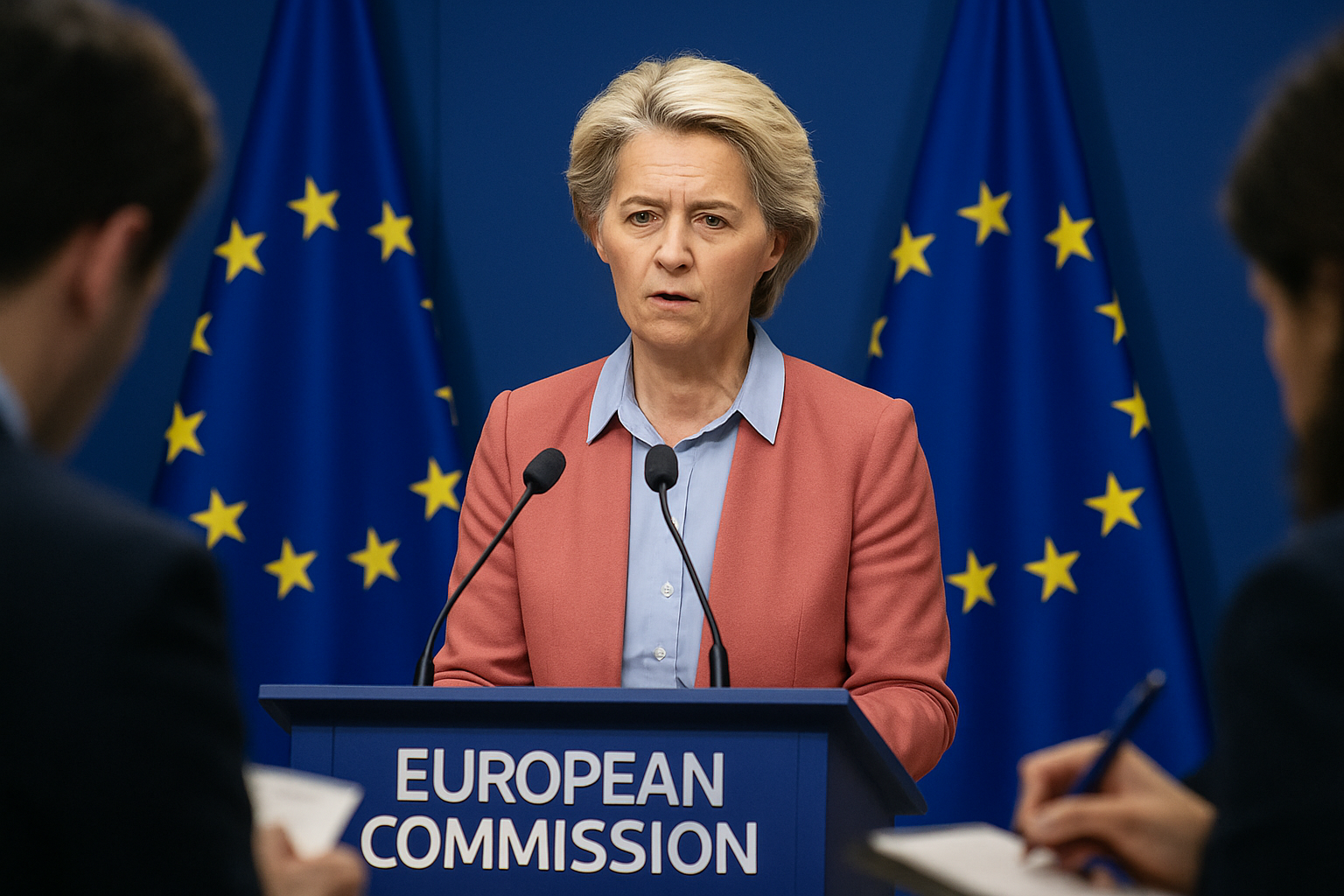
European Commission President Ursula von der Leyen has declared that Europe can no longer serve as "guardian of the old world order" and must adopt a more "realistic" foreign policy approach in response to the dramatically changing global landscape.
Speaking on Monday, von der Leyen acknowledged that the international system based on multilateral rules and diplomatic norms "has disappeared and will not return," marking a watershed moment in European strategic thinking that reflects the continent's response to unprecedented global challenges.
The End of the Rules-Based Order
Von der Leyen's stark assessment comes as the European Union grapples with cascading crises that have fundamentally undermined traditional diplomatic frameworks. The war in Ukraine, now in its fifth year, has accelerated Russian territorial gains while systematic attacks on civilian infrastructure violate international humanitarian law with apparent impunity.
Simultaneously, the complete breakdown of nuclear diplomacy with Iran - despite Geneva talks achieving "broad agreement on guiding principles" in the most significant progress since the JCPOA collapse in 2018 - has led to the most dangerous Middle East crisis since the Cold War ended. The Trump administration's explicit demand for "unconditional surrender" and claims of the right to personally choose Iran's next Supreme Leader represent the starkest rejection of diplomatic solutions in decades.
"Europe can no longer be the guardian of the old world order, of a world that has disappeared and will not return"
— Ursula von der Leyen, European Commission President
The Commission President's remarks reflect a broader European awakening to the limitations of institutional diplomacy when faced with actors willing to systematically violate international law. The expiration of the New START treaty on February 5, 2026 - ending more than 50 years of US-Russia nuclear constraints - has created what UN Secretary-General António Guterres calls the "highest nuclear risks in decades."
Strategic Autonomy and European Response
This philosophical shift accompanies concrete moves toward European strategic autonomy that would have been unthinkable just years ago. French President Emmanuel Macron and German Chancellor Friedrich Merz have initiated unprecedented discussions about expanding France's nuclear deterrent beyond national scope - the first serious such conversations since the Cold War ended.
The European Union's response to the Iran crisis exemplifies this new pragmatic approach. While Spain's government maintains that European military assets can only support activities "consistent with the UN Charter and international law," the EU has simultaneously activated unprecedented crisis management mechanisms, including the first-ever implementation of Cyprus's ESTIA evacuation protocol.
This measured response contrasts sharply with the Trump administration's approach, which has explicitly rejected multilateral frameworks in favor of unilateral action. President Trump's characterization of Spain as a "terrible ally" for refusing base access for Iran operations highlights the growing transatlantic divide over proper diplomatic conduct.
Crisis-Driven Transformation
Von der Leyen's call for a "more realistic" foreign policy emerges from painful lessons learned through successive crises that have tested European unity and effectiveness. The ongoing Ukrainian war, now requiring historic EU support of €90 billion - the largest single-nation assistance package in European history - has exposed both the limits of European military capability and the depth of internal divisions.
Hungary's Viktor Orbán continues to threaten vetoes over the Druzhba pipeline dispute, forcing serious discussions about enhanced cooperation mechanisms that would allow willing member states to proceed without unanimity. This institutional evolution reflects the practical necessity of maintaining European agency in an increasingly chaotic international environment.
"Europe cannot rely on the rules-based system as the only way to defend its interests"
— European diplomatic sources
The Commission President's assessment has generated significant debate within European capitals. Spanish Deputy Prime Minister Yolanda Díaz responded sharply, emphasizing that "international legality must be respected. The alternative is barbarism," highlighting the tension between idealistic principles and pragmatic responses to global disorder.
Implications for Global Governance
Von der Leyen's declaration represents more than rhetorical adjustment - it signals potential fundamental changes to how Europe engages with global challenges. The EU's provisional implementation of the Mercosur trade agreement despite fierce French opposition demonstrates willingness to use institutional flexibility when strategic interests are at stake.
Similarly, the coordinated European naval response to protect Cyprus following Iranian drone attacks on British sovereign bases - the first attack on European territory since World War II - shows operational capabilities that complement diplomatic transformation. The deployment of HMS Dragon, Spanish frigates, and vessels from Italy, France, the Netherlands, and Greece represents unprecedented European military coordination outside traditional alliance structures.
This approach extends beyond security matters to encompass digital sovereignty initiatives, including Slovakia's €1.3 billion digital euro pilot project and coordinated platform regulation that imposes criminal executive liability - policies that prioritize European autonomy over global regulatory harmonization.
Challenges and Contradictions
However, translating von der Leyen's vision into coherent policy faces significant obstacles. The European Union's institutional structure, designed for consensus-building among democratic societies, struggles to respond rapidly to crisis situations. The enhanced cooperation mechanisms under discussion would fundamentally alter decision-making processes that have defined European integration for decades.
Moreover, the tension between "realistic" policy and European values remains unresolved. While acknowledging that Iran's regime "has inflicted death and imposed repression on its own people," European leaders have stopped short of endorsing military solutions, instead emphasizing the need for credible political transitions through diplomatic engagement.
The coming months will test whether European strategic autonomy can develop within existing alliance frameworks or requires more fundamental restructuring of transatlantic relationships. The June 2026 Ukraine peace talks in Washington represent a critical juncture where European diplomatic influence will be measured against American military dominance.
Looking Forward
Von der Leyen's call for foreign policy realism reflects broader questions about democratic governance in an era of authoritarian challenge and technological disruption. The success or failure of European adaptation will influence not only continental security but global democratic resilience in the 21st century.
As the Commission President noted, Europe must find its place in a "new convulsive scenario" where traditional diplomatic tools prove inadequate. Whether this transformation strengthens or fragments Western unity remains the defining question for international stability in the coming decade.
The stakes extend far beyond European borders, as other democratic societies worldwide observe whether institutional adaptation can preserve both security and values under unprecedented pressure. Von der Leyen's acknowledgment that the old world order "has disappeared and will not return" may prove prophetic - the question is what will replace it.