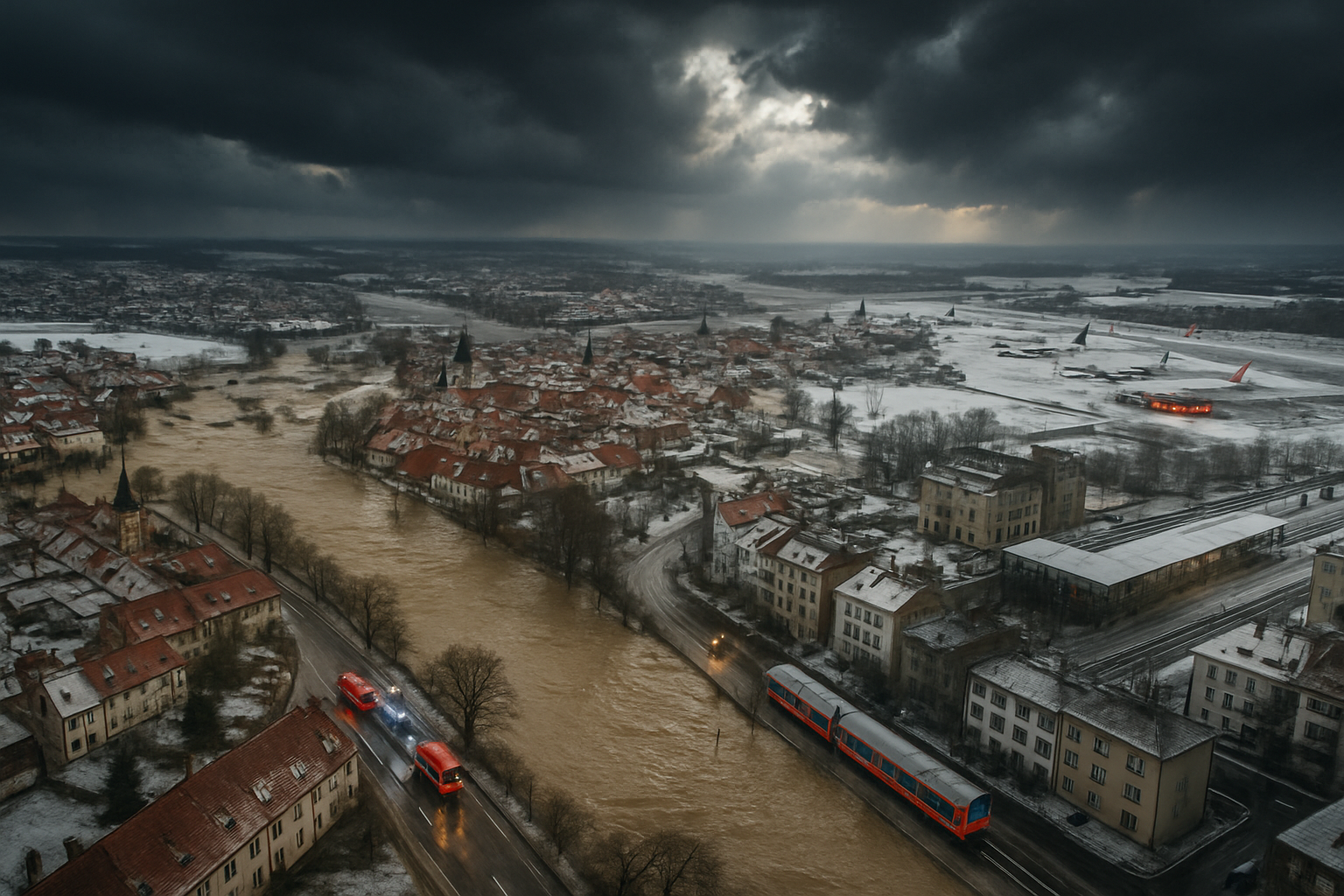
A massive storm system is sweeping across Europe this Friday, bringing potentially lethal conditions to a continent already reeling from weeks of extreme weather that has killed dozens of people and displaced thousands more across multiple countries.
Storm Nils has already claimed two lives in France, leaving 450,000 households without power as violent winds exceeding 100 km/h tear through western regions. The latest system represents the fifth major weather emergency to strike Europe in February 2026, following the devastating succession of Storms Kristin, Leonardo, and Marta that overwhelmed emergency services across the continent.
France Bears Immediate Brunt of Storm Nils
French authorities confirmed two deaths in the Tarn-et-Garonne region as Storm Nils brought catastrophic flooding and winds that ripped trees from their roots across southern France. Power operator Enedis reported that approximately 450,000 homes remained without electricity Friday morning, with emergency crews struggling to restore services amid ongoing dangerous conditions.
Météo-France maintained red alerts for flooding in Gironde and Lot-et-Garonne departments, while violent wind warnings remained in effect for Aude and Pyrénées-Orientales. The storm system has generated wind gusts exceeding 162 km/h in some coastal areas, prompting authorities to advise residents to remain indoors.
"The situation continues to be extremely dangerous across western France,"
— Météo-France Emergency Coordinator
Emergency services have received more than 1,600 calls for assistance related to fallen trees and debris removal, stretching response capabilities to their limits.
Portugal Faces Infrastructure Catastrophe
Portugal is grappling with unprecedented infrastructure damage as the Mondego River reached critical flood levels, threatening the historic city of Coimbra with what officials describe as a potential "centennial flood" - the worst flooding event in a century.
The crisis escalated dramatically when a major highway viaduct on the A1 - Portugal's primary north-south transportation corridor - collapsed near Coimbra following catastrophic flooding. Infrastructure Minister Miguel Pinto Luz confirmed the critical link between Lisbon and Porto would require "several weeks" to repair, effectively severing the country's most important transportation artery.
Portugal continues to maintain its largest peacetime rescue operation in national history, with 26,500 personnel deployed including 1,975 military staff and 30 naval vessels. The operation has responded to over 1,800 weather-related incidents since the beginning of February, demonstrating the unprecedented scale of the crisis.
The succession of storms has left 33,000 Portuguese households without power, with some communities in the Pombal region enduring more than 10 days without electricity. The Castanheira-Alverca railway line remains suspended indefinitely, severely disrupting commuter services to Lisbon.
Baltic States Under Severe Winter Emergency
The crisis extends far beyond southwestern Europe, with the Baltic nations experiencing their harshest winter conditions in decades. Latvia is bracing for what meteorologists are calling the strongest blizzard of the winter season, with heavy snow and dangerous winds expected to create whiteout conditions across much of the country.
In the capital Riga, public transportation systems are already experiencing delays of 10-15 minutes as snow and ice create hazardous conditions. City officials have confirmed that schools will remain open despite the challenging weather, but authorities are closely monitoring the situation.
Finland continues to deal with the aftermath of Storm Hannes, which struck in late December and caused damages now estimated at 25 million euros by insurance company Lähitapiola alone. The storm damaged thousands of buildings and caused extensive forest destruction across the country.
Transportation Networks Collapse Across Europe
The severe weather has caused widespread transportation disruptions across the continent. Germany's Cologne/Bonn Airport suspended all flight operations Friday morning due to technical failures in newly installed security baggage screening systems, affecting thousands of passengers.
Railway services across multiple countries face severe disruptions. Long-distance rail connections on Portugal's Northern Line have been suspended, while several high-speed rail services in Spain remain offline following earlier storm damage.
In Lithuania, emergency services faced unusual rescue operations, including freeing a horse that had fallen into a snow-covered canal in the Šilalė district. Meanwhile, a truck caught fire on the Via Baltica highway near Truskava, though the incident was brought under control without casualties.
Southern Europe Battles Flooding and Landslides
Greece is experiencing severe weather impacts with torrential rains causing significant flooding and landslides on the islands of Chios and Crete. Fire services have received dozens of emergency calls for water pumping operations as communities struggle with rising flood waters.
The crisis has forced authorities to implement unprecedented emergency measures, including mass evacuations and the deployment of military resources for civilian rescue operations across multiple countries simultaneously.
International Response and Climate Context
The European Union has activated its Civil Protection Mechanism to coordinate international assistance, while Sweden and Denmark have announced a €246 million emergency assistance package to support affected nations.
The current crisis occurs against the backdrop of January 2026 being confirmed as the hottest month in recorded global history - the 18th consecutive month to exceed 1.5°C above pre-industrial levels. Climate scientists note the concerning pattern of global warming enabling both extreme heat records and devastating regional weather events simultaneously.
"We are witnessing climate volatility where warming trends override natural cooling patterns while enabling extreme regional events,"
— European Climate Research Institute
Economic and Social Impact Mounting
The economic toll continues to mount across multiple sectors. Agricultural regions have suffered billions in damages, while tourism industries face widespread cancellations and infrastructure damage. The disruption to transportation networks is affecting supply chains across the continent.
Emergency services report operating at capacity limits, with many regions requiring mutual aid agreements to maintain basic emergency response capabilities. Hospitals in affected areas have seen increases in weather-related injuries and are preparing for potential evacuations in flood-prone areas.
The crisis has exposed significant vulnerabilities in European infrastructure designed for historical climate patterns rather than the increasingly volatile conditions now occurring regularly. Recovery efforts are expected to take months, with total economic damages estimated in the tens of billions of euros.
Looking Ahead: More Storms Developing
Meteorological services across Europe warn that additional Atlantic storm systems are developing, suggesting the crisis may persist for several more weeks. The unprecedented frequency and intensity of these weather events are forcing a fundamental reassessment of European emergency preparedness and infrastructure resilience.
As communities across Europe brace for continued severe weather, the crisis has become a defining test of the continent's ability to adapt to increasingly volatile climate conditions while maintaining essential services and protecting vulnerable populations.
The situation represents a new phase in European climate adaptation challenges, demonstrating the urgent need for enhanced international cooperation and infrastructure investment designed for the climate realities of the coming decades rather than the patterns of the past.