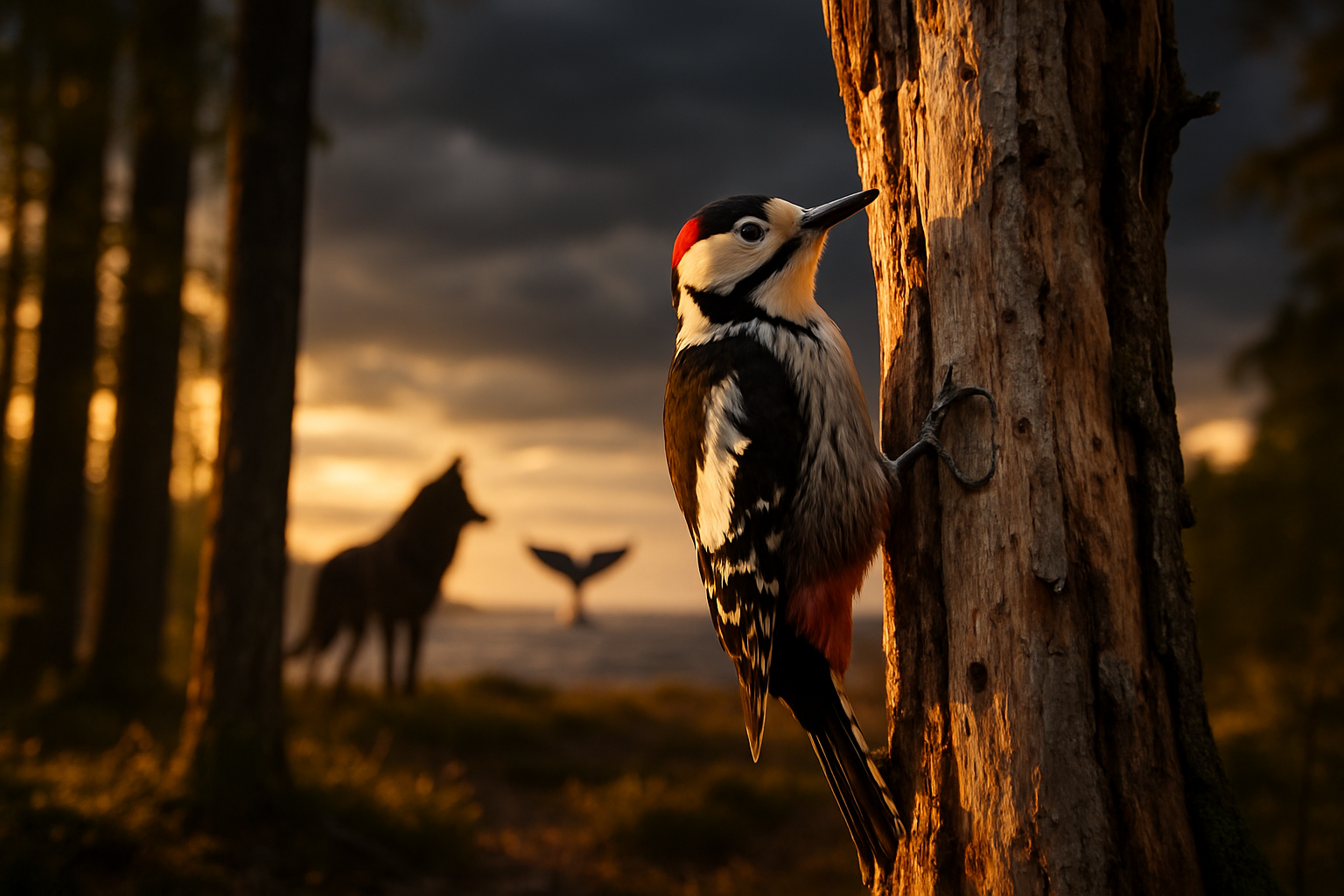
Four Nordic and European nations are spearheading a remarkable conservation renaissance as wildlife protection efforts achieve unprecedented success despite facing the most challenging environmental conditions in recorded history during the 24th consecutive month of global temperatures exceeding 1.5°C above pre-industrial levels.
From Denmark's complex wolf management strategies to Spain's mysterious color-changing Iberian lynx, from Germany's controversial whale rescue operations to Sweden's protection of critically endangered woodpeckers, these conservation initiatives represent a fundamental evolution in environmental protection methodology—one that synthesizes cutting-edge technology with traditional ecological knowledge while operating under extreme climate pressure.
Denmark's Wolf Management Dilemma
Danish authorities face an increasingly complex challenge as wolf populations continue expanding across Vestjylland, particularly around the Oksbøl region. Recent incidents involving six wolves following a man onto a farmyard property have prompted heightened awareness from environmental authorities, marking another chapter in Denmark's delicate balance between species recovery and community safety.
The situation reflects broader European conservation successes—wolf populations have steadily recovered across the continent over recent decades, creating new challenges requiring sophisticated management approaches that balance conservation goals with agricultural community concerns. Climate change compounds these challenges by altering traditional habitat boundaries and forcing wildlife into increased contact with human settlements.
Germany's Whale Rescue Controversy
The Baltic Sea has become an unlikely stage for dramatic conservation medicine as a humpback whale stranding near Poel Island has exposed deep divisions within wildlife rescue communities. German authorities suspended rescue efforts after internal conflicts erupted among volunteer rescuers, with the sole whale expert—a Hawaiian veterinarian—departing the mission amid accusations that crucial intervention opportunities were being squandered.
"Seine Chance auf Freiheit zunichte gemacht" (His chance for freedom has been destroyed)
— Hawaiian veterinarian, departing German whale rescue team
The incident highlights the complexity of marine conservation medicine, where expertise, timing, and coordinated response protocols can determine life or death outcomes for marine megafauna. With the Baltic Sea representing an unusual habitat for humpback whales, the presence of this individual may indicate broader oceanographic changes associated with rapid climate warming.
Spain's Enigmatic Color-Changing Lynx
In the mountains of Jaén, Spain, conservation biologists are tracking one of nature's most puzzling phenomena: a female Iberian lynx named Satureja who has undergone a dramatic transformation from normal tawny coloration to an almost ghostly white appearance, retaining only her distinctive black spots—the genetic "fingerprint" that allows individual identification.
Born in 2021 with typical Iberian lynx coloration, Satureja was first documented in her altered state by wildlife photographer Ángel Hidalgo in October 2025. Now, months later, the lynx appears to be changing color again, presenting Andalusian authorities with an unprecedented scientific mystery. Despite multiple capture attempts, Satureja remains elusive, and the causes behind her color transformation continue to baffle researchers.
The Iberian lynx represents one of Europe's greatest conservation success stories, having been pulled back from the brink of extinction through intensive management programs. However, Satureja's case illustrates how much remains unknown about species biology even under intensive scientific study.
Sweden's Critical Species Protection
On Stora Tuvan island in Umeå, Swedish conservation authorities have taken the unprecedented step of closing an entire island to public access to protect a breeding pair of white-backed woodpeckers—one of Europe's most critically endangered bird species. This marks the fourth consecutive year the species has attempted to nest on the island, demonstrating both the fragility and persistence of endangered species recovery efforts.
"Vi förstår att det begränsar förutsättningarna för fågelskådning i området" (We understand that this limits the opportunities for birdwatching in the area)
— Åsa Stenman, Länsstyrelsen
The white-backed woodpecker's presence represents a conservation milestone, as the species requires specific forest conditions—particularly old-growth forests with dead and dying trees—that have become increasingly rare across Europe. The decision to close Stora Tuvan reflects the critical balance between public access to nature and species protection during crucial breeding periods.
Technology Meets Tradition in Modern Conservation
These conservation initiatives exemplify a fundamental evolution in environmental protection methodology. Modern programs integrate sophisticated technology—environmental DNA sampling, satellite monitoring, AI-powered threat detection, and GPS tracking—with traditional ecological knowledge accumulated over generations by local communities and indigenous peoples.
Danish wolf monitoring employs advanced tracking systems combined with rural community knowledge of livestock protection techniques. German marine rescue operations utilize cutting-edge sonar technology while drawing on centuries of Baltic maritime expertise. Spanish lynx research combines genetic analysis with traditional hunting ground knowledge, while Swedish forest management integrates digital monitoring with traditional silvicultural practices.
Economic Dimensions of Conservation
Modern conservation increasingly functions as an economic development strategy rather than a regulatory burden. Countries implementing comprehensive wildlife protection demonstrate greater economic resilience and attract substantial sustainable investment across multiple sectors including eco-tourism, environmental technology, and green services.
Sweden's forest conservation supports a multi-billion-dollar eco-tourism industry while attracting international research partnerships. Denmark's wolf management creates opportunities for nature-based tourism while supporting traditional pastoral livelihoods. Spain's lynx conservation underpins premium eco-tourism experiences that generate substantial revenue for rural communities. Germany's marine conservation efforts enhance the country's environmental credentials, attracting sustainable investment in renewable energy and environmental technology sectors.
Economic analyses consistently demonstrate that ecosystem services provided by intact natural systems—water purification, carbon sequestration, climate regulation, and biodiversity maintenance—deliver greater long-term economic value than resource extraction activities. Wetlands prevent billions in flood damage annually, forests regulate water cycles and climate patterns, and biodiversity hotspots support pharmaceutical research and eco-tourism worth hundreds of billions globally.
Climate Crisis Context
These conservation victories emerge during Earth's most challenging environmental period in recorded history. The sustained warming streak extending through 2026 has completely overridden natural climate variability, including La Niña cooling effects, demonstrating that human-induced climate change has fundamentally altered atmospheric systems beyond natural recovery mechanisms.
Climate change functions as a "threat multiplier," creating compound environmental effects that traditional conservation approaches struggle to address. Rising sea levels threaten coastal ecosystems, changing precipitation patterns affect forest regeneration, and increased extreme weather frequency disrupts marine food chains and terrestrial habitats. Wildlife migration patterns developed over millennia are being disrupted, forcing species into novel environmental conditions and increased human contact.
Adaptive Management Requirements
Conservation strategies must now account for rapidly changing baseline environmental conditions while maintaining long-term sustainability goals. Traditional conservation methods designed for stable environmental conditions require fundamental evolution to address multiple simultaneous stressors: climate change, pollution, habitat destruction, and invasive species interact to create challenges exceeding the sum of individual threats.
International Cooperation Framework
Environmental challenges increasingly transcend political boundaries through ocean currents, atmospheric systems, and species migrations that connect ecosystems globally, making unilateral conservation efforts insufficient. Success requires unprecedented coordination through shared policy frameworks, collaborative monitoring systems, joint enforcement efforts, and innovative financing mechanisms that recognize ecosystem services as essential economic infrastructure.
Knowledge sharing between these European conservation programs creates global networks that strengthen local capacity while contributing to planetary sustainability. The diversity of approaches—from Denmark's community-based wolf management to Sweden's species-specific island protection—provides resilience against single-solution dependencies by offering multiple adaptation pathways for complex environmental challenges.
Recent international conservation successes demonstrate the potential for coordinated global action. Ecuador's reintroduction of 158 giant tortoises to Floreana Island after a 150-year absence, Zimbabwe's world-first DNA forensic wildlife prosecution, and Croatia's record griffon vulture populations all illustrate how sophisticated conservation programs can achieve remarkable results even under extreme environmental stress.
Implementation Success Factors
Analysis of successful conservation programs reveals consistent elements: community ownership and engagement in conservation planning and implementation, transparent governance frameworks with accountability and sustainable funding, economic incentives that make protection financially viable for local communities, and sophisticated integration of traditional ecological knowledge with modern conservation science.
Challenges persist in funding sustainability, particularly for developing nations where immediate economic pressures override long-term environmental considerations. Technical capacity building requires sustained investment in education, training, and institutional development. Climate change disrupts project timelines, requiring adaptive management approaches capable of responding to rapidly changing environmental conditions.
Critical Action Window
Environmental scientists warn that the window for effective conservation action is narrowing rapidly as ecological systems approach critical thresholds that could trigger potentially irreversible changes affecting global food security, climate stability, and human settlements. The choice facing the international community is between reactive crisis management and proactive ecosystem service management.
Tools, knowledge, and cooperation frameworks for comprehensive environmental protection exist and have been demonstrated through diverse international initiatives achieving remarkable results during Earth's most challenging environmental period. However, success depends on sustained international cooperation, enhanced multi-sector coordination, and increased financial commitments that recognize environmental protection as essential infrastructure for human prosperity and planetary sustainability.
Future Implications
The environmental conservation developments across Northern Europe in 2026 may prove decisive for conservation approaches in the decades ahead, influencing global biodiversity protection, climate adaptation, and sustainable development strategies for generations. These programs provide practical templates for scaling environmental protection globally through coordinated approaches that address multiple challenges simultaneously while building local capacity and fostering international cooperation.
The integration of cutting-edge technology with traditional ecological wisdom creates adaptable frameworks that respect cultural diversity while leveraging global capabilities for maximum conservation impact. Success in maintaining planetary habitability during this unprecedented environmental challenge period depends on humanity's ability to organize and implement solutions rapidly enough to match the pace of environmental change while protecting the natural systems on which human prosperity depends.
As the longest sustained warming streak in human history continues, these European conservation initiatives demonstrate both the remarkable adaptive capacity of species protection efforts and the urgent need for coordinated global action. The conservation renaissance of 2026 offers hope and practical guidance for the massive coordinated effort required to maintain planetary habitability during the most environmentally challenging period in recorded history.