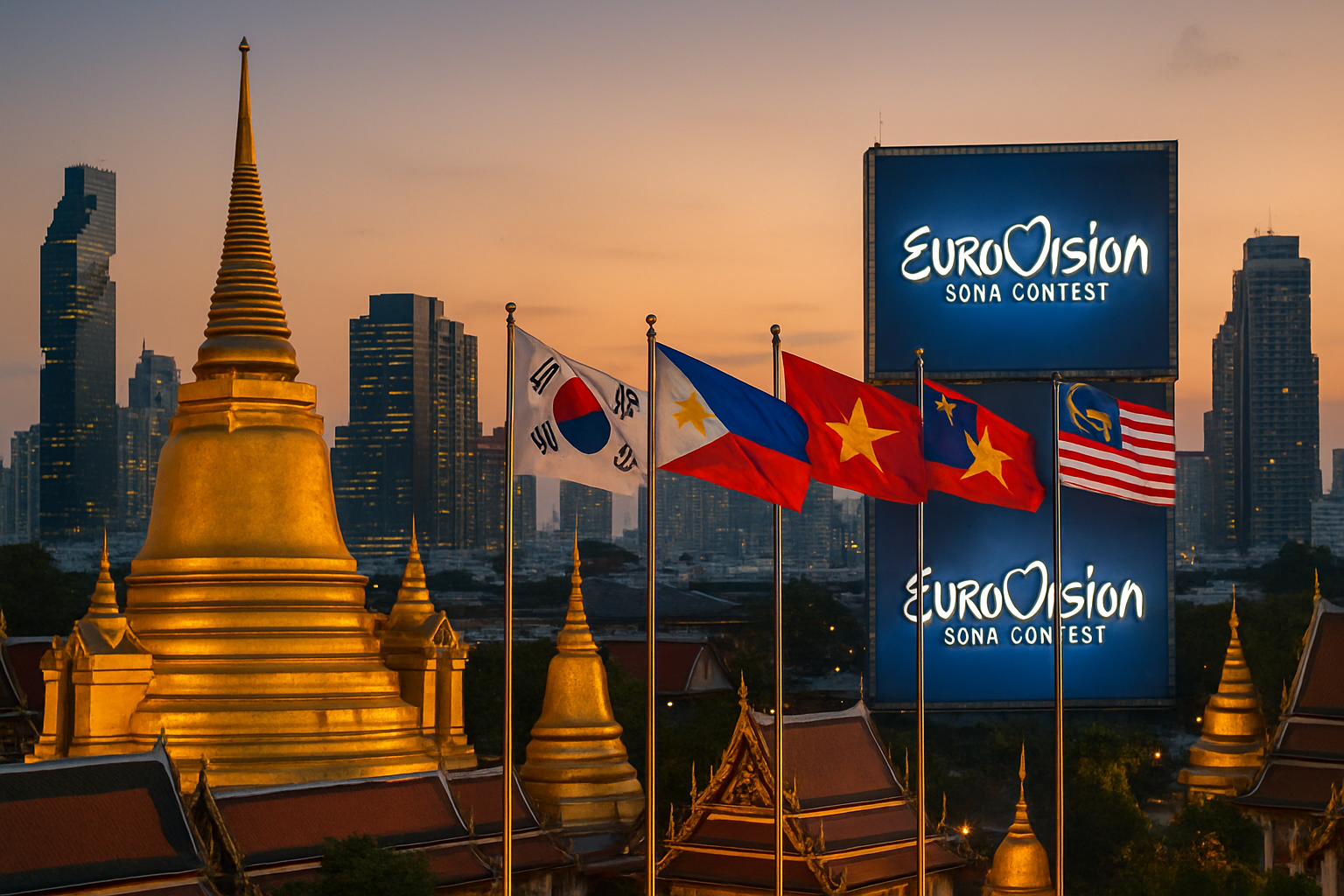
Eurovision Song Contest Asia 2026 has confirmed artists from at least 10 countries across Asia will compete in the inaugural competition, marking a historic expansion that transforms the beloved European tradition into a truly global cultural phenomenon.
The European Broadcasting Union (EBU) announced that Thailand, South Korea, the Philippines, Vietnam, Malaysia, Cambodia, Laos, Bangladesh, Nepal and Bhutan will participate in the first-ever Asian edition, scheduled for November 14, 2026, at venues across Bangkok. Additional countries are expected to join before the finale, according to organizers.
Bangkok Chosen as Pioneer Host City
The selection of Bangkok as the inaugural host city reflects Thailand's strategic positioning as Southeast Asia's entertainment hub. The partnership brings together the European Broadcasting Union, Voxovation, Thailand's S2O Productions, and Channel 3, creating a collaborative framework that balances Eurovision's established standards with authentic regional representation.
Martin Green, Director of the Eurovision Song Contest, presented the trophy to Chuwit Sirivajjakul, Deputy Governor for Policy Planning at the Tourism Authority of Thailand, during the historic announcement ceremony. The symbolic handover marked Eurovision's most significant international expansion since its inception in 1956.
"This represents Eurovision's evolution from a European tradition to a global cultural diplomacy platform promoting cross-cultural understanding through music."
— Martin Green, Eurovision Song Contest Director
Cultural Renaissance Context
The Asian expansion occurs during what cultural observers have termed the "February 2026 Cultural Renaissance," a period emphasizing authentic artistic expression over manufactured content. This movement has seen unprecedented success for authentic cultural productions across multiple continents, with Korean content achieving Oscar recognition and traditional music forms gaining international prominence.
Thailand's entertainment infrastructure, political stability, and cultural hub status made it an ideal location for data-intensive cultural operations. The country has recently positioned itself through dual strategies: promoting "Healing is the New Luxury" tourism experiences while establishing itself as "Asia's Content Hub" through strategic partnerships and infrastructure development.
Economic and Cultural Impact
The Eurovision Song Contest Asia is expected to generate substantial economic benefits through international tourism, media attention, and entertainment industry development. Tourism officials anticipate the event will attract visitors from across the region and globally, building on Thailand's successful cultural tourism strategies.
The competition follows Eurovision's established format, combining musical performance with cultural celebration. Each participating country will showcase its unique musical traditions while competing for the inaugural Asian Eurovision crown, creating a platform for regional cultural exchange unprecedented in scale.
Regional Participation and Diversity
The confirmed participating countries represent an extraordinary diversity of musical traditions and cultural expressions. From South Korea's globally successful K-pop industry to traditional folk music from Bangladesh, Nepal, and Bhutan, the competition promises to showcase the full spectrum of Asian musical heritage.
Southeast Asian countries including the Philippines, Vietnam, Malaysia, Cambodia, and Laos bring their own rich musical traditions, while the inclusion of South Asian nations ensures broad continental representation. Each country will have the opportunity to present their musical identity to a global audience estimated to reach hundreds of millions of viewers.
Infrastructure and Technology Integration
Bangkok's selection leverages Thailand's advanced entertainment infrastructure and modern venue capabilities. The city's proven track record in hosting major international events, combined with state-of-the-art broadcasting facilities, ensures professional production standards matching Eurovision's global reputation.
The competition will incorporate sophisticated enhancement technologies while preserving authentic cultural elements. Social media integration and digital engagement strategies will extend the cultural influence beyond immediate audiences, following successful templates from other major international competitions.
Template for Global Expansion
Success of Eurovision Song Contest Asia will establish precedents for potential future Eurovision expansions to other continents, creating a global network of Eurovision-style cultural celebrations. The Asian edition serves as a crucial test case for whether Eurovision's format can successfully adapt to different cultural contexts while maintaining its core values of unity through diversity.
The initiative represents a sophisticated understanding of modern cultural consumption patterns, where authentic expressions achieve both domestic resonance and international commercial success. Regional cooperation has replaced individual competition, with multiple countries working together to create multi-destination cultural experiences.
Looking Toward November
As preparations intensify for the November grand final, participating countries are developing their national selection processes and artist development programs. The competition format will mirror European Eurovision traditions while incorporating elements specific to Asian cultural contexts.
The European Broadcasting Union has indicated that more countries may join before the final participant list is confirmed. Interest has been expressed from additional Asian nations, potentially expanding the competition beyond its current 10-country foundation.
Eurovision Song Contest Asia 2026 represents more than entertainment expansion—it demonstrates culture's power to unite communities, transcend boundaries, and create sustainable foundations for future human flourishing. The November competition will serve as a landmark moment in international cultural cooperation, establishing new standards for authentic cultural celebration in an interconnected world.