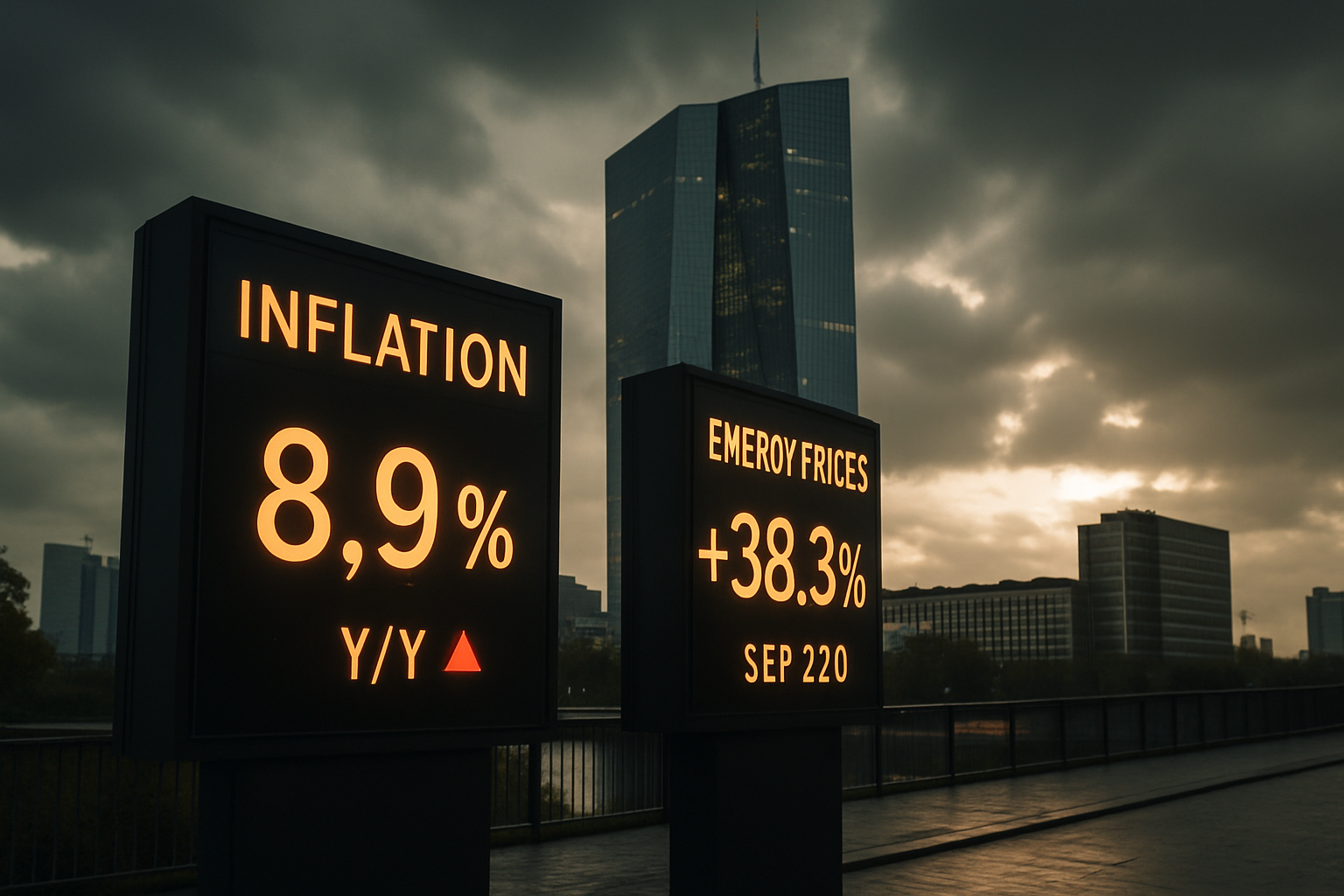
Eurozone inflation surged to 2.5% in March 2026, up from 1.9% in February, marking a sharp acceleration driven primarily by energy price increases stemming from the ongoing Middle East conflict that has disrupted global oil and gas supplies.
According to preliminary data released by Eurostat, the six-tenths increase represents the most significant monthly jump since the energy crisis began, with energy prices rising 4.9% as Iran's closure of the Strait of Hormuz continues to impact global markets.
Regional Variations Across Member States
The inflation surge has not affected European Union member states uniformly. Austria experienced the most dramatic acceleration, with inflation jumping to 3.1% in March, driven by what trade unions criticized as "war-driven price explosions" in fuel costs that have risen over 20%.
Cyprus registered a more moderate increase to 1.5% annually, up from 0.9% in February, with monthly inflation at 1.0%. Despite this uptick, Cyprus inflation remains well below the 2.1% recorded in March 2025, indicating the island nation's relative insulation from continental energy market pressures.
Italy's preliminary data suggests inflation at 1.7% annually, with the "shopping basket" of essential goods rising to 2.2%, reflecting the broader impact of energy costs filtering through to consumer prices across all sectors.
"The high fuel prices have immediately translated into higher inflation. For other products, the increased energy costs will continue to be passed on in the future"
— Austrian economic analysis, derStandard.at
Energy Crisis Drives Price Pressures
The underlying driver of this inflationary surge is the unprecedented energy crisis triggered by Iran's effective closure of the Strait of Hormuz, which handles 40% of global seaborne oil transit. Oil prices have breached $100 per barrel for the first time since 2022, with Brent crude reaching peak levels of $119.50 and West Texas Intermediate jumping 18.98% to $108.15 in single-day trading sessions.
Natural gas prices have exploded by 24% across Europe and 78% in the United States, reaching €47.32 per megawatt-hour – the highest levels since February 2025. Qatar, which supplies approximately 20% of global LNG exports, has halted production at major facilities following Iranian drone attacks.
The crisis has prompted European governments to implement emergency measures. Hungary introduced immediate gasoline and diesel price caps to combat what officials called "war-driven price explosions." France deployed 500 fuel station inspectors to prevent price manipulation, while Romania outlined five scenarios to prevent diesel from exceeding 10 lei per liter.
Core Inflation Shows Mixed Signals
European Central Bank officials will likely focus on core inflation data, which excludes volatile energy and food prices. Spanish reports indicate that underlying inflation, stripping out energy and food components due to their volatility, actually decreased by one-tenth to 2.3%, suggesting that fundamental price pressures may not be as embedded in the broader economy.
This divergence between headline and core inflation presents a complex challenge for ECB policymakers, who must distinguish between temporary energy-driven price shocks and more persistent inflationary trends that would require monetary policy adjustments.
Policy Response and Market Implications
The European Central Bank has maintained its deposit rate at 2.0% through the crisis, with officials emphasizing their commitment to data-driven monetary policy. However, the sharp acceleration in energy prices is testing the central bank's framework for dealing with supply-side shocks versus demand-driven inflation.
Financial markets have shown significant volatility, with the crisis contributing to a global market downturn. Pakistan's KSE-100 suffered its largest single-day decline in history, falling 8.97%, while South Korea's KOSPI dropped 12% triggering circuit breakers. European markets have experienced severe losses, prompting central banks including the ECB and Bank of Japan to coordinate emergency liquidity provisions.
Supply Chain Disruptions Intensify
Beyond energy, the Middle East crisis has created broader supply chain disruptions affecting consumer goods and industrial materials. The 21-mile Strait of Hormuz represents a single-point failure for modern global logistics, with major shipping companies Maersk and MSC suspending Persian Gulf operations, leaving over 150 oil and LNG tankers stranded with billions in cargo value.
The aviation industry faces parallel challenges, with over 18,000 flights cancelled worldwide – the most extensive disruption since COVID-19. Dubai International Airport, the world's busiest with over 86 million passengers annually, remains completely shut down due to missile damage.
Long-term Economic Implications
Energy analysts warn that the current crisis exposes fundamental vulnerabilities in European energy architecture. Samuel Ciszuk, a leading energy analyst, described it as "the most severe energy security crisis in decades, exposing single-chokepoint vulnerabilities that require fundamental restructuring."
The crisis has accelerated discussions about supply diversification and renewable energy transitions, though experts note these structural changes require years or decades to implement. Strategic petroleum reserves, while providing temporary relief, are insufficient for sustained disruptions of this magnitude.
Estonia's renewable energy leadership – achieving 88% renewable electricity generation with continental Europe's largest battery storage serving 90,000 households – offers a template for energy independence, but the transition timeline leaves European economies vulnerable during critical periods.
Consumer Impact Across Europe
European consumers are experiencing immediate impacts from the energy price surge. Swedish authorities predict electricity increases of 10-20 öre and gasoline rises of 1-2 kronor, with the southern Malmö region most exposed due to continental market integration.
In Ireland, heating oil has approached €2 per liter, with officials describing price increases as "brazen rip-offs." Malta faces fuel prices 45% higher than they would be without government subsidies, while Bosnia-Herzegovina has been reduced to just two days of gas reserves.
The crisis has prompted governments across the continent to activate emergency protocols, including Cyprus's first-ever implementation of the ESTIA evacuation plan and coordinated strategic petroleum reserve releases through the International Energy Agency.
Future Outlook
The recovery timeline remains uncertain, as it depends on military and diplomatic developments rather than predictable economic factors. Unlike weather-related disruptions, the current crisis requires resolution of underlying geopolitical conflicts affecting international stability mechanisms.
UN Secretary-General António Guterres has described the situation as "the greatest test of multilateral cooperation in crisis management in the modern era," with implications extending far beyond current events to influence international approaches to conflict resolution and energy market evolution for decades to come.
As European policymakers navigate this unprecedented challenge, the March 2026 inflation surge serves as a stark reminder of the continent's energy vulnerabilities and the urgent need for fundamental transformation of its energy security architecture.