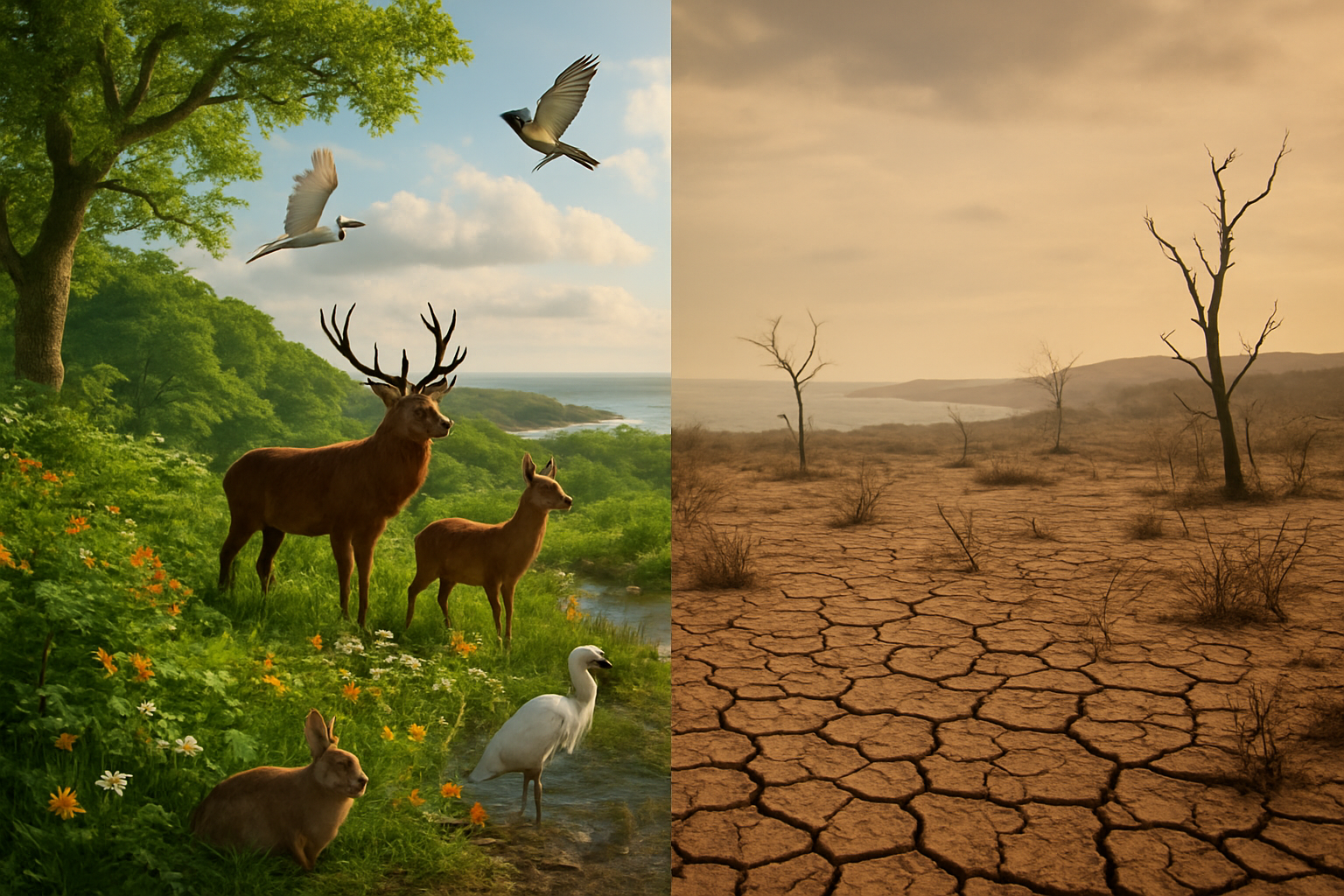
Extreme climate events could eliminate 36% of Earth's terrestrial biodiversity by 2085 if current warming trends continue, according to groundbreaking research from Portugal that fundamentally challenges existing climate impact projections and reveals the urgent need for immediate carbon neutrality.
The devastating projection emerges during the 25th consecutive month of global temperatures exceeding the critical 1.5°C pre-industrial threshold – the longest sustained extreme warming streak in recorded human history – as researchers document unprecedented cumulative impacts of heat waves, wildfires, and flooding on global ecosystems.
The Cumulative Climate Crisis
The Portuguese research, published as extreme weather events intensify worldwide, reveals that the cumulative impact of multiple climate stressors – heat waves, megafires, and catastrophic flooding – poses a far greater threat to biodiversity than previously understood. Unlike traditional climate models that examine individual weather events, this study analyzes the devastating compound effects of simultaneous extreme conditions.
"If emissions are reduced to carbon neutrality by mid-century, these impacts could be avoided," the research emphasizes, providing a narrow but critical window for planetary intervention. However, the study's findings suggest that current biodiversity loss projections have dramatically underestimated the speed and scale of ecosystem collapse under accelerating climate change.
"The cumulative impact of heat waves, fires and floods threatens global ecosystems in ways we have never witnessed before. The window for effective action is rapidly closing."
— Climate Researcher, Portuguese Study
Global Context of Unprecedented Warming
The research findings emerge against a backdrop of unprecedented global environmental crisis. January 2026 marked the hottest month in recorded history, extending a temperature streak that has completely overridden natural climate variability, including La Niña cooling effects that typically moderate global temperatures.
This sustained warming demonstrates that human-induced climate change has fundamentally altered Earth's atmospheric systems beyond natural recovery mechanisms, creating compound environmental effects that traditional conservation approaches struggle to address. The 36% biodiversity loss projection represents not a gradual decline, but a potential cascading collapse of interconnected ecosystems worldwide.
The Biodiversity Tipping Point
Recent climate science reveals that 2°C warming could trigger extreme climate events previously expected only at 3-4°C temperature increases, fundamentally challenging Paris Agreement safety assumptions. This non-linear relationship means small temperature increases trigger disproportionately large ecological responses, making the 36% biodiversity loss scenario increasingly plausible under current warming trajectories.
Ecosystem Services Under Threat
The potential loss of over one-third of terrestrial biodiversity represents more than an environmental catastrophe – it threatens the foundation of human prosperity. Forests covering 32% of Earth's surface provide critical ecosystem services supporting 80% of terrestrial biodiversity and two-thirds of bird species, while 1.6 billion people depend directly on forest ecosystems for their livelihoods.
The economic implications extend far beyond immediate environmental costs. Ecosystem services from intact natural systems – including water purification, carbon sequestration, and climate regulation – deliver greater long-term economic value than resource extraction activities, often worth hundreds of billions annually in pharmaceutical research, sustainable tourism, and natural disaster prevention.
Conservation Renaissance Amid Crisis
Despite these alarming projections, a global "conservation renaissance" is emerging, characterized by unprecedented international coordination combining cutting-edge technology with traditional ecological knowledge. Recent successes include Ecuador's reintroduction of 158 giant tortoises to Floreana Island after a 150-year absence, Zimbabwe's world-first DNA forensic wildlife prosecutions, and New Zealand's possum-free Otago Peninsula declaration.
This evolution from reactive crisis management to proactive ecosystem service management demonstrates that sophisticated conservation programs can achieve remarkable results even under extreme environmental stress, providing templates for scaling protection globally.
Technology-Tradition Integration
Modern conservation success stories increasingly rely on sophisticated synthesis of cutting-edge technology – environmental DNA sampling, satellite monitoring, AI-powered threat detection – with traditional ecological knowledge and community-based management. This integration creates comprehensive frameworks that combine scientific rigor with cultural sensitivity and community ownership.
International Cooperation at Breaking Point
Environmental challenges transcend political boundaries through ocean currents, atmospheric systems, and species migrations that connect ecosystems globally, making unilateral conservation efforts insufficient. The simultaneity of climate crises across multiple continents is testing international cooperation mechanisms designed for sequential rather than concurrent disasters.
Traditional mutual aid frameworks, historically allowing countries to assist each other during localized emergencies, are failing when multiple continents face simultaneous environmental catastrophes. The EU Civil Protection Mechanism has been repeatedly activated, with Sweden and Denmark providing €246 million in assistance – the largest coordinated European response on record – yet still insufficient for the scale and simultaneity of current challenges.
The Carbon Neutrality Imperative
The Portuguese research's most critical finding offers both warning and hope: achieving carbon neutrality by mid-century could prevent the projected 36% biodiversity loss. This represents a narrow but achievable pathway to avoiding ecological collapse, requiring unprecedented speed in coordinated international action.
Current conditions preview what could become routine by the 2030s without comprehensive climate adaptation investment. The choice between reactive crisis management and proactive ecosystem service management is becoming increasingly critical as ecological systems approach thresholds that could trigger irreversible changes affecting global food security, climate stability, and human settlements.
Economic Transformation Required
Countries implementing comprehensive environmental protection consistently demonstrate greater economic resilience and attract sustainable investment across eco-tourism, green technology manufacturing, and environmental services. Environmental degradation costs – healthcare expenses from pollution, infrastructure damage from extreme weather, and tourism losses from ecosystem destruction – often exceed the investments required for proactive protection.
Critical Action Window Closing
Environmental scientists warn that the window for effective conservation action is narrowing rapidly as ecological systems approach critical thresholds potentially triggering irreversible changes. The tools, knowledge, and cooperation frameworks for comprehensive environmental protection exist, demonstrated by diverse international initiatives achieving remarkable results during Earth's most challenging environmental period.
Success depends on sustained international cooperation, enhanced multi-sector coordination, and increased financial commitments recognizing environmental protection as essential infrastructure for human prosperity and planetary sustainability. The integration of cutting-edge technology with traditional ecological wisdom offers pathways to maintaining planetary habitability, but requires immediate coordinated global action with maximum urgency.
A Decisive Moment for Planetary Future
The Portuguese research emerges at a critical juncture in global environmental protection, offering both stark warning and actionable pathway forward. The projected 36% terrestrial biodiversity loss by 2085 represents a potential point of no return for Earth's ecosystems, yet the study's emphasis on carbon neutrality by 2050 provides a scientifically grounded target for preventing catastrophic collapse.
This moment represents a test of humanity's adaptive capacity to protect the essential natural systems upon which all life depends. The convergence of unprecedented climate challenges with growing conservation innovation and international cooperation offers hope, but only through rapid implementation of comprehensive protection strategies that match the pace of environmental change during this decisive climate action decade.