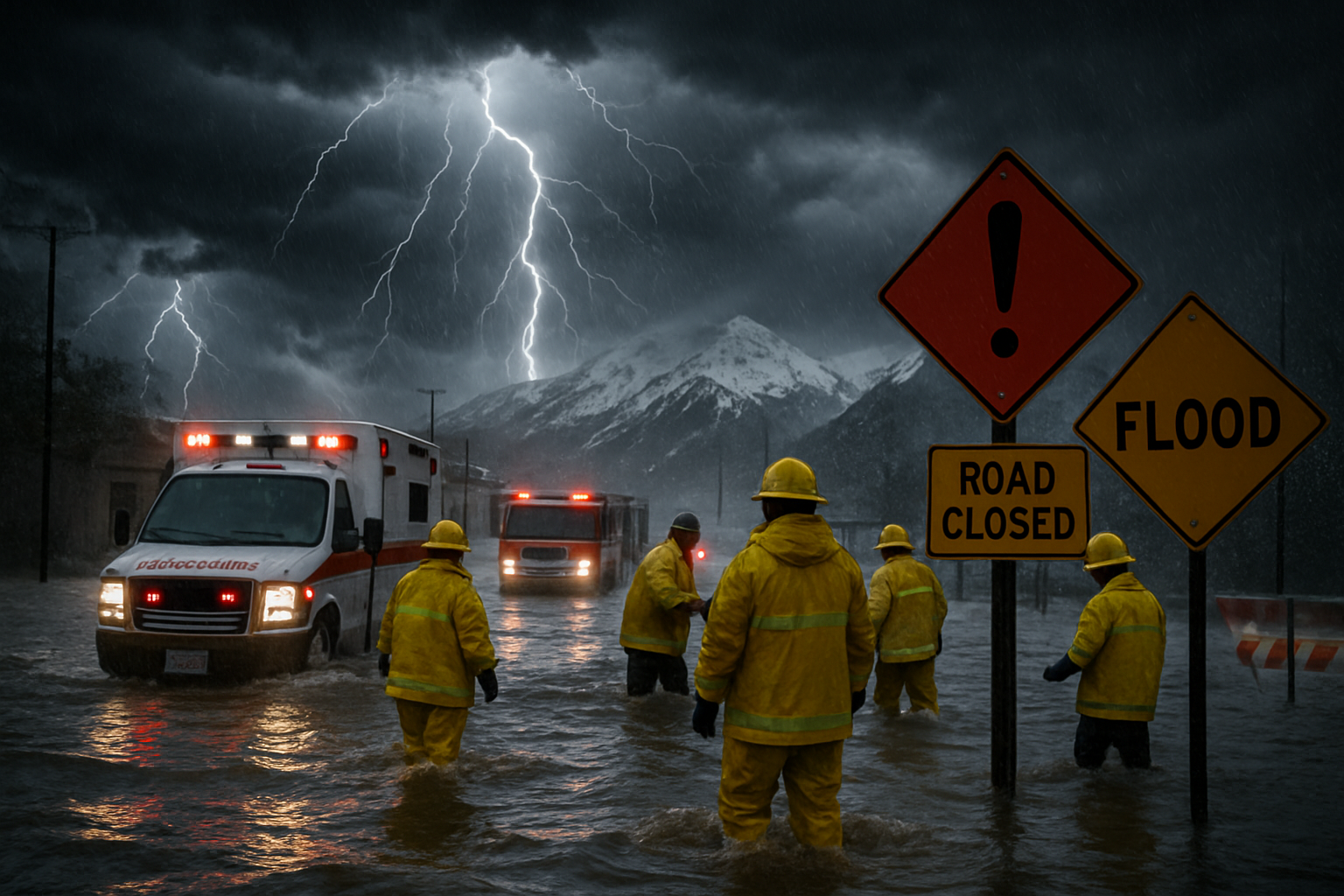
A convergence of extreme weather disasters across five continents has exposed critical gaps in global disaster preparedness systems, as emergency services struggle to cope with simultaneous crises during the 21st consecutive month of temperatures exceeding 1.5°C above pre-industrial levels.
From early spring snow in Bulgaria to catastrophic flooding in Democratic Republic of Congo, from seismic activity in Nicaragua to severe weather warnings in New Zealand, March 2026 has witnessed an unprecedented pattern of weather-related emergencies that are overwhelming traditional response mechanisms designed for sequential, not concurrent disasters.
Multi-Continental Crisis Unfolds
Bulgaria faces an unusual weather phenomenon as astronomical spring arrives on Friday at 4:46 PM local time, yet climatologist Prof. Georgi Rachev warns of possible snowfall through Friday morning. The specialist explained that precipitation will be minimal, confined to limited areas of the Pre-Balkan region and higher parts of Western Bulgaria, with snow predominating in mountainous areas above 1,500 meters.
Meanwhile, in the Democratic Republic of Congo, the city of Uvira in South Kivu is experiencing renewed flooding from rising waters in the Nyangara swamp. Local sources report multiple houses and schools inundated, with residents beginning to relocate to safer areas. The crisis represents a continuation of water level increases that have persisted for over two years, affecting both the Nyangara swamp and Lake Tanganyika.
"The city of Uvira is once again struck by rising waters from the Nyangara swamp, with several houses and schools flooded,"
— Local Sources, Radio Okapi
Caribbean and Pacific Alerts
Haiti has declared a yellow alert across several northern departments due to an approaching weather system capable of producing heavy rains, storms, and dangerous maritime conditions. The National Risk and Disaster Management System warns that weather deterioration will primarily affect the North, Northeast, and Northwest regions starting late Thursday and continuing through the evening.
Authorities are warning against risks of flooding, landslides, and strong swells along the coasts, urging residents in vulnerable areas to take necessary precautions and stay informed about weather developments.
In Nicaragua, specialists are analyzing whether tectonic faults or magma caused recent seismic activity, with SINAPRED and INETER reporting over 20 earthquakes located near Santiago crater. Experts emphasize that thanks to a new network of monitoring stations, surveillance is now permanent, providing better early warning capabilities.
Infrastructure Under Strain
New Zealand presents a different set of challenges, with the Queenstown Lakes District council agreeing to lodge a 35-year resource consent application for discharge from the Shotover Wastewater Treatment Plant. This infrastructure decision reflects the growing pressure on municipal systems to adapt to changing environmental conditions while maintaining essential services.
The global nature of these simultaneous events exposes critical vulnerabilities in emergency response systems that were designed for historical climate patterns. Traditional mutual aid mechanisms, which rely on stable regions assisting others during localized emergencies, are proving inadequate when multiple continents face disasters simultaneously.
Historical Context and Acceleration
These current events build upon a devastating pattern established throughout 2026. February witnessed one of the most catastrophic weather sequences in European history, with the Atlantic storm succession of Kristin-Leonardo-Marta-Nils-Pedro claiming over 35 lives across Portugal, Spain, and France. Portugal deployed 26,500 emergency personnel in its largest peacetime operation, while the EU Civil Protection Mechanism was activated with Sweden and Denmark providing €246 million in assistance—the largest coordinated European weather response on record.
The climate context is unprecedented: January 2026 marked the hottest month in recorded history, extending what is now the 21st consecutive month of global temperatures exceeding 1.5°C above pre-industrial levels. This represents the longest sustained extreme warming period in human history, with human-induced climate change now fundamentally overriding natural cooling mechanisms, including La Niña effects.
Emergency Response Evolution
Emergency management experts are identifying a critical shift from sequential disasters to concurrent "compound disasters," where multiple emergency types occur simultaneously, fundamentally challenging traditional response capabilities. The Australian Fire Emergency Services Authority (AFAC) has noted this transition, requiring resource allocation strategies that differ fundamentally from historical approaches.
Transportation networks, power grids, and communication systems built for historical climate patterns are repeatedly failing as conditions exceed operational parameters. Recovery timelines have shifted from weeks to months or years, representing a fundamental change in disaster response and preparation approaches.
Economic and Social Impact
The economic devastation spans multiple sectors, with agricultural operations facing mounting losses as extreme weather destroys crops and disrupts supply chains during critical growing seasons. Tourism industries are experiencing extended cancellations and infrastructure damage during peak revenue periods. The human cost includes families potentially losing generational homes multiple times within a decade, small businesses facing extinction, and vulnerable populations requiring extended support.
Mental health services report increased demand due to climate anxiety and repeated extreme weather trauma. The psychological burden of unprecedented environmental volatility is placing strain on communities worldwide, with traditional support systems stretched beyond capacity.
Adaptation Imperatives
Climate scientists emphasize that current conditions provide a preview of routine circumstances expected in the 2030s without significant climate adaptation investment. The choice between reactive crisis management and transformative infrastructure adaptation has become increasingly critical as extreme weather frequency and intensity exceed current response capabilities.
"Building back better" with climate-resilient infrastructure has evolved from an optional enhancement to an essential survival strategy. Traditional seasonal patterns that have guided infrastructure design, agricultural planning, and emergency preparedness for centuries are no longer reliable frameworks for future planning.
International Cooperation Under Pressure
Environmental challenges transcend political boundaries, with atmospheric systems and ocean currents transporting climate effects globally regardless of borders. Traditional aid frameworks that assume stable regions can assist others during isolated emergencies are breaking down when multiple continents face disasters simultaneously.
The simultaneity of disasters is testing cooperation mechanisms that were developed assuming sequential rather than concurrent emergencies. This requires unprecedented international cooperation, enhanced coordination, and financial commitments that recognize environmental protection as essential infrastructure for human prosperity and planetary sustainability.
Technology and Traditional Knowledge Integration
Successful responses increasingly require sophisticated integration of cutting-edge technology with traditional ecological knowledge and community-based management. Examples include combining satellite monitoring and environmental DNA analysis with centuries of European forestry expertise, or integrating meteorological forecasting with traditional river management by rural communities.
This hybrid approach provides resilience against single-solution dependencies and offers multiple pathways for addressing complex, interconnected climate challenges.
Looking Ahead: A Decisive Moment
March 2026 represents a potential watershed moment in global climate preparedness, forcing fundamental reconsideration of how humanity responds to permanent climate volatility. The window for effective climate action is narrowing rapidly, with ecological systems approaching critical thresholds that could trigger irreversible changes affecting global food security, climate stability, and human settlements.
The World Meteorological Organization indicates a 50-60% probability of El Niño development during July-September 2026, which could potentially drive unprecedented global temperatures by combining baseline warming with natural cycle amplification during an already record-breaking warming streak.
Additional weather systems are developing across Atlantic and Pacific regions, with authorities maintaining high alert status globally. Current conditions may persist for weeks, representing a potential turning point toward a new baseline of climate volatility rather than exceptional events.
The tools, knowledge, and cooperation frameworks exist for comprehensive environmental protection, but success requires unprecedented speed and coordination through sustained international cooperation and political commitment to environmental protection as essential infrastructure.
The question is no longer whether transformative climate action is needed, but whether humanity can organize and implement solutions rapidly enough to maintain planetary habitability during Earth's most environmentally challenging period in recorded history. The choices made in the coming months may prove decisive for global climate resilience strategies affecting generations to come.