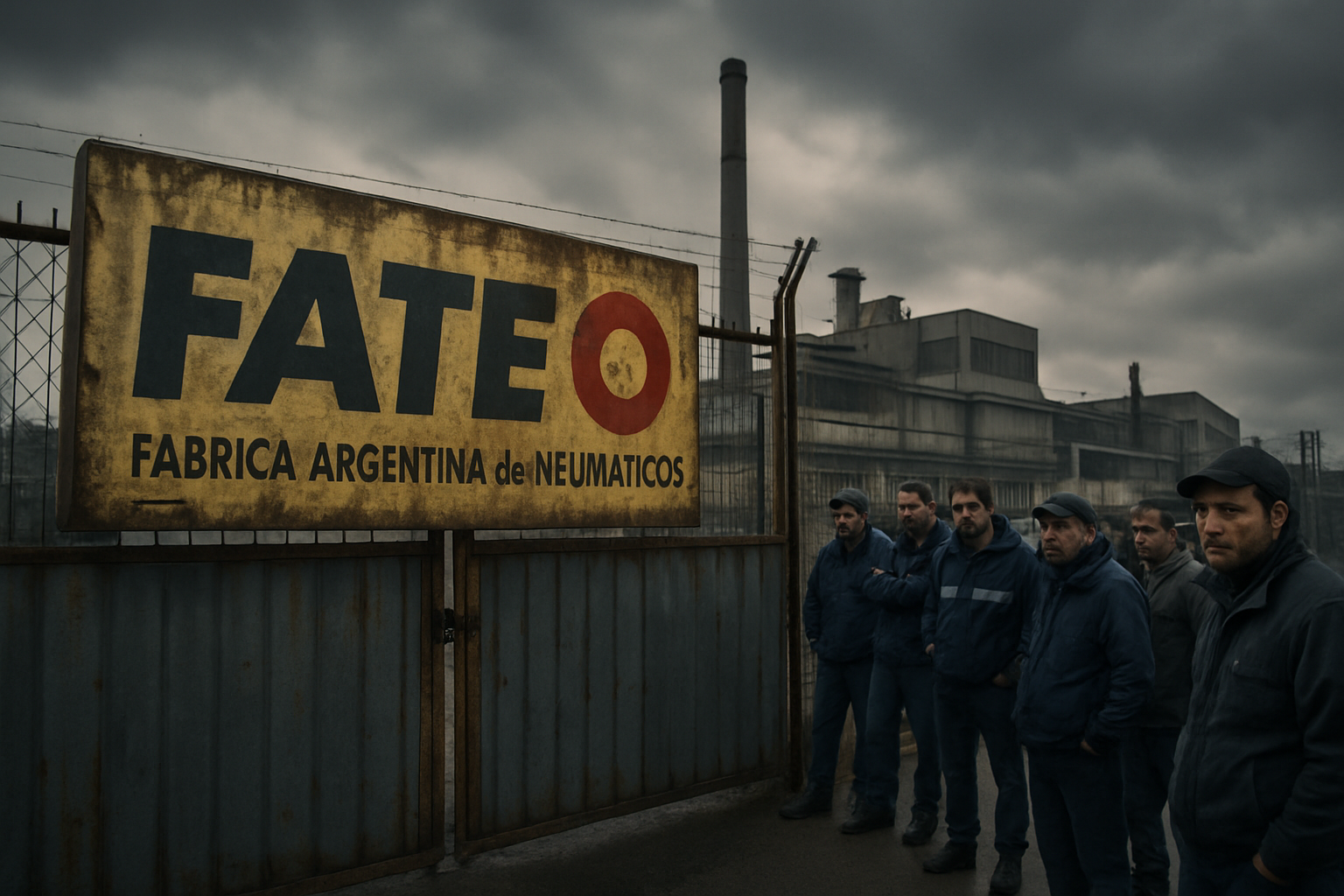
Argentina faces a major industrial and political crisis following the abrupt closure of Fate, the country's iconic tire manufacturer, which dismissed 920 workers at its San Fernando plant on Wednesday, February 18, 2026, in a move that has triggered fierce government accusations of political manipulation and renewed debates over President Javier Milei's economic policies.
The closure of the 80-year-old company, owned by the prominent Madanes Quintanilla family, represents far more than a corporate decision – it has become a flashpoint in Argentina's broader economic transformation under Milei's libertarian administration. The dismissals were delivered through telegrams citing "a context of severe crisis economic and productive, which for some time has been very negatively affecting the company's activity."
Workers Discover Locked Gates
César, a plant operator with 13 years at the company, told LN+ television how he received his dismissal telegram around midday Wednesday. The document, which he showed to reporters, represented the end of nearly a century of tire production in Argentina. "Almost 1,000 employees were left without work this Wednesday after Fate, Argentina's radial tire producer, decided to close the doors of its San Fernando plant," according to reports from the scene.
Jorge Ayala, another dismissed worker with 32 years of service, expressed the human cost of the closure: "Where the hell am I going to work again? I won't have another opportunity, I'm old for the job market, I thought I was going to retire here." His desperation reflects the broader impact on families who had built their lives around steady employment at the historic factory.
Government Alleges Political Motives
President Milei's administration has responded with unprecedented accusations against the company's ownership. The government denounced what it calls a "political measure" behind the closure, with officials using social media to harshly question the Madanes Quintanilla family's motives. This represents an unusual direct confrontation between Argentina's government and one of its most established business families.
The timing of the closure has raised suspicions within government circles, coming amid Milei's push for comprehensive labor reforms and trade liberalization policies. Critics of the administration argue that the closure demonstrates the devastating impact of rapid economic restructuring, while government supporters suggest it represents deliberate sabotage by established business interests resistant to change.
Broader Economic Context
The Fate closure occurs within Argentina's severe employment crisis, with 21,938 companies ceasing operations under the Milei administration, affecting 290,602 workers according to the Superintendency of Labor Risks. This represents one of the most significant industrial contractions in recent Argentine history, heavily concentrated in the construction and manufacturing sectors.
Economist Carlos Maslatón provided sharp analysis of the situation, stating: "There is only one reason for this catastrophe: the exchange rate, monetary and debt policy in force since 2024. This Martínez de Hoz model was validated at the polls last October and now we have to accept the consequences of that democratic decision. Even if nothing is left standing." He also criticized "the happiness expressed by the Argentine government every time a national company goes bankrupt."
The company's closure directly reflects the impact of commercial liberalization policies that have allowed Chinese tire imports to devastate the domestic market. Owner Javier Madanes Quintanilla is reportedly focusing on the energy business through his Aluar company, abandoning tire manufacturing entirely.
Political Opposition Response
Opposition leaders have seized on the Fate closure as evidence of the Milei administration's failed economic approach. Governor Vargas Aignasse criticized the national government, stating: "Each factory that closes in Argentina is not just a number in a statistic: they are families that lose stability, shops that sell less and communities that weaken."
The closure has become a rallying point for critics of Milei's rapid trade liberalization, coinciding with ongoing labor reform debates and the recent US-Argentina trade agreement that eliminated over 1,600 tariffs. Opposition figures argue that the pace of change is overwhelming Argentina's industrial capacity to adapt.
Historical Significance
Fate's closure marks the end of an era for Argentine industry. The company represented Argentina's industrial heritage and manufacturing capacity built over decades. The 40-hectare facility in Virreyes, San Fernando, Buenos Aires Province, employed nearly 1,000 workers and served as an anchor for the local economy through supplier and service provider relationships.
The closure symbolizes broader challenges facing Latin American manufacturing under pressure from Asian competition, particularly from China. It demonstrates how quickly trade liberalization can disrupt established industries when domestic companies cannot compete with lower-cost international alternatives.
Worker Impact and Community Response
Many of the dismissed workers have 20-30 years of service, mortgages, and families dependent on their income. The multiplier effect extends throughout the San Fernando community, affecting local businesses, schools, and services that relied on worker spending. The company has promised severance payments "in due time and form," though workers and union representatives express skepticism about the timeline and adequacy of compensation.
Local unions are reviewing legal options while preparing for what could be a prolonged struggle over worker rights and compensation. The broader labor movement views the Fate closure as emblematic of the challenges facing workers under Milei's economic restructuring.
International and Regional Implications
The Fate controversy illustrates broader tensions in Argentina's economic transformation. While the Milei administration pursues closer ties with the Trump administration through trade agreements and investment partnerships, domestic industrial capacity faces unprecedented pressure. The closure occurs as Argentina positions itself as a key US partner in South America, raising questions about balancing international competitiveness with domestic industrial preservation.
The case represents a template for industrial vulnerability under unrestricted import competition, with implications extending beyond Argentina to other Latin American countries considering similar trade liberalization policies. Regional observers are monitoring whether the speed of economic transformation can be managed without overwhelming social safety nets designed for gradual adjustment.
As Argentina grapples with this latest industrial crisis, the Fate closure stands as a stark reminder of the human cost of rapid economic change and the complex political dynamics surrounding President Milei's transformative agenda. The resolution of this crisis may well determine the sustainability of Argentina's economic model and the government's ability to maintain public support while implementing fundamental structural reforms.