February 2026 is shaping up to be one of the most extraordinary months in recent astronomical history, with a rare six-planet alignment culminating on February 28 coinciding with groundbreaking discoveries about black holes and fundamental questions about the universe's structure.
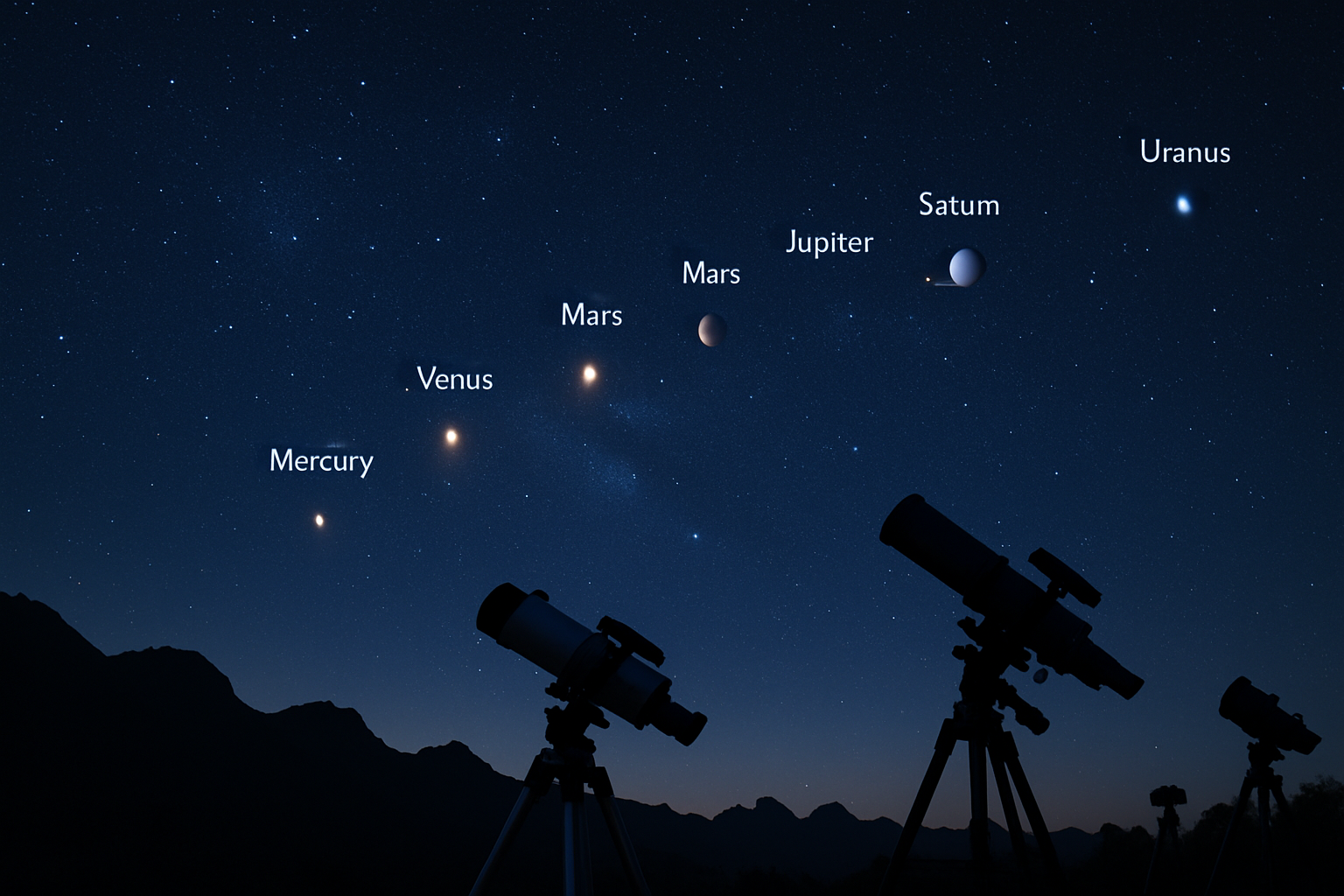
The highly anticipated planetary alignment, described by astronomical experts as one of the year's most spectacular celestial events, will feature Mercury, Venus, Mars, Jupiter, Saturn, and Uranus in a rare "parade of planets" formation visible from multiple countries worldwide. According to Star Walk, a specialized astronomy portal, the phenomenon will reach its peak visibility during the last week of February, with maximum proximity and visibility occurring on February 28.
The Great Planetary Parade of 2026
The alignment, also known as a "planetary parade," represents a remarkable convergence of celestial mechanics that occurs when planets appear to line up in the sky from Earth's perspective. This particular alignment is especially significant due to the inclusion of Uranus, making it visible to amateur astronomers with proper equipment.
The event will be observable from several vantage points around the globe, with optimal viewing conditions varying by geographic location. Argentina, along with other South American countries, is expected to have excellent visibility for this cosmic spectacle, weather permitting.
"This type of alignment offers unique opportunities for both scientific observation and public engagement with astronomy," explained researchers familiar with the phenomenon. The event coincides with broader international efforts to make astronomical observations more accessible through digital streaming and collaborative observation programs.
Revolutionary Black Hole Discovery Challenges Cosmic Understanding
While skywatchers prepare for the planetary alignment, astronomers have announced a discovery that could fundamentally alter our understanding of black hole behavior. A cosmic event first detected in 2018 continues to intensify years later, baffling scientists with its unprecedented power and unusual characteristics.
The black hole, located hundreds of millions of light-years from Earth, is releasing energy estimated to be 100 trillion times greater than the fictional Death Star from Star Wars. What makes this discovery particularly remarkable is not just the scale of energy release, but the sustained nature of the phenomenon, which continues to increase in intensity long after the initial detection.
This discovery builds on recent breakthroughs in black hole research documented throughout early 2026. Previous studies have revealed black holes with persistent matter ejection lasting over six years following stellar consumption, challenging conventional understanding of tidal disruption events. These phenomena, sometimes described as cosmic "indigestion" or "burping," represent complex feeding mechanisms that extend far beyond the brief explosive events typically observed.
Einstein's Universe Under Question
Adding to February's astronomical significance, new research published in Reviews of Modern Physics has detected discrepancies in galaxy distribution that challenge one of the fundamental pillars of modern cosmology. The study suggests the universe might not be as symmetric as Einstein's theories predicted, questioning the long-held assumption that the universe appears identical in all directions.
This research represents part of a broader pattern of discoveries that are forcing astronomers to reconsider fundamental cosmic principles. Earlier findings have included the identification of "impossible" planetary systems 116 light-years away that shouldn't exist according to current formation theories, and NASA's Juno mission revealing that Jupiter is smaller than previously calculated for over 50 years.
"These discoveries are not just adding to our knowledge – they're forcing us to rewrite textbooks and reconsider fundamental assumptions about how the universe works."
— International Astronomy Research Community
The Golden Age of Space Observation
February 2026's astronomical events occur during what experts are calling the transition from the "AI revolution to the space economy golden age." This period has been marked by unprecedented international cooperation in space observation, with facilities like the James Webb Space Telescope continuing to revolutionize our cosmic understanding through infrared capabilities and advanced positioning.
Recent achievements include the first direct measurement of cosmic rays in the Barnard 68 nebula 400 light-years away, accomplished by Technion-Israel Institute of Technology researchers using innovative infrared techniques. This breakthrough has opened what scientists describe as "a new field of astrophysics research," enabling understanding of how high-energy particles from supernovae and active galactic nuclei influence star formation processes.
The University of Washington has also achieved record-breaking asteroid discovery using the new Vera C. Rubin Observatory in Chile, demonstrating the facility's unprecedented capabilities with the world's largest digital camera designed for the Legacy Survey of Space and Time (LSST).
International Collaboration Drives Discovery
The convergence of these astronomical phenomena highlights the increasing importance of international cooperation in space research. Multiple countries have established observation networks, shared telescope facilities, and coordinated research programs that enable discoveries impossible for any single nation to achieve alone.
This collaborative approach extends beyond traditional space powers. Emerging nations are gaining space capabilities through educational initiatives, with universities deploying nanosatellites for scientific research and public safety applications. The democratization of space technology is enabling developing countries to participate in the space economy through innovation and education.
Thailand's appointment as chair of the UN Scientific and Technical Subcommittee for space governance reflects this shift toward broader international participation in space affairs. Meanwhile, sophisticated monitoring networks in multiple countries are providing rapid detection and analysis of astronomical events, contributing to global understanding of cosmic phenomena.
Technology Meets Traditional Astronomy
The February 2026 discoveries demonstrate how advanced technology is revolutionizing astronomical research. AI integration is enabling autonomous navigation for space-based instruments, real-time decision-making across cosmic distances, and sophisticated algorithms for distinguishing cosmic phenomena from other electromagnetic signals.
However, these technological advances build upon centuries of astronomical tradition. The planetary alignment visible on February 28 represents the same type of celestial event that has fascinated humanity since ancient times, now enhanced by modern understanding of orbital mechanics and advanced observation equipment.
Digital streaming and global observation networks will make the February 28 planetary alignment accessible to worldwide audiences, bridging the gap between professional astronomy and public engagement. This accessibility reflects broader trends toward democratizing scientific knowledge and encouraging citizen participation in astronomical observation.
Looking Beyond February 2026
The astronomical discoveries of February 2026 establish important precedents for future research. The sustained black hole emissions suggest that cosmic phenomena may operate on longer timescales and through more complex mechanisms than previously understood. The potential asymmetry in universe structure could require fundamental revisions to cosmological models.
Meanwhile, the planetary alignment serves as a reminder of the precise clockwork of celestial mechanics, even as discoveries about "impossible" planetary systems challenge our understanding of how such systems form and evolve.
These developments occur during a critical period for space exploration, with multiple nations advancing their capabilities and international cooperation frameworks expanding. The combination of traditional astronomical observation with cutting-edge technology, enhanced by global collaboration, positions humanity for an era of unprecedented cosmic discovery.
As February 2026 concludes, the month will be remembered as a watershed period when spectacular natural phenomena coincided with paradigm-shifting scientific discoveries, demonstrating both the predictable beauty of celestial mechanics and the persistent mysteries that continue to challenge our understanding of the universe. The planetary alignment of February 28 offers a perfect metaphor for this moment – a rare convergence of cosmic elements that illuminates new possibilities while reminding us of the vast unknowns that still await discovery.