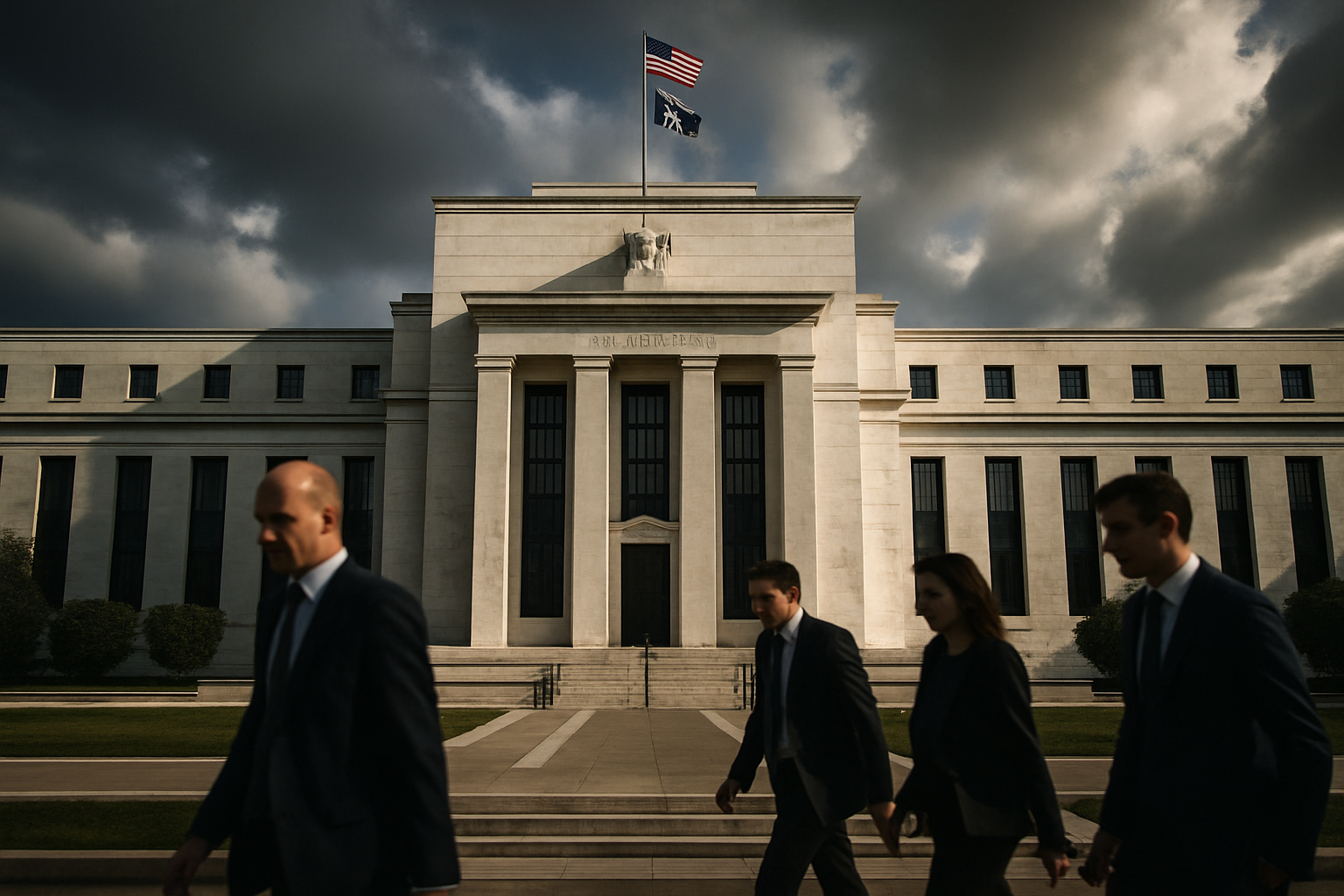
The Federal Reserve maintained interest rates unchanged at 3.5-3.75 percent on Wednesday in a narrow 11-1 vote, defying pressure from President Trump while citing unprecedented economic uncertainty from the escalating Iran conflict and persistent inflation concerns.
Fed Chair Jerome Powell delivered a measured statement emphasizing the central bank's independence during what he described as "one of the most challenging economic environments in decades." The decision comes as oil prices have surged above $100 per barrel for the first time since 2022, driven by Iran's closure of the Strait of Hormuz affecting 40% of global oil transit.
"The implications of developments in the Middle East for the US economy are uncertain," Powell stated at the post-meeting press conference. "We are monitoring energy price developments closely and their potential impact on inflation expectations."
Energy Crisis Drives Policy Caution
The Fed's decision reflects growing concern about the economic fallout from the ongoing Iran-Israel conflict, which has created the most severe energy crisis since the 1970s oil shocks. Brent crude has peaked at $119.50 per barrel, with West Texas Intermediate jumping a record 18.98% in a single day to $108.15.
Natural gas prices have exploded 24% in Europe and 78% in the United States, reaching €47.32/MWh—the highest since February 2025. The International Energy Agency has announced the largest strategic petroleum reserve release in its 50-year history, deploying 400 million barrels from 32 countries in an unprecedented emergency response.
Powell acknowledged that energy price volatility creates a complex challenge for monetary policy. "Unlike typical supply-demand imbalances, geopolitical disruptions of this magnitude create uncertainty that traditional monetary policy tools cannot easily address," he explained.
Trump Administration Pressure Intensifies
The Fed's decision comes despite intense pressure from the Trump administration, which has called for rate cuts to stimulate economic growth. Sources familiar with the discussions indicate the White House has grown increasingly frustrated with Powell's independence, particularly as the 2026 midterm elections approach.
The tension between the administration and the Fed reached new heights earlier this month when a federal judge blocked Justice Department subpoenas targeting Powell, ruling that the investigation was "politically motivated" harassment designed to pressure the Fed chairman into policy changes.
Powell remained diplomatic when asked about administration pressure, stating: "The Federal Reserve makes monetary policy decisions based on economic data and our dual mandate of price stability and maximum employment, independent of political considerations."
Global Financial Market Turmoil
The Fed's decision came against the backdrop of severe global financial market disruption. Pakistan's KSE-100 index suffered its worst single-day decline in history, plunging 8.97%. South Korea's KOSPI fell 12%, triggering circuit breakers, while the Korean won hit a 17-year low.
Wall Street futures indicated significant declines, with the Dow dropping 400-570 points in pre-market trading. Several major IPOs, including PayPal's $1.1 billion offering, have been postponed indefinitely due to market volatility.
Aviation markets have been particularly hard hit, with over 18,000 flights cancelled worldwide—the most severe disruption since COVID-19. Dubai International Airport, the world's busiest, remains shuttered due to missile damage, while major carriers including Emirates and Air France-KLM have suspended operations indefinitely.
Inflation Concerns Resurface
The Fed's statement highlighted renewed inflation pressures from the energy crisis. Core personal consumption expenditures (PCE) inflation, the Fed's preferred measure, had been trending toward the 2% target before the recent geopolitical developments.
"Energy price shocks of this magnitude have historically proven to be highly inflationary, with effects extending far beyond transportation and heating costs."
— Fed Governor Lisa Cook
The central bank now projects one rate cut by year-end, down from earlier expectations of three cuts. Several Fed officials expressed concern that premature easing could allow inflation expectations to become "unanchored" if energy price increases prove persistent.
Regional Economic Impact
The crisis has created uneven regional impacts across the United States. Energy-producing states like Texas and North Dakota are experiencing economic benefits from higher oil prices, while manufacturing centers in the Midwest face rising input costs that could pressure profit margins.
Consumer spending patterns are already shifting, with retail sales data showing increased purchases of fuel-efficient vehicles and energy-saving appliances. Household energy costs have risen approximately 15% nationally since the conflict began, with larger increases in regions dependent on imported energy.
International Coordination Efforts
Powell revealed that the Fed is coordinating closely with other major central banks, including the European Central Bank and Bank of Japan, to monitor global financial stability risks. The central banks have established emergency liquidity facilities to prevent the kind of funding stress that could amplify the crisis.
"The interconnected nature of global financial markets requires unprecedented coordination among central banks," Powell noted. "We're prepared to take additional actions if market functioning becomes impaired."
Nuclear Diplomacy Collapse Context
The Fed's cautious approach reflects broader uncertainty about the conflict's duration and economic impact. The current crisis stems from the complete breakdown of US-Iran nuclear negotiations, despite earlier breakthrough progress in Geneva talks that had raised hopes for a diplomatic solution.
Iran's exclusion of ballistic missiles and regional proxies as "red lines" proved incompatible with US demands for a comprehensive agreement covering missiles, armed groups, and human rights issues. This scope disagreement led to Operation Epic Fury, the largest US-Israeli coordinated military operation since 2003, followed by Iran's massive retaliation campaign.
Forward Guidance Challenges
The Fed faces unusual challenges in providing forward guidance given the unprecedented nature of the current crisis. Unlike typical economic cycles driven by domestic factors, the current uncertainty stems from geopolitical developments that monetary policy cannot directly influence.
"We're in uncharted territory," acknowledged Fed Vice Chair Lael Brainard. "Traditional economic models don't adequately capture the feedback effects between geopolitical conflict and financial market stability."
The central bank indicated it would remain "data dependent" but acknowledged that standard economic indicators may be less reliable during periods of severe geopolitical stress. The Fed will closely monitor energy markets, supply chain disruptions, and their second-order effects on consumer spending and business investment.
Market Reaction and Analysis
Financial markets showed mixed reactions to the Fed's decision. While equity futures declined sharply on concerns about economic growth, bond markets rallied as investors sought safe-haven assets. The dollar strengthened against most major currencies, reflecting its traditional role as a global reserve currency during periods of uncertainty.
Fixed income analysts noted that the Fed's cautious stance provides some stability anchor during the current turbulence. "The Fed's decision to remain on hold gives markets one less variable to worry about," said Maria Rodriguez, senior economist at Goldman Sachs.
Looking Ahead
The Fed's next meeting in six weeks will likely prove crucial in determining the central bank's response to the ongoing crisis. Powell indicated that officials would be watching several key indicators, including energy price stabilization, supply chain recovery, and the broader geopolitical situation's evolution.
The central bank faces the challenging task of maintaining price stability while supporting economic growth during what Powell described as "the most significant geopolitical crisis since the Cold War." The outcome of this delicate balancing act will have profound implications for both the US and global economies.
As global markets continue to grapple with unprecedented energy price volatility and geopolitical uncertainty, the Federal Reserve's commitment to data-driven, independent monetary policy provides a crucial anchor of stability. Whether this approach proves sufficient to navigate the current crisis remains to be seen, but it represents the institution's determination to fulfill its mandate despite extraordinary external pressures.