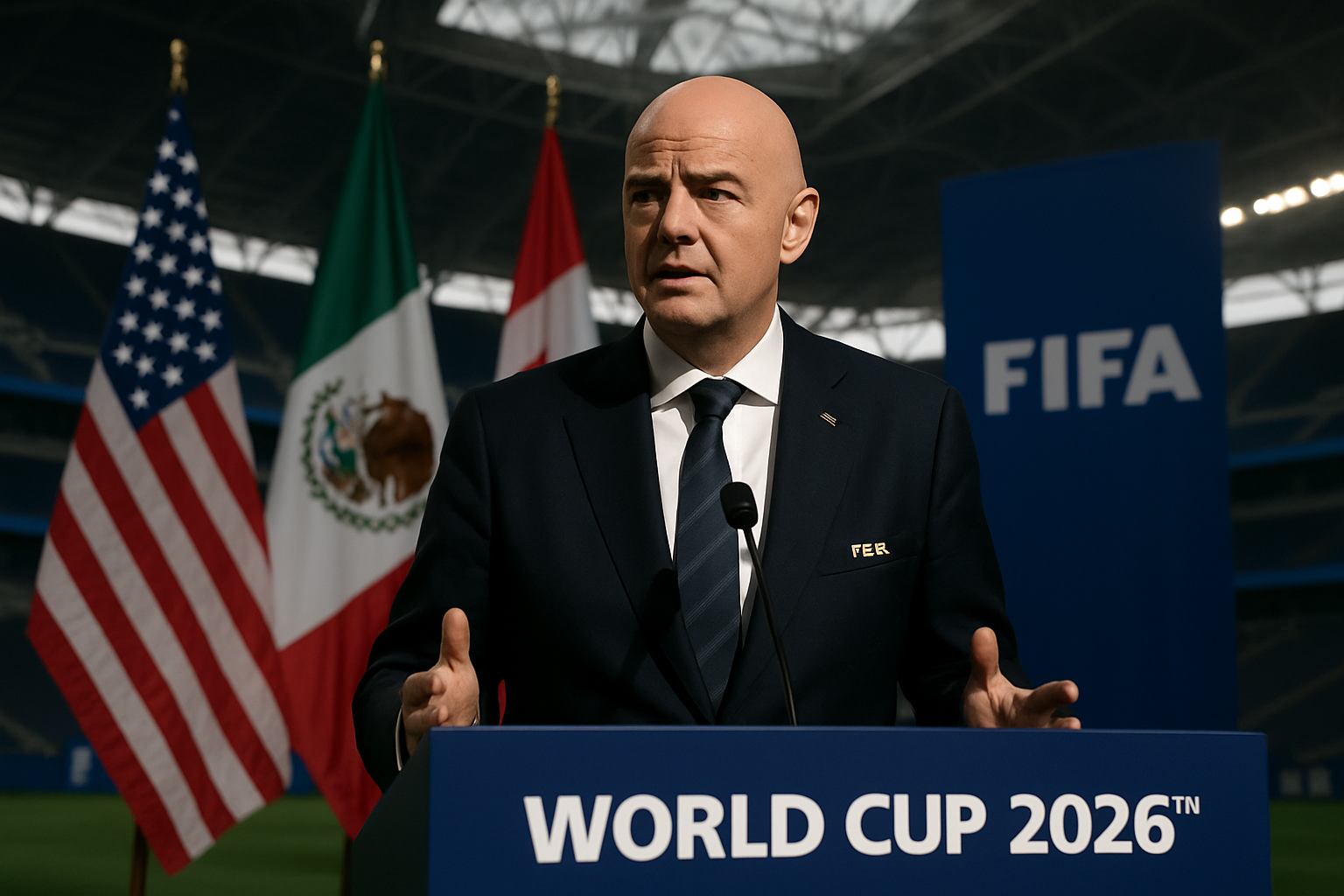
FIFA President Gianni Infantino has definitively confirmed that Iran will participate in the 2026 FIFA World Cup and will play their group stage matches in the United States as originally scheduled, despite ongoing geopolitical tensions and previous requests from Iranian officials to relocate their games to Mexico.
Speaking to AFP after attending Iran's friendly match against Costa Rica near Antalya, Turkey, on Tuesday, Infantino declared unequivocally: "Iran will be at the World Cup and will play their group matches in the United States, according to the original planning." This statement ends months of speculation and uncertainty surrounding Iran's participation in football's premier tournament.
Iran's Group G Schedule Remains Unchanged
Iran is drawn in Group G alongside Belgium, New Zealand, and Egypt, with their matches scheduled at prestigious US venues. The Iranian national team will face New Zealand on June 15 at SoFi Stadium in Inglewood, California, followed by a match against Belgium on June 21 at the same venue. Their final group stage encounter against Egypt is set for June 26 at Lumen Field in Seattle.
These fixtures represent significant moments for the substantial Iranian-American community in Los Angeles, known as "Tehrangeles," which numbers over 200,000 residents. The community had been uncertain about supporting their national team amid the complex geopolitical backdrop.
Months of Uncertainty and Diplomatic Requests
The confirmation comes after a prolonged period of uncertainty that began in February 2026. Iranian Football Federation President Mehdi Tadj had previously stated there was "no clarity" regarding Iran's participation due to ongoing tensions between Iran and the United States following military conflicts that erupted in early 2026.
Multiple reports indicated that Iran had formally requested FIFA to relocate their matches from US venues to Mexican territory, citing security concerns. The Islamic Republic suggested alternative venues including Estadio Azteca in Mexico City, BBVA Stadium in Monterrey, and Akron Stadium in Guadalajara. Mexican President Claudia Sheinbaum had publicly stated that Mexico would have "no inconvenience" hosting Iran's matches if FIFA approved the changes.
"Iran will be at the World Cup and will play their group matches in the United States, according to the original planning."
— Gianni Infantino, FIFA President
FIFA's Institutional Stance on Political Neutrality
FIFA's decision to maintain the original scheduling represents a significant institutional stance on the organization's commitment to political neutrality while managing unprecedented geopolitical challenges. The governing body has repeatedly emphasized that football should transcend political boundaries, even in the face of complex international relations.
This marks the first time in World Cup history that a qualified nation has sought venue changes due to geopolitical tensions with a host country, setting a crucial precedent for how international sporting bodies navigate political conflicts. FIFA had requested detailed security reports from all three host nations but maintained confidence in US hosting capabilities throughout the process.
Security Preparations and Tournament Logistics
The 2026 World Cup represents the most logistically complex tournament in FIFA history, being the first to span three countries (United States, Canada, and Mexico) with an expanded 48-team format featuring 104 matches across 16 host cities. The tournament begins on June 11 at Estadio Azteca in Mexico City and concludes on July 19 at MetLife Stadium in New York.
Mexico has deployed an unprecedented 100,000 security personnel for the tournament - the largest security operation in the country's history - following cartel violence that affected Guadalajara earlier in 2026. FIFA has worked closely with all three host nations to ensure comprehensive security arrangements for the historic tri-national event.
Broader Context and Historical Precedent
Iran's confirmed participation comes against the backdrop of the most dangerous international crisis since the Cold War, which saw massive disruptions to global aviation, energy markets, and diplomatic relations throughout early 2026. The crisis led to over 18,000 flight cancellations worldwide and significant disruptions to international sporting events and travel.
The situation had raised concerns about Iran potentially becoming the first qualified nation in World Cup history to withdraw due to military conflict. Such an unprecedented withdrawal would have required FIFA to implement contingency plans, potentially advancing Iraq as the next-ranked Asian team or restructuring Group G entirely.
Tournament's Vision of Global Unity
FIFA President Infantino has consistently emphasized the 2026 World Cup's role in demonstrating football's power to unite nations and transcend political differences. The tournament features several innovations, including the first tri-national hosting arrangement and the expanded format that provides opportunities for more nations to participate on the global stage.
With nearly 2 million tickets already sold in the first two phases, the tournament is generating unprecedented interest across North America. The inclusion of Iran alongside traditional football powers Belgium and emerging nations like New Zealand creates compelling group dynamics that exemplify the World Cup's global reach.
Looking Ahead to June 2026
As preparations continue for the historic tournament, FIFA's decision to maintain Iran's participation in US venues demonstrates the organization's commitment to sporting integrity over political considerations. The matches will serve as a test case for international sports' ability to provide neutral ground for competition despite complex geopolitical realities.
For the Iranian national team, the confirmation provides crucial clarity for their preparation, allowing them to focus on football rather than venue uncertainty. Their participation ensures that the expanded World Cup will feature its full complement of qualified nations, maintaining the tournament's credibility as the world's premier football competition.
The 2026 World Cup's success in navigating these unprecedented challenges may establish important precedents for future international sporting events facing similar geopolitical complexities in an increasingly interconnected but politically divided world.