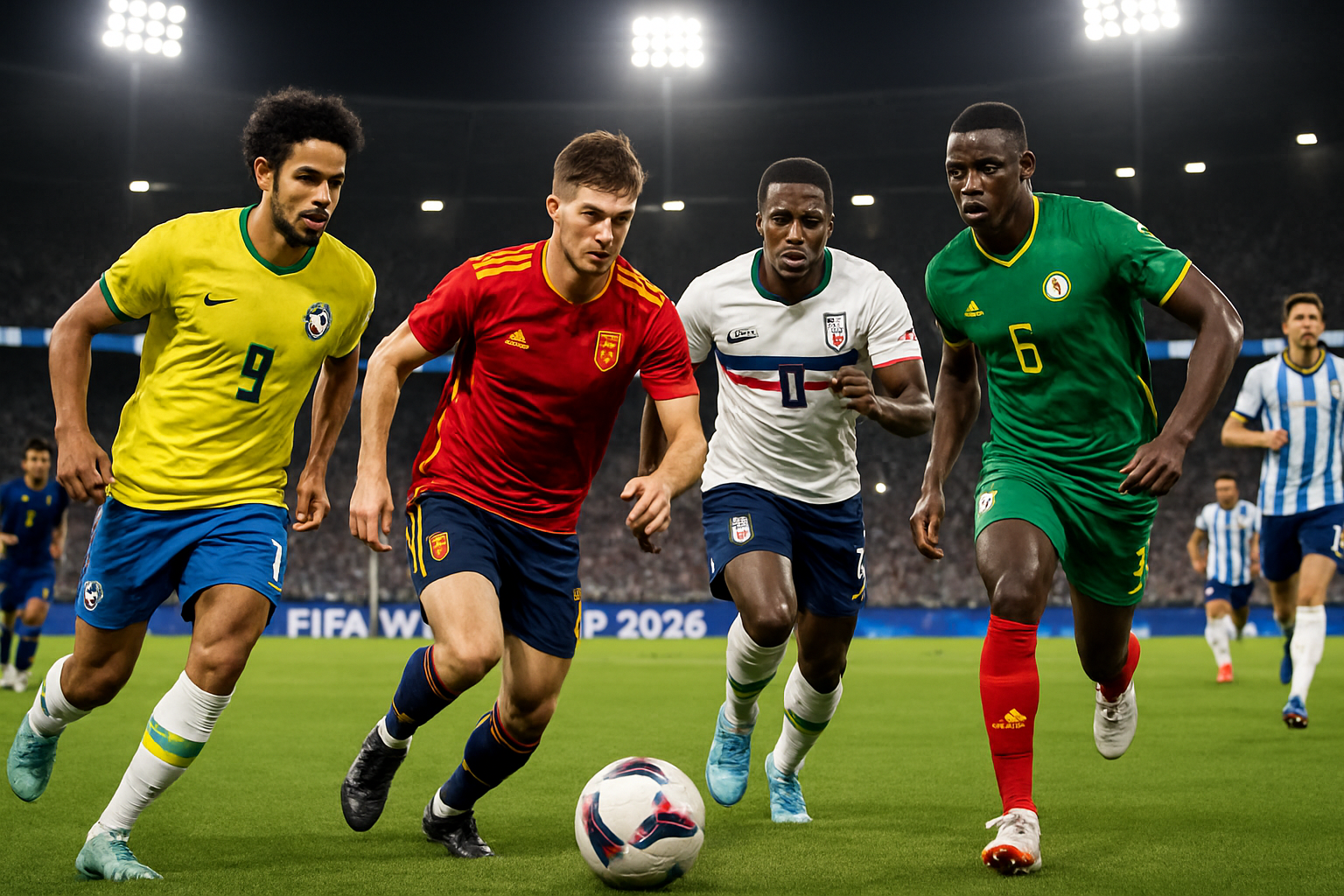
With fewer than 100 days remaining until the FIFA World Cup 2026 kicks off on June 11, national teams worldwide are intensifying their preparations through crucial qualification playoffs, international friendlies, and strategic player development ahead of the expanded 48-team tournament across the United States, Canada, and Mexico.
European Playoff Drama Reaches Climax
The stakes could not be higher in European qualification, where traditional powerhouses face the specter of missing another World Cup. Bosnia and Herzegovina secured a dramatic victory over Wales, advancing 4-2 on penalties after a 1-1 draw in Cardiff that saw Edin Džeko score his 74th international goal to equalize Daniel James's earlier strike.
The victory sets up a playoff final against Italy on March 31 at Zenica, with Bosnia pursuing their first-ever World Cup qualification since independence. "This is Mount Everest for us," acknowledged Italian coach Gennaro Gattuso, recognizing the magnitude of the challenge facing the defending European champions.
Italy's path to the final came through a convincing 2-0 victory over Northern Ireland, with goals from Sandro Tonali and Moise Kean. However, the Azzurri face the uncomfortable reality of potentially missing a third consecutive World Cup, having failed to qualify for both the 2018 and 2022 tournaments.
Global Friendly Preparations Showcase Tournament Readiness
International friendlies across the globe have provided teams with crucial preparation opportunities. New Zealand's All Whites delivered a statement performance with a comprehensive 4-0 victory over Chile at Eden Park, breaking their longstanding winless streak against South American opposition.
"This result gives us enormous confidence heading into the World Cup,"
— New Zealand coach, following the historic victory over Chile
The match was particularly significant as it marked New Zealand's first victory over a South American team in decades, providing a major psychological boost ahead of their World Cup campaign in Group G, where they will face Iran's replacement team following Iran's unprecedented withdrawal due to geopolitical tensions.
In South America, Argentina continued their World Cup preparations with a 2-1 victory over Mauritania at La Bombonera, featuring goals from Enzo Fernández and Nicolás Paz. Coach Lionel Scaloni utilized tactical rotation, with Lionel Messi entering only in the second half as part of careful player management ahead of the tournament.
FIFA Series Competitions Provide Final Test
The FIFA Series 2026 has emerged as a crucial testing ground for teams fine-tuning their preparations. Azerbaijan took on Sierra Leone in what represents a vital opportunity for emerging football nations to gain international experience ahead of the expanded World Cup format.
Venezuela faced Uzbekistan in another FIFA Series encounter, with matches providing teams from diverse confederations the chance to test themselves against unfamiliar opposition styles. These competitions have become increasingly important as the 48-team format creates opportunities for nations that previously had limited chances of World Cup qualification.
Tournament Logistics and Challenges
The 2026 World Cup represents the largest in history, featuring 48 teams competing in 104 matches across three countries. The tournament's scale has created unprecedented logistical challenges, from visa processing to security coordination across borders spanning over 4,000 kilometers.
Recent developments have highlighted these complexities, with FIFA cancelling 70-80% of hotel reservations in Vancouver and Toronto, affecting roughly 15,000 room nights according to the BC Hotel Association. The changes, occurring just months before the tournament begins, have raised questions about accommodation planning and economic projections for Canadian host cities.
Individual Stars and Team Dynamics
Several key players have emerged as focal points for their national teams' World Cup ambitions. Latvia's media coverage has highlighted uncertainty surrounding Argentina's Lionel Messi's participation, with coach Lionel Scaloni maintaining strategic ambiguity about the superstar's role in what could be his final World Cup.
Bosnia's Edin Džeko continues to defy age expectations, with his equalizer against Wales marking another milestone in a career that has seen him become his country's all-time leading scorer. The 37-year-old striker represents the experience and leadership that could prove crucial in Bosnia's historic qualification bid.
Qualification Stakes and National Dreams
For many nations, the 2026 World Cup represents more than just sporting achievement. Jamaica's Reggae Boyz have been training intensively for their playoff against the Democratic Republic of Congo, seeking their first World Cup appearance since 1998. The match, held in Mexico, carries enormous significance for both nations pursuing breakthrough moments on football's biggest stage.
The Democratic Republic of Congo, meanwhile, aims to reach their first World Cup since 1974, having navigated a challenging qualification path that saw them eliminate higher-ranked opponents to reach this crucial playoff stage.
Enhanced Competition Format Creates New Opportunities
The expanded 48-team format has fundamentally altered World Cup qualification dynamics, providing more opportunities for traditionally underrepresented regions while maintaining competitive intensity. The format has created additional playoff pathways, allowing teams that might have missed previous tournaments to compete for qualification.
This democratization of opportunity is evident in the diverse range of nations still competing for final spots, from European stalwarts like Italy to emerging football nations seeking their first World Cup appearances.
Final Countdown Begins
As teams enter the final phase of preparation, the next few weeks will prove decisive. The European playoff finals on March 31 will determine the continent's final qualifiers, while intercontinental playoffs will complete the field for what promises to be the most diverse and competitive World Cup in history.
The tournament's June 11 start date at Mexico City's iconic Estadio Azteca is rapidly approaching, with teams worldwide making final tactical adjustments, injury assessments, and squad selections. For many players and nations, this represents a once-in-a-generation opportunity to compete on football's ultimate stage.
With global attention intensifying and preparation matches providing final tune-ups, the 2026 FIFA World Cup is positioned to deliver unprecedented drama, diversity, and sporting excellence when it begins across North America this summer.