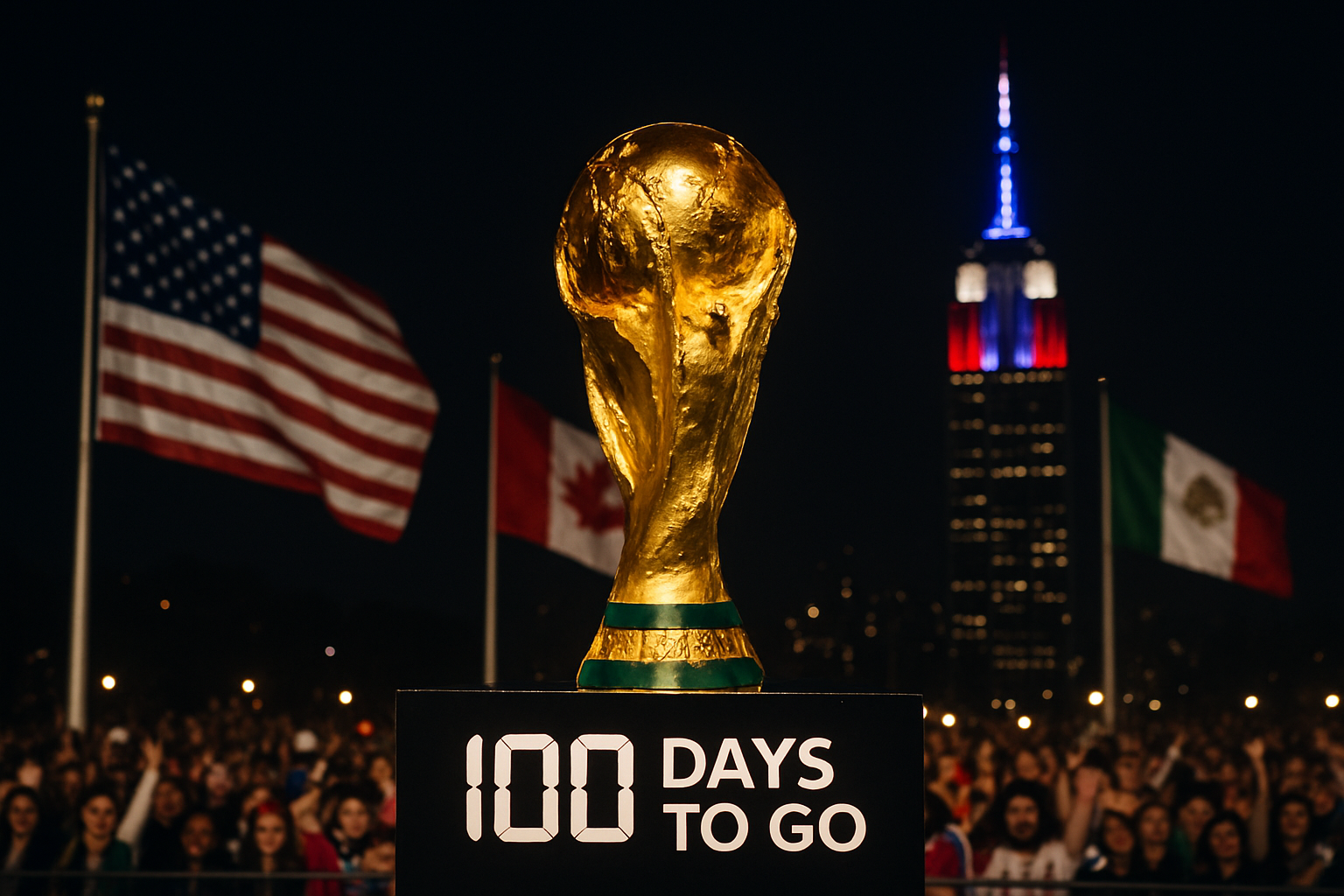
FIFA announced strong early ticket sales of nearly two million tickets for the 2026 World Cup, as the tournament enters its final 100-day countdown with Iran's participation status creating unprecedented uncertainty for football's premier global event.
The global football governing body confirmed that approximately two million tickets were sold during the first two phases of sales for the expanded 48-team tournament, which will be jointly hosted by the United States, Canada, and Mexico from June 11 to July 19, 2026.
Historic Tournament Milestone Approaches
The ticket sales announcement comes as organizers marked a symbolic milestone with the Empire State Building in New York illuminated in the colors of the three host nations' flags. The ceremony featured the tournament's three official mascots: Maple the moose (Canada), Zayu the jaguar (Mexico), and Clutch the bald eagle (United States).
This World Cup represents the largest in football history, expanding from the traditional 32 teams to 48 nations competing across 104 matches. The tournament will begin at Mexico City's iconic Estadio Azteca on June 11, 2026, and conclude at the New York New Jersey Stadium on July 19.
"Our objective as the Organizing Committee for New York-New Jersey is to be prepared to welcome the world," tournament organizers stated during the countdown ceremony.
— FIFA World Cup 2026 Organizing Committee
Iran's Uncertain Future
However, the tournament faces an unprecedented challenge with Iran's participation status remaining unclear due to ongoing geopolitical tensions. Iranian Football Federation President Mehdi Tadj has confirmed there is "no clarity" on whether Iran's national team can participate in the tournament.
Iran qualified for the World Cup and is drawn in Group G alongside Belgium, New Zealand, and Egypt. Their matches are scheduled for Inglewood, California (against New Zealand on June 15 and Belgium on June 21) and Seattle (against Egypt on June 26). The uncertainty creates logistical and competitive challenges for FIFA and the teams in Iran's group.
The situation would mark the first potential exclusion of a qualified nation due to geopolitical conflict in World Cup history, presenting FIFA with a dilemma of maintaining political neutrality while managing security concerns.
Host Nation Preparations Advance
Despite the Iran uncertainty, preparations continue across the three host countries. The tri-national hosting model represents a historic first, requiring unprecedented coordination across borders for transportation infrastructure, security coordination, visa processing, and currency systems.
In Los Angeles, home to approximately 200,000 Iranian-Americans in what is sometimes called "Tehrangeles," local football clubs like Arya FC are hoping to support Iran's national team. Shawn Rezaei, a 58-year-old Iranian-American footballer, expressed the community's mixed emotions about the situation.
"There's so much agitation in Iran right now... so everything is in suspense," Rezaei said, reflecting the uncertainty felt by many in the Iranian diaspora.
— Shawn Rezaei, Iranian-American footballer
Ongoing Security Challenges
The tournament preparations occur against a backdrop of various security challenges across the host nations. Mexico has faced significant cartel violence in recent months, particularly affecting Guadalajara, one of the designated host cities. Despite these concerns, FIFA President Gianni Infantino has maintained "complete confidence" in Mexico's hosting capabilities.
FIFA has requested detailed security reports from all three host nations to ensure the safety of the millions of international visitors expected for the tournament. The organization faces the challenge of balancing security requirements with its commitment to political neutrality in international football.
Economic Impact and Legacy
The strong ticket sales figures demonstrate robust global interest in the expanded tournament format. Economic projections suggest the World Cup 2026 will generate unprecedented revenue across North America, with Mexico particularly counting on the tournament for post-pandemic tourism recovery.
The tournament is expected to create lasting infrastructure improvements, youth football programs, and permanent academies across the three host nations. The tri-national model could establish a template for future major sporting events, showcasing how international cooperation can enhance the scale and impact of global competitions.
FIFA's Diplomatic Challenge
FIFA faces a complex diplomatic situation as it attempts to maintain the tournament's integrity while navigating international political tensions. The organization's handling of Iran's potential exclusion will set important precedents for how international sporting events manage geopolitical conflicts.
Should Iran be unable to participate, FIFA would need to implement contingency plans that could include advancing the next-highest ranked team from qualification or restructuring Group G's format. Such decisions carry significant sporting and political implications for the tournament's credibility.
Global Football's Biggest Test
As the tournament approaches its June kickoff, FIFA World Cup 2026 represents more than just an expanded football competition. It serves as a test of international cooperation, sporting diplomacy, and the ability of "the beautiful game" to transcend political boundaries.
The combination of record ticket demand, unprecedented tournament scale, and complex geopolitical challenges makes the 2026 World Cup one of the most ambitious and challenging sporting events ever organized. Success will depend on resolving outstanding diplomatic issues while delivering an exceptional experience for the 48 participating nations and millions of global fans.
With 100 days remaining until kickoff, the world watches as FIFA navigates these challenges while preparing to welcome the globe's attention to North America for football's grandest spectacle.