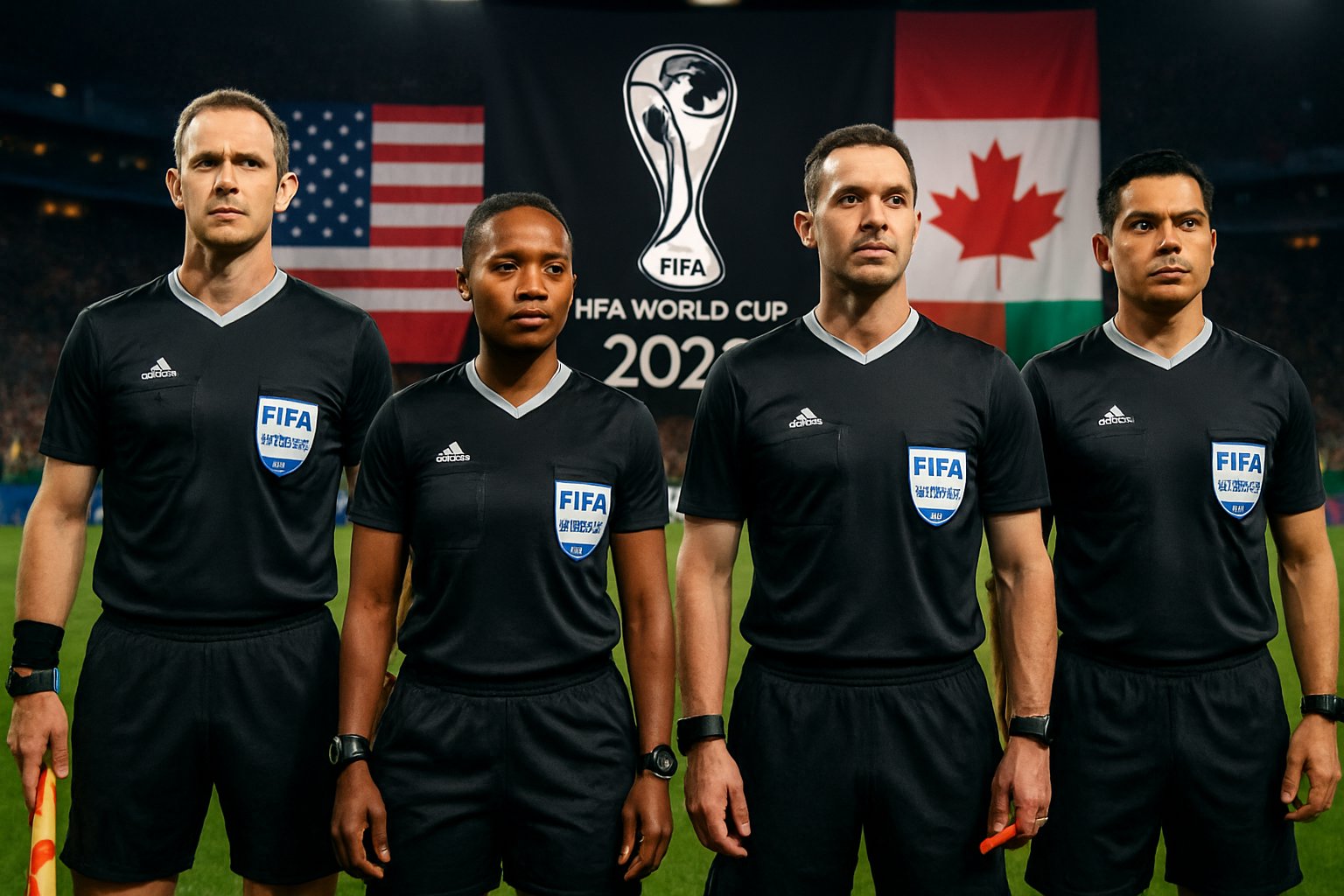
FIFA announced the selection of 52 referees for the 2026 World Cup on April 9, 2026, representing the largest officiating team in World Cup history as the tournament expands to an unprecedented 48 teams across the United States, Mexico, and Canada.
The comprehensive announcement reveals a total of 170 match officials selected from 50 member associations across all six confederations, including 52 referees, 88 assistant referees, and 30 video match officials. This represents a significant expansion from previous tournaments to accommodate the enlarged format of 104 matches scheduled from June 11 to July 19, 2026.
Historic Female Representation
Breaking new ground in World Cup officiating, two women will be among the 52 referees selected for the tournament. American Tori Penso and Mexican Katia Garcia have been included in the referee roster, marking a historic moment for gender representation in football's premier competition.
This selection builds on the precedent set at recent tournaments where female officials have gradually gained prominence in major international competitions, reflecting FIFA's commitment to diversity and equality in football administration.
Qatar's Strong Showing
Qatar achieved notable success in the selection process, with four Qatari match officials selected for the tournament. This achievement highlights the nation's growing prominence in international officiating, particularly following their experience hosting the 2022 World Cup. The selection also coincides with four Qatari referees being chosen for AFC Champions League finals, demonstrating the country's rising profile in Asian football administration.
Notable Disappointments and Exclusions
The selection process has not been without disappointment for several nations. Bolivia will not have any referees at the 2026 World Cup, continuing a pattern of exclusion that has persisted for more than two decades. The last Bolivian presence at a World Cup was Marcelo Ortubé in 2002, marking nearly 24 years since the country had representation in football's biggest tournament.
Even more notably, despite Bolivia's national team recently qualifying for the tournament after a 32-year absence, their referees were not selected. Bolivian referee Ivo Méndez had been invited by FIFA's Referees Committee in 2024 to participate in evaluations as part of the preselected group, and was even considered a strong candidate until late 2025, making the eventual exclusion particularly disappointing for the South American nation.
Similarly, the Democratic Republic of Congo expressed disappointment as no Congolese referees were selected for the tournament. This exclusion comes despite the DRC national team's historic qualification for the 2026 World Cup, ending a 52-year absence since their participation as Zaire in 1974.
Bosnia Herzegovina's Missing Opportunity
Bosnia and Herzegovina's top referee Irfan Peljto, widely considered the country's best official, was not selected for the tournament. This exclusion is particularly notable given that Bosnia will be making only their second World Cup appearance after their dramatic qualification, having defeated Italy on penalties in the playoff final.
FIFA's Selection Process and Criteria
The selection process has been rigorous and comprehensive, spanning multiple years of evaluation. FIFA expanded its assessment procedures through several continental seminars before establishing the final roster. The organization has emphasized a "quality first" principle in selections, led by Pierluigi Collina, FIFA's Chief Refereeing Officer.
The evaluation process considered multiple factors including domestic league performance, international competitions, previous FIFA tournament experience, physical fitness, and continuous monitoring through seminars and assessments. Officials were assessed through a three-year evaluation period, reflecting FIFA's commitment to thorough preparation for the expanded tournament format.
"The 2026 FIFA World Cup will feature the highest standard of officiating in tournament history, with officials selected based on merit and quality from across all confederations."
— FIFA Official Statement
Global Representation and Regional Balance
The selection demonstrates FIFA's commitment to global representation while maintaining the highest standards. Officials have been chosen from all six confederations – UEFA, CONMEBOL, CONCACAF, CAF, AFC, and OFC – ensuring that the tournament reflects football's worldwide reach.
Notable selections include referees from traditional footballing nations as well as emerging countries, showcasing the global development of officiating standards. The inclusion of officials from smaller nations alongside those from major footballing powers reflects FIFA's effort to balance geographic representation with technical excellence.
Technological Integration and VAR
The 2026 World Cup will feature the most extensive use of Video Assistant Referee (VAR) technology in tournament history, with 30 specialized VAR officials selected specifically for this role. This represents a significant investment in technological advancement and accuracy in decision-making.
The expanded VAR team reflects the complexity of managing 104 matches across three countries, requiring unprecedented coordination and technical expertise. The system will be crucial in maintaining consistency and accuracy across all venues in the tri-national tournament.
Tournament Context and Challenges
The referee selection comes as the 2026 World Cup faces unique logistical challenges as the first tournament hosted across three countries. The 48-team format will require officials to manage not only more matches but also navigate different legal systems, languages, and cultural contexts across the United States, Mexico, and Canada.
Recent developments have added complexity to tournament preparations. Iran's withdrawal from the competition due to geopolitical tensions represents an unprecedented situation in World Cup history. Mexico has deployed 100,000 security personnel in the largest security operation in the country's history, following cartel violence that affected Guadalajara, one of the host cities.
Despite these challenges, FIFA President Gianni Infantino has maintained "complete confidence" in the tournament's success, with nearly 2 million tickets already sold across the first two phases of sales.
Legacy and Future Impact
The expanded officiating team for 2026 sets new precedents for future World Cups. The inclusion of 170 match officials represents FIFA's recognition that larger tournaments require proportionally larger support systems to maintain quality and consistency.
The selection process and final roster will likely influence how FIFA approaches officiating for future tournaments, particularly as the organization considers further expansion of the World Cup format. The emphasis on global representation while maintaining quality standards provides a template for balancing inclusivity with excellence.
Preparation and Training
Selected officials will undergo intensive preparation programs leading up to the tournament. This includes physical conditioning, technical training, and familiarization with the unique challenges of officiating in a tri-national tournament setting.
The preparation period is particularly crucial given the expanded format and the need for consistency across multiple venues and countries. Officials will need to adapt to different climates, altitudes, and cultural contexts while maintaining uniform application of FIFA's Laws of the Game.
As the June 11, 2026 tournament opening approaches, the selected referees represent not only the technical pinnacle of football officiating but also the global nature of the beautiful game. While some nations celebrate their inclusion and others lament their absence, the final roster reflects FIFA's ongoing commitment to combining excellence with representation in football's most prestigious tournament.