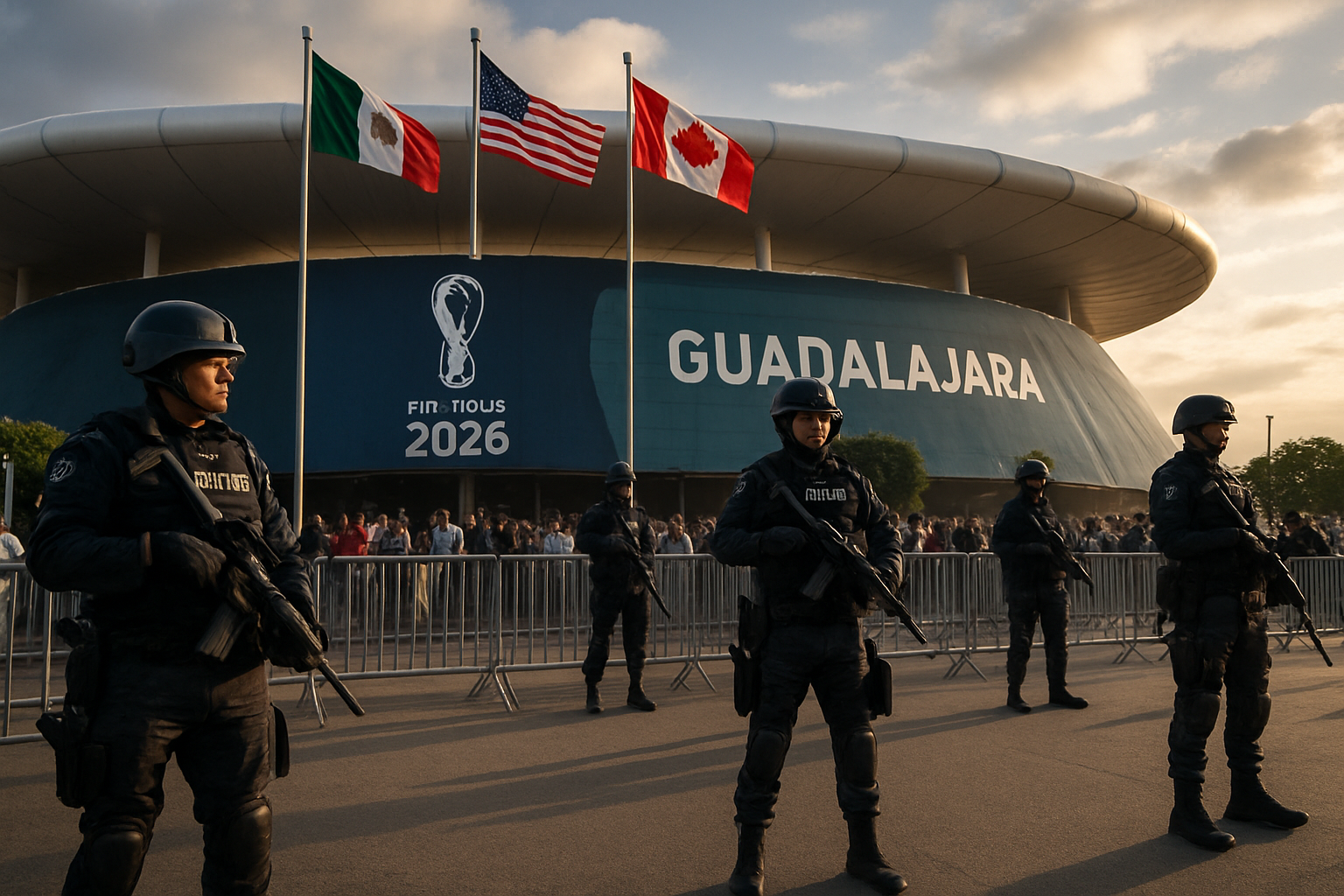
FIFA President Gianni Infantino has declared himself "very reassured" about Mexico's capacity to safely host 2026 World Cup matches, despite ongoing violence that has killed dozens and prompted international travel advisories just months before the tournament begins.
Speaking in Barranquilla, Colombia, Infantino expressed complete confidence in the tournament's success, stating "Very reassured, everything's good. It's going to be spectacular." His comments come as Mexico grapples with severe security challenges that have raised serious questions about the country's readiness to welcome millions of international visitors for the world's biggest sporting event.
Cartel Violence Rocks World Cup Host Cities
The security concerns intensified dramatically following the February 22, 2026 death of powerful cartel leader Nemesio Oseguera Cervantes, known as "El Mencho," which triggered unprecedented retaliatory violence across Mexico. The city of Guadalajara, a designated World Cup host venue, has been particularly affected by the escalating crisis.
According to comprehensive investigative reports, the violence has resulted in at least 25 National Guard members killed in retaliation attacks, plus one police officer and one judicial employee. Mexican forces eliminated approximately 70 members of the Jalisco New Generation Cartel (CJNG) during operations, but the systematic targeting of civilian infrastructure has created widespread fear.
Puerto Vallarta, a major tourist destination, witnessed the burning of a Costco store and multiple Banco del Bienestar branches as criminal organizations launched coordinated attacks on businesses and government facilities across 20 Mexican states.
"The territory of Mexico, and particularly the city of Guadalajara, was hit by a wave of violence after the death on Sunday of Nemesio Oseguera, the powerful leader of a cartel."
— Portuguese media reports
Government Response and Military Deployment
Mexican President Claudia Sheinbaum has maintained a position of "no risk" to the tournament despite deploying over 10,000 troops across western regions in what represents the largest security operation in recent years. Jalisco Governor Pablo Lemus declared a "red code" emergency with schools suspended across eight states following the violence.
The Mexican government has authorized closure of courts for safety reasons and suspended commercial activities in affected areas. Tourism industry experts report that major hotel chains have closed facilities and transportation systems have been disrupted, creating the strongest threat to the sector since the pandemic.
Defense Secretary Ricardo Trevilla confirmed that the operation represented a "sophisticated intelligence breakthrough" achieved through U.S.-Mexico cooperation, but the violent aftermath has tested bilateral security frameworks.
International Concerns and Travel Advisories
Multiple countries have issued urgent travel advisories for Mexico in response to the violence. Canada is closely monitoring the situation with thousands of citizens affected as Air Canada and WestJet temporarily suspended flights before resuming operations under enhanced security protocols.
Australia has urged travelers to exercise a "high degree of caution" for Mexico travel, while Belize's Ambassador Oscar Arnold advised nationals to "reconsider and delay Mexico travel entirely." Malaysia's Foreign Ministry, through its Mexico City embassy, urged citizens to "remain vigilant, exercise caution, remain circumspect" in areas affected by security operations.
The Dominican Republic specifically advised against non-essential travel to Jalisco state until greater stability is restored. These widespread international warnings have created a crisis of confidence just four months before the tournament begins in June 2026.
U.S. Security Funding Crisis
Compounding Mexico's challenges, the United States faces its own World Cup security crisis. Representatives from U.S. host cities testified before a House Homeland Security Committee expressing concerns about "catastrophic" security problems with little more than 100 days before kickoff.
The federal government shutdown has led FEMA to scale back to "bare-minimum, life-saving operations," freezing nearly $900 million earmarked for World Cup host cities in the United States. This funding crisis threatens security preparations across North America, as the tournament represents the first tri-nation World Cup in history.
Witnesses at the congressional hearing pointed to two primary reasons for the security delays: frozen FEMA funds and a lack of coordination between local entities and the federal government.
FIFA's Continued Confidence
Despite the mounting challenges, FIFA has maintained its support for Mexico's hosting capabilities. The organization has requested detailed security reports from the Mexican government following the violence in Guadalajara, but officials continue to express confidence in the tournament's success.
Al Jazeera reports confirm that Infantino has stated he has "complete confidence" in Mexico's ability to host World Cup matches, even as questions persist about the extent of cartel power in Mexico following what media outlets describe as a "wave of violence triggered by killing."
The Portuguese Football Federation has announced it is closely monitoring the situation in Mexico as Cristiano Ronaldo and the Portuguese national team are scheduled to play a match in the country in March, indicating that even individual federations are taking precautionary measures.
Economic and Tourism Impact
The violence has created devastating economic implications for Mexico's tourism industry, which had projected the strongest performance since the pandemic driven by the World Cup. The tournament was expected to provide crucial economic recovery, but current disruptions have severely damaged international visitor confidence.
Hotel chains are reporting facility closures, while transportation systems have faced widespread suspensions. U.S. tourists have been advised to remain in hotels until further notice, and courts have authorized business closures for safety reasons.
The economic stakes are enormous, as Mexico was counting on co-hosting the World Cup with the United States and Canada to provide sustained infrastructure development and international marketing benefits extending far beyond the competition period.
Historical Context and Precedent
The elimination of El Mencho represents the most significant cartel leadership takedown since the capture of Joaquín "El Chapo" Guzmán in 2016. However, security analysts warn that historical patterns show leadership eliminations typically cause organizational splintering rather than decreased violence.
Victor Manuel Sánchez Valdés, a respected security analyst, warned that the territorial magnitude and financial resources of CJNG, combined with the lack of clear succession, could create internal disputes and focused violence episodes as factions compete for control.
The timing is particularly concerning as Mexico faces the challenge of preventing CJNG from splintering into multiple competing organizations, which could potentially create even more violence in the lead-up to the World Cup.
International Cooperation and Diplomatic Response
U.S. President Trump praised the bilateral operation on social media, emphasizing that Mexico must "increase efforts against cartels and drugs." The operation demonstrated effective U.S.-Mexico intelligence frameworks, with American agencies providing crucial support in tracking the cartel leader through surveillance of his romantic partner at a luxury mountain hideout.
However, the violent aftermath has raised questions about whether tactical victories against criminal organizations can be sustained without creating greater instability that threatens major international events like the World Cup.
European media have characterized the situation as a critical test of modern democratic responses to organized crime challenges, with implications extending far beyond Mexico's borders.
Path Forward and Tournament Preparations
With the World Cup scheduled to begin in June 2026, Mexican authorities face the enormous challenge of restoring stability and rebuilding international confidence within just four months. The success or failure of current security operations will significantly influence how other countries approach organized crime challenges globally.
FIFA's continued confidence in Mexico's hosting capabilities represents a calculated risk that the country's institutional capacity can overcome the current crisis. The tournament is expected to attract millions of international visitors, making security guarantees absolutely critical for the event's success.
The coming months will be decisive in determining whether Mexico can balance World Cup preparations with urgent public safety restoration while rebuilding the international confidence necessary for the tournament's success.
"The stakes extend beyond the World Cup as Mexico's crisis management influences global approaches to sophisticated transnational criminal organizations."
— Security Analysis Reports
As the world watches, Mexico's ability to manage this unprecedented security challenge while maintaining its World Cup commitments will serve as a template for how democratic institutions can respond to sophisticated criminal organizations in an era of global connectivity and international sporting events.