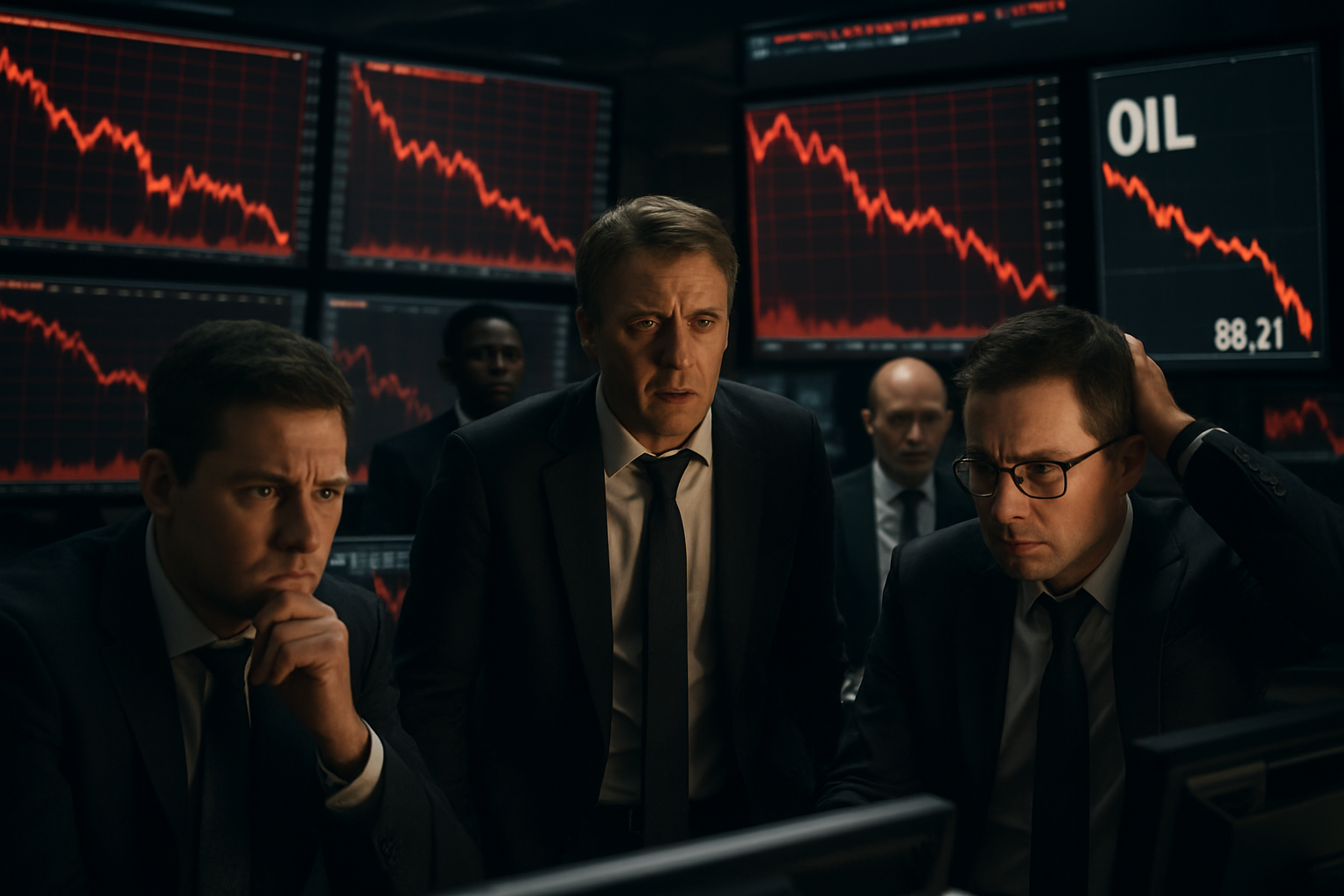
Global financial markets remain on edge as investors weigh the fragile Middle East ceasefire against persistent energy security concerns, with currency movements and stock volatility reflecting deep uncertainty about the durability of diplomatic progress following the worst energy crisis since the 1970s oil shocks.
The dollar has strengthened to weekly highs as markets express growing doubts over the sustainability of the Iran ceasefire agreement, while South Korea's producer prices have surged to their fastest pace in over three years, highlighting the lasting inflationary pressures from the ongoing energy crisis that has reshaped global economic relationships since March 2026.
Dollar Strength Amid Ceasefire Uncertainty
Currency markets are reflecting heightened investor anxiety as the U.S. dollar reaches its strongest position in a week, driven by skeptical market sentiment regarding the longevity of the recently brokered Middle East ceasefire. Trading patterns suggest institutional investors are positioning for potential renewed volatility, drawing on lessons learned from the unprecedented market disruptions experienced during the March energy crisis.
The strengthening dollar follows a pattern established during the height of the crisis when safe-haven demand drove significant capital flows to U.S. assets. However, the current movement appears more nuanced, reflecting sophisticated risk assessment by investors who have witnessed how quickly diplomatic progress can unravel in the volatile Middle East environment.
Inflationary Pressures Persist in Asia
South Korea's producer price index acceleration to its fastest pace in more than three years underscores the lasting economic impact of the energy crisis that began when Iran's Revolutionary Guard declared the Strait of Hormuz "unsafe for shipping" in March. The price surge affects 40% of global seaborne oil transit through the critical 21-mile chokepoint, demonstrating how regional conflicts instantly become global economic challenges in today's interconnected world.
The Korean economy has proven particularly vulnerable to energy price volatility, with the Korean won having hit 17-year lows during the peak crisis period when the KOSPI index suffered a devastating 12% decline that triggered circuit breakers. Foreign capital flight from AI and memory chip positions during that period highlighted how technology-heavy economies face compound risks during geopolitical crises.
Wall Street Struggles with Mixed Signals
U.S. equity markets closed in negative territory as investors processed conflicting signals about Middle East stability and energy market recovery. Wall Street's cautious approach reflects institutional memory of the severe market disruption experienced in March when the Dow futures plunged 400-570 points during peak crisis periods, and major IPOs like PayPal's $1.1 billion offering were postponed indefinitely due to extreme volatility.
The persistent uncertainty has prompted a fundamental shift in investment strategy, with portfolio managers abandoning broad regional themes in favor of country-specific fundamental analysis based on institutional quality and governance frameworks. This evolution reflects hard-learned lessons about the limitations of traditional geographic diversification during structural geopolitical disruptions.
"The situation is going longer than people initially thought. Financial markets are the ultimate constraint on prolonged conflict."
— Damien Boey, Portfolio Strategist
Historical Context of the Energy Crisis
The current market volatility must be understood against the backdrop of March 2026's watershed crisis, which energy analyst Samuel Ciszuk described as "the most severe energy security crisis in decades, with single-chokepoint vulnerabilities fully exposed." Oil prices surged to unprecedented levels with Brent crude peaking at $119.50 and WTI experiencing a record 18.98% single-day jump to $108.15, marking the first breach of $100 per barrel since 2022.
The International Energy Agency's response was historic in scale, deploying 400 million barrels from strategic petroleum reserves across 32 countries—double the amount released during the 2022 Ukraine crisis. Japan's contribution of 80 million barrels marked its first such deployment since the 2011 Fukushima disaster, highlighting the crisis's severity for Middle East-dependent economies.
Supply Chain and Aviation Sector Recovery
The aviation industry continues its gradual recovery from unprecedented disruption that saw over 18,000 flights cancelled worldwide—the most extensive disruption since COVID-19. Eight Middle Eastern countries simultaneously closed their airspace, creating what industry experts termed an "aviation black hole" for Europe-Asia corridors. Dubai International Airport, the world's busiest with 86 million passengers annually, remains in recovery mode following extensive missile damage during the peak conflict period.
Supply chain vulnerabilities exposed during the crisis continue to influence market behavior. The complete suspension of Maersk and MSC operations in the Persian Gulf left over 150 oil and LNG tankers stranded, representing billions in cargo value and demonstrating the dangerous over-dependence on strategic chokepoints that characterizes modern global logistics.
Central Bank Coordination and Policy Challenges
Central banks worldwide have maintained the emergency coordination mechanisms established during the March crisis, with the European Central Bank and Bank of Japan continuing their liquidity provision frameworks. However, traditional monetary policy tools have proven limited in effectiveness against structural geopolitical disruptions, prompting a fundamental reconsideration of crisis response capabilities.
The era of synchronized global monetary policy has definitively ended, with regional central banks pursuing divergent strategies based on domestic conditions rather than international coordination. This shift creates complex currency dynamics that add another layer of uncertainty for international investors and multinational corporations.
Regional Economic Divergence
Different regional responses to the energy crisis have created a more fragmented global economic landscape. European nations implemented unprecedented emergency measures including Hungary's immediate price caps on gasoline and diesel to prevent "war-driven price explosions," France's deployment of 500 fuel inspectors to prevent price manipulation, and Romania's five scenarios to prevent diesel from exceeding 10 lei per liter.
Consumer impacts varied dramatically by region but were universally severe. Bangladesh implemented fuel rationing for 170 million people, Pakistan activated wartime austerity measures including four-day government work weeks, and Ireland faced heating oil prices approaching €2 per liter that consumers criticized as "brazen rip-offs." These disparate impacts have contributed to the current policy divergence and market fragmentation.
Nuclear Diplomacy and Long-term Stability
The underlying geopolitical tensions that triggered the crisis remain unresolved, with the complete breakdown of U.S.-Iran nuclear negotiations providing a sobering backdrop to current market movements. The February 2026 expiration of the New START treaty created the first 50+ year period without U.S.-Russia nuclear constraints, while Iran continues 60% uranium enrichment with over 400kg of weapons-grade material.
UN Secretary-General António Guterres has described the situation as "the greatest test of multilateral cooperation and crisis management in the modern era," with nuclear risks at their "highest levels in decades." This assessment provides crucial context for understanding why markets remain so sensitive to Middle East developments despite the current ceasefire.
Energy Architecture Transformation
The crisis has accelerated discussions about fundamental energy architecture transformation to reduce dependence on volatile geopolitical regions and strategic chokepoints. The 21-mile Strait of Hormuz has been definitively proven as a dangerous single-point failure for modern logistics, with no realistic alternatives for handling massive oil and LNG volumes.
Strategic petroleum reserves, while providing temporary market stability, have proven insufficient as buffers against sustained geopolitical disruptions. The urgent need for supply diversification and renewable energy transitions has gained unprecedented political momentum, though implementation timelines still require years to decades of sustained investment and political commitment.
Investment Strategy Evolution
The crisis has fundamentally altered investment approaches, with successful portfolio managers shifting from regional themes to country-specific analysis based on institutional quality, policy effectiveness, and governance frameworks. Strong institutional capacity, regulatory clarity, and economic diversification have emerged as the primary determinants of resilience during periods of extreme global volatility.
Digital payment systems and financial technology infrastructure have demonstrated superior stability compared to traditional markets during periods of stress, with countries possessing sophisticated digital payment networks showing greater resilience. This has accelerated the shift toward operational excellence and practical utility over speculative investment approaches.
Looking Forward: Template for 21st Century Crisis Management
The March 2026 energy crisis represents a template-setting moment for 21st-century international relations and crisis management. The rapid transition from diplomatic engagement to military confrontation demonstrated the fragility of crisis management mechanisms in an increasingly multipolar world, while the eventual return to diplomatic solutions through innovative middle-power mediation offered hope for future conflict resolution.
The success or failure of current diplomatic efforts will have implications extending far beyond immediate market concerns, potentially reshaping international approaches to conflict resolution, energy security planning, and nuclear governance for decades to come. Financial markets will continue serving as the "ultimate constraint" on prolonged conflicts, as their sensitivity to geopolitical developments provides real-time feedback on the sustainability of political and military strategies.
As markets navigate this uncertain landscape, the lessons of March 2026 remain fresh: the interconnected nature of modern global systems means that regional conflicts can instantly become worldwide economic crises, requiring unprecedented levels of international coordination and adaptive crisis management frameworks capable of responding to rapidly evolving geopolitical realities.