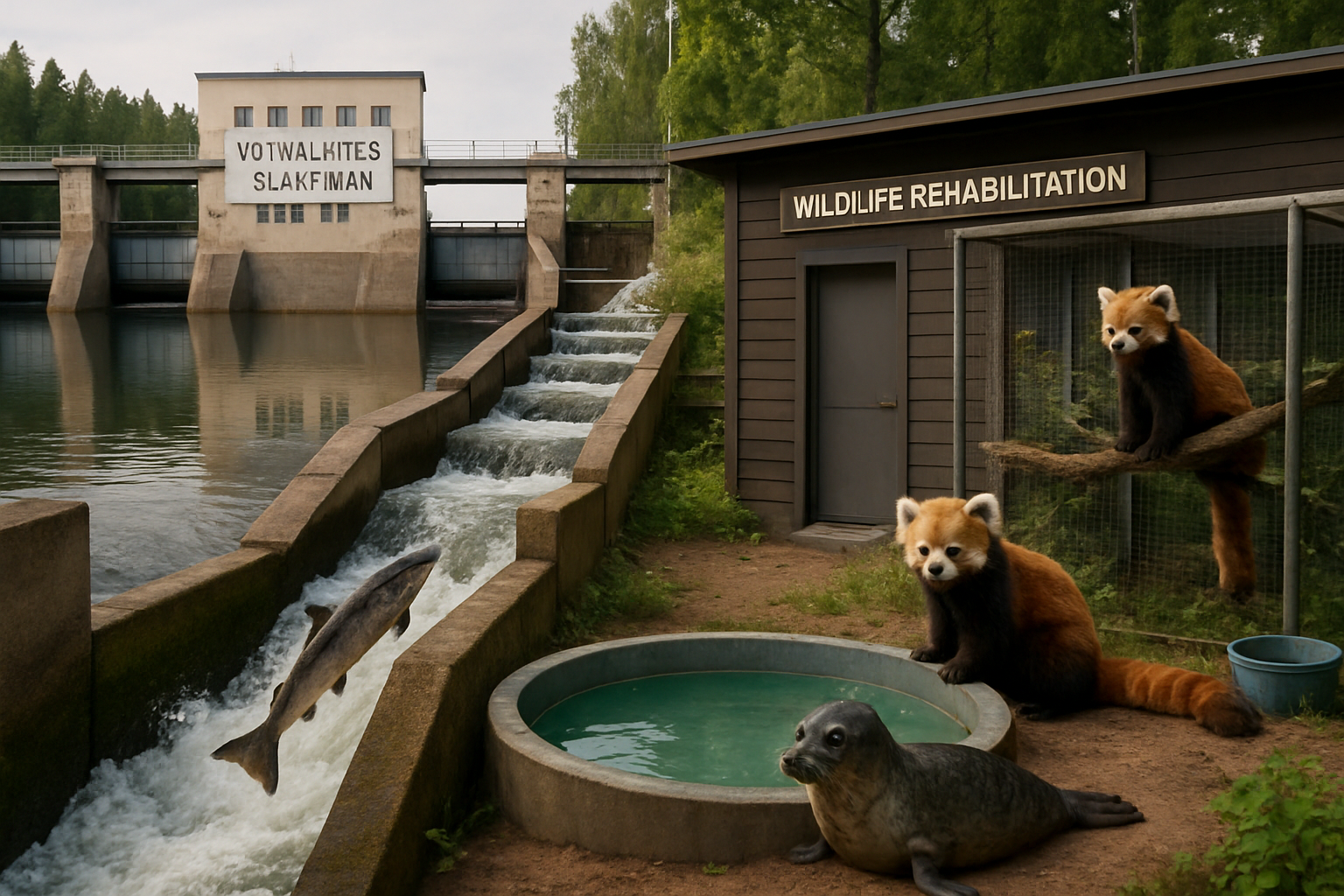
In southeastern Finland, a 70-year-old hydroelectric power plant will permanently cease operations to make way for a crucial migration route for the endangered Baltic sea trout, while thousands of kilometers away in Hong Kong, Ocean Park announced the euthanization of a 17-year-old red panda due to age-related health complications, illustrating the complex realities of modern wildlife conservation.
The small private power plant in Lappeenranta, southeastern Finland, has generated electricity for seven decades, but environmental authorities have determined that its closure is essential for the survival of the Baltic sea trout (Salmo trutta), a species that has faced severe population declines due to habitat fragmentation and dam barriers blocking traditional spawning routes.
Finland's Groundbreaking Conservation Decision
The Finnish decision represents a significant shift in environmental policy, prioritizing ecosystem restoration over energy production. Baltic sea trout populations have declined dramatically over the past century, with many river systems losing their spawning populations entirely due to hydroelectric infrastructure that blocks fish migration routes.
Environmental scientists have documented how dams and power plants create insurmountable barriers for anadromous fish species that must travel between marine and freshwater environments to complete their life cycles. The Lappeenranta facility, while relatively small in terms of power generation, occupies a critical bottleneck in a river system that once supported substantial sea trout populations.
"The ecological value of restoring this migration corridor far exceeds the economic impact of losing this single power plant," explained marine biologist Dr. Helena Virtanen from the Finnish Environment Institute. "Sea trout populations in this region have been isolated from their spawning grounds for generations, and removing this barrier could trigger a remarkable recovery."
Hong Kong's Conservation Medicine Challenge
Meanwhile, Hong Kong's Ocean Park faced a different but equally challenging conservation decision. Rou Rou, a 17-year-old female red panda, was euthanized after experiencing severe degenerative joint problems that left her in increasing discomfort despite five years of comprehensive veterinary care and palliative treatment.
Red pandas (Ailurus fulgens) are classified as endangered, with fewer than 2,500 individuals remaining in the wild across their native range in the Himalayas and southern China. Ocean Park's animal care and veterinary teams had provided Rou Rou with advanced geriatric care, but age-related ailments including severe arthritis ultimately made her quality of life unsustainable.
The decision highlights the challenging intersection of conservation medicine and animal welfare in captive breeding programs. While zoos and wildlife parks play crucial roles in species preservation through breeding programs and public education, they also must make difficult end-of-life decisions for individual animals.
Conservation Renaissance Amid Climate Crisis
These developments occur within what conservationists are calling a "global conservation renaissance" - an unprecedented surge in coordinated environmental protection efforts during a period of accelerating climate change. January 2026 marked the hottest month on record, extending a streak of 19 consecutive months exceeding 1.5°C above pre-industrial levels.
The contrast between Finland's habitat restoration approach and Hong Kong's captive care management exemplifies the diverse strategies required for comprehensive wildlife protection. Finland's power plant closure represents proactive ecosystem service management, removing human infrastructure to restore natural processes. Hong Kong's veterinary intervention demonstrates advanced conservation medicine capabilities essential for maintaining genetic diversity in captive populations.
"Modern conservation requires both large-scale habitat restoration and sophisticated individual animal care. The Finnish approach addresses ecosystem-level threats, while Hong Kong's veterinary program maintains genetic resources for future reintroduction efforts."
— Dr. Sarah Mitchell, Conservation Biology Institute
Technology and Traditional Knowledge Integration
Both conservation initiatives demonstrate the sophisticated integration of cutting-edge technology with traditional ecological knowledge that characterizes successful modern environmental protection. Finland's restoration project employs environmental DNA sampling to track sea trout populations, satellite monitoring of river conditions, and genetic analysis to ensure maximum breeding success, while incorporating centuries of Nordic fisheries management wisdom.
Hong Kong's red panda program utilized advanced veterinary diagnostics, specialized geriatric care protocols, and behavioral enrichment techniques developed through decades of captive breeding expertise. The facility maintains detailed genetic records contributing to global red panda breeding coordination efforts.
This technology-tradition synthesis represents a fundamental evolution in conservation methodology, moving beyond purely technological or traditional approaches toward comprehensive frameworks that respect cultural knowledge while leveraging global scientific capabilities.
Economic Dimensions of Conservation
The economic implications of both decisions illustrate how environmental protection increasingly functions as an economic development strategy rather than a regulatory burden. Finland's power plant closure, while representing a short-term loss of energy production, positions the country as a leader in ecosystem restoration, potentially attracting sustainable investment and eco-tourism revenue.
Research indicates that restored river systems supporting healthy fish populations generate substantial economic returns through recreational fishing, nature tourism, and ecosystem services including water purification and flood control. The long-term economic value of a healthy Baltic sea trout population likely exceeds the modest electricity generation from the aging facility.
Hong Kong's investment in advanced veterinary care for endangered species enhances the territory's reputation as a center for conservation excellence, supporting its broader environmental leadership objectives in the Asia-Pacific region. Ocean Park's research and breeding programs contribute to international conservation networks while attracting conservation-focused tourism.
International Cooperation Framework
Both conservation successes highlight the critical importance of international cooperation in addressing transnational environmental challenges. Baltic sea trout migration patterns cross multiple national boundaries, requiring coordinated management across Nordic countries. The species' recovery depends on habitat restoration efforts in Finland working in conjunction with marine protection measures in Sweden, Denmark, and other Baltic nations.
Red panda conservation similarly requires international coordination, with breeding programs in Hong Kong, China, Europe, and North America sharing genetic material and expertise to maintain viable captive populations. The species' wild populations span multiple countries across the Himalayan region, necessitating coordinated habitat protection and anti-poaching efforts.
Implementation Challenges and Opportunities
The contrasting approaches also reveal different implementation challenges facing conservation initiatives globally. Finland's ecosystem restoration benefits from strong government environmental policies and public support for renewable energy alternatives that can replace lost hydroelectric capacity. The country's commitment to carbon neutrality by 2035 provides policy framework supporting such decisions.
Hong Kong's captive breeding challenges include limited space for expanding facilities, high operational costs for specialized veterinary care, and the complex logistics of international breeding program coordination. However, the territory's advanced veterinary infrastructure and research capabilities position it as a regional hub for conservation medicine.
Funding sustainability remains critical for both approaches, with ecosystem restoration requiring long-term monitoring and maintenance, while captive breeding programs need sustained financial support for multi-generational breeding efforts.
Strategic Significance for Global Conservation
March 2026 represents a critical juncture for global environmental protection, with the choice between reactive crisis management and proactive ecosystem service management determining whether conservation efforts can keep pace with accelerating environmental change during this decisive climate action decade.
Finland's power plant closure and Hong Kong's advanced veterinary care both contribute to this broader conservation renaissance, demonstrating that effective environmental protection requires diverse approaches adapted to local conditions while contributing to global conservation networks.
The environmental action window is narrowing rapidly as ecological systems approach critical thresholds that could trigger irreversible changes affecting global food security, climate stability, and human settlements. However, the tools, knowledge, and cooperation frameworks exist for comprehensive protection, as demonstrated by these initiatives requiring sustained international cooperation and enhanced coordination.
Future Implications
The success or failure of conservation approaches like Finland's habitat restoration and Hong Kong's captive breeding programs may prove decisive for conservation strategies in coming decades. These initiatives provide practical templates for scaling environmental protection globally through coordinated international approaches that build local capacity while fostering international cooperation.
As climate change continues to accelerate, the integration of large-scale ecosystem restoration with sophisticated individual animal care will become increasingly essential. The window for effective environmental action continues narrowing, but the convergence of innovation, cooperation, and political commitment demonstrated by these initiatives offers hope for maintaining planetary habitability during this unprecedented period of environmental challenge.
Environmental protection increasingly recognized as essential infrastructure for human prosperity and planetary sustainability requires the maximum urgency of coordinated international response, with Finland's ecosystem restoration and Hong Kong's conservation medicine providing complementary models for the comprehensive approach needed to address the scale and complexity of current environmental challenges.