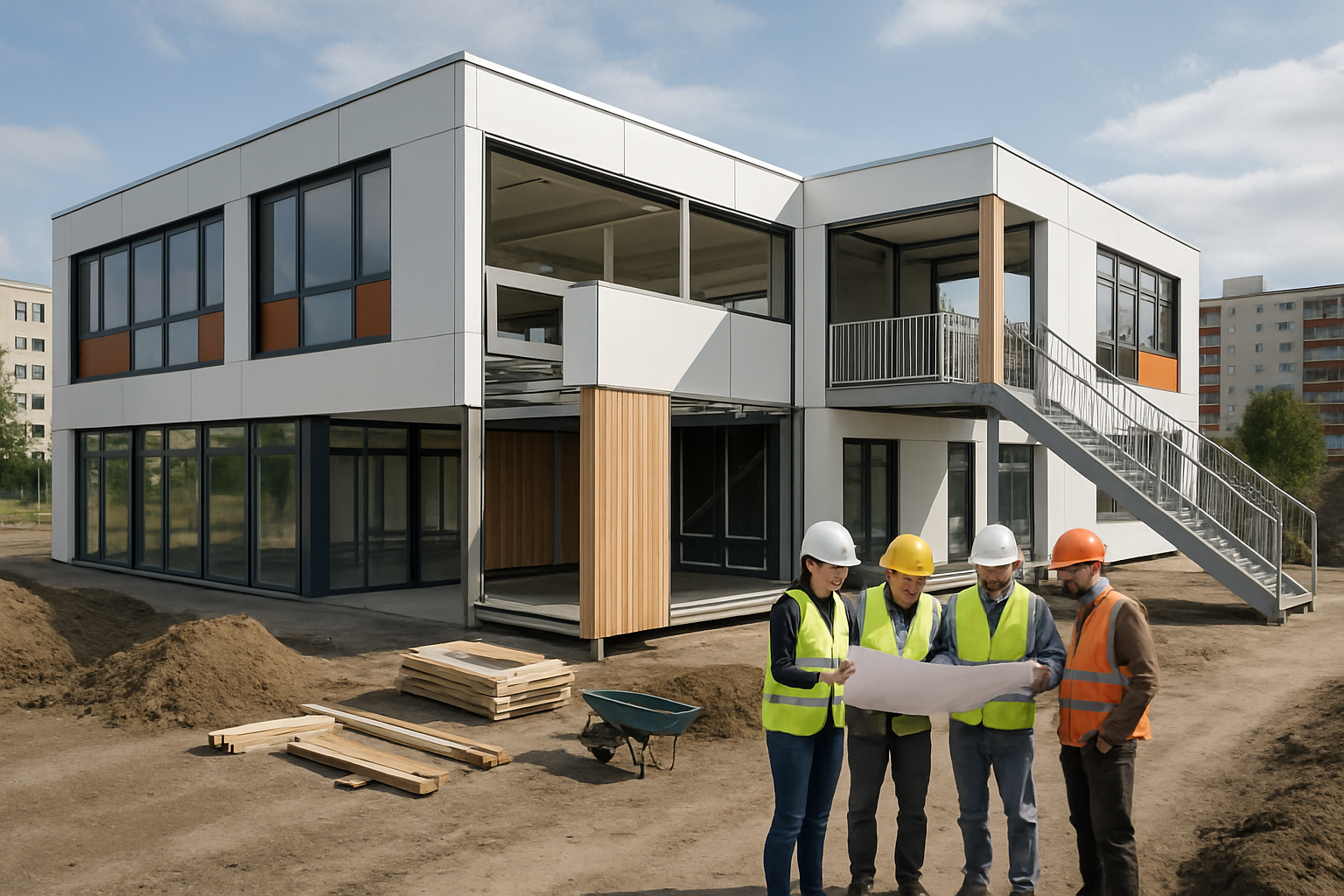
Finland is constructing its first school building designed with removable sections to adapt to declining student populations, while Austria continues to innovate in residential comfort solutions, highlighting Europe's adaptive approach to changing demographic and housing needs.
In a groundbreaking development that reflects Europe's demographic realities, the city of Lappeenranta in Finland has embarked on constructing a revolutionary school building designed with future flexibility in mind. The project represents the country's first educational facility where an entire wing can be completely removed if student numbers decline due to falling birth rates.
This innovative approach to educational infrastructure comes as European cities grapple with declining birth rates and changing population dynamics. According to the Finnish source, the decision to build with such adaptability stems directly from concerns about "lasten väheneminen" (the decrease in children), a demographic trend affecting communities across Scandinavia and much of Europe.
Modular Architecture Meets Demographic Reality
The Lappeenranta project exemplifies a new paradigm in public infrastructure planning, where buildings are designed not just for current needs but for potential future scenarios. This forward-thinking approach allows municipalities to optimize their investments in educational infrastructure while maintaining fiscal responsibility in the face of uncertain demographic trends.
The modular design enables school administrators to reconfigure the facility as enrollment numbers fluctuate, potentially converting unused sections for other community purposes or completely removing them to reduce maintenance costs and energy consumption. This represents a significant departure from traditional school construction, which typically assumed steady or growing enrollment.
Such adaptive planning reflects broader European trends documented in our comprehensive housing and urban development analysis. Countries across the continent are reimagining their approach to public and private infrastructure, moving away from static designs toward flexible solutions that can evolve with changing community needs.
Austria's Residential Comfort Innovation
Meanwhile, Austria continues to advance residential innovation with new insights into creating genuinely comfortable living spaces. Austrian research emphasizes the critical role of proper lighting, but extends beyond illumination to encompass colors, textiles, and what experts describe as "courage for personality" in home design.
The Austrian approach recognizes that as Europeans spend more time in their homes - a trend accelerated by remote work patterns and changing lifestyle preferences - the quality of residential spaces becomes increasingly important. This focus on comfort and livability complements broader European housing initiatives aimed at improving quality of life while addressing affordability challenges.
European Housing Context: Adaptation and Innovation
These developments occur within the broader context of Europe's ongoing housing transformation. Our analysis reveals that European nations are increasingly coordinating their responses to housing challenges, recognizing these issues as transnational concerns requiring sophisticated policy approaches.
The global construction industry continues to face significant challenges, with rising material costs creating negative profit margins for developers across multiple regions. Memory chip shortages have driven semiconductor prices sixfold, affecting smart building technologies that are becoming standard in modern developments. These constraints affect construction timelines and costs, making adaptive and efficient design approaches even more valuable.
Finland's demographic-responsive school design and Austria's comfort-focused residential research represent different aspects of Europe's comprehensive approach to built environment challenges. Both initiatives prioritize long-term sustainability and adaptability over short-term solutions.
Technology Integration Despite Constraints
Despite global supply chain challenges, both countries continue advancing technological integration in their building projects. Smart city systems, sustainable materials, and community-centered design are becoming standard requirements rather than premium options. This evolution reflects a mature understanding that initial technology investment provides decades of operational benefits, even when implementation faces current cost pressures.
The Finnish school project likely incorporates advanced building management systems that can be reconfigured as the physical structure changes. Similarly, Austrian residential comfort research benefits from sophisticated environmental monitoring and control systems that optimize lighting, temperature, and air quality for occupant wellbeing.
Regional Development Implications
These initiatives contribute to broader European regional development strategies that emphasize quality over quantity in infrastructure investment. Rather than building maximum capacity for peak historical demand, both approaches optimize for sustainable, adaptable solutions that serve communities effectively across changing circumstances.
The success of such projects could influence similar initiatives across Europe and globally. Educational facilities designed for demographic adaptation could become standard practice in regions facing similar population dynamics. Meanwhile, residential comfort innovations enhance property values and quality of life, supporting broader housing market stability.
Policy Innovation and International Cooperation
Finland's approach to adaptive school construction aligns with European Union initiatives promoting sustainable and efficient public infrastructure. These projects demonstrate how national and local governments can implement innovative solutions while contributing to broader regional development goals.
The emphasis on flexibility and adaptation reflects sophisticated understanding of 21st-century policy challenges, where traditional approaches may prove insufficient for current challenge scales and complexity. Success requires innovative frameworks balancing immediate needs with long-term sustainability, incorporating community input and environmental considerations.
Future Implications for Urban Development
Both the Finnish school project and Austrian residential research provide templates for addressing universal challenges through regionally-specific solutions. The window for effective action is narrowing due to demographic pressures, urbanization trends, and climate adaptation complexity, making such innovative approaches increasingly valuable.
These developments suggest that successful urban planning in the coming decades will require unprecedented flexibility and sophistication. Infrastructure must serve multiple functions, adapt to changing circumstances, and optimize resource utilization while maintaining high quality standards for community members.
The combination of demographic adaptation, comfort optimization, and technological integration represented by these projects establishes important precedents for European and global urban development. As other regions face similar challenges, the Finnish and Austrian approaches offer practical models for balancing innovation with sustainability, efficiency with quality, and current needs with future adaptability.