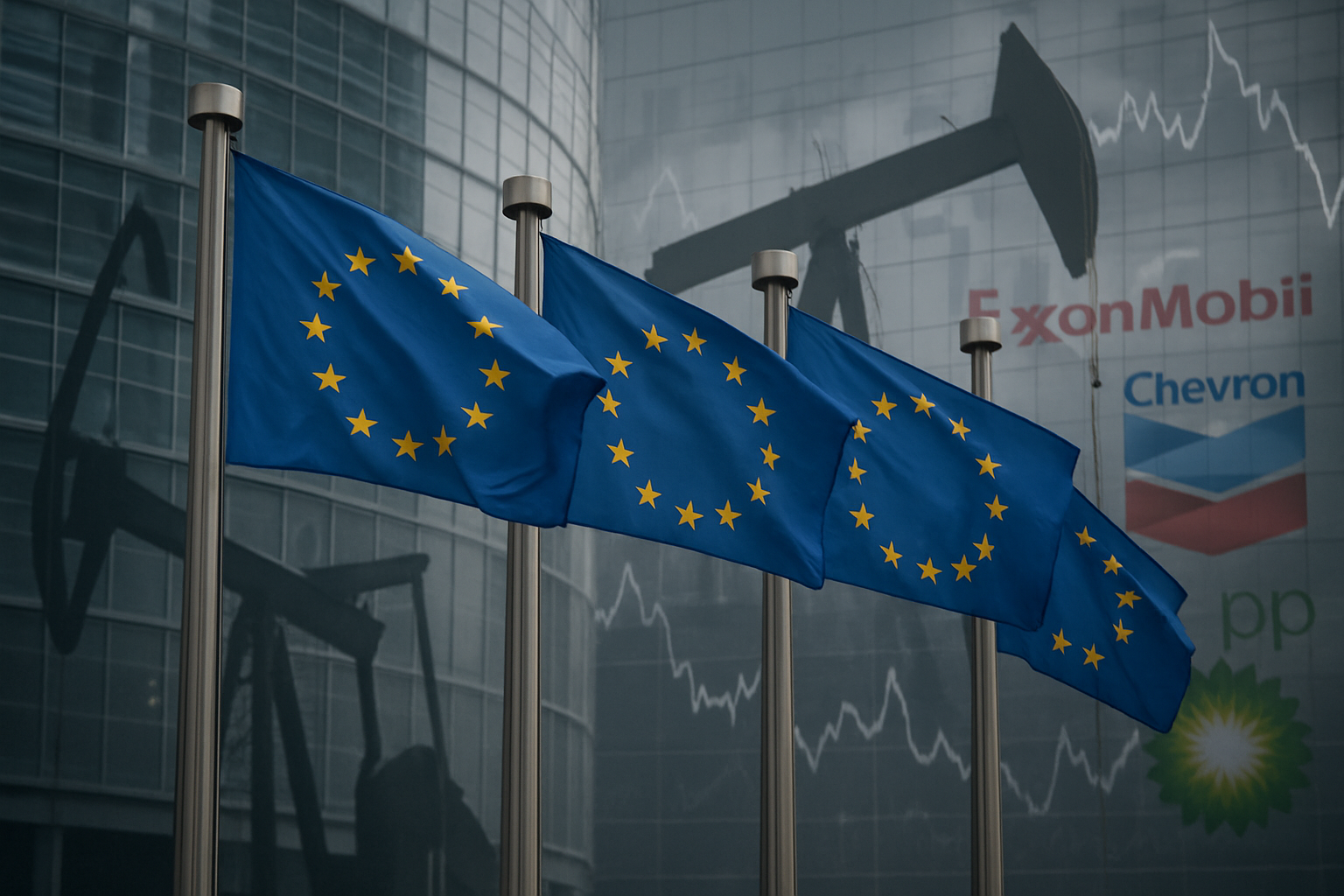
Five European Union nations have united in calling for an unprecedented bloc-wide windfall tax on energy companies as fuel prices surge to crisis levels due to the ongoing Middle East conflict, marking the most significant European energy market intervention since the 1970s oil shocks.
Finance ministers from Germany, Italy, Spain, Portugal and Austria formally submitted a letter to the European Commission on Friday, demanding immediate action to capture excess profits from energy companies amid soaring oil and gas prices driven by Iran's closure of the Strait of Hormuz. The coordinated call represents a watershed moment in European energy policy, abandoning traditional free-market principles to protect consumers from "war-driven price explosions."
Unprecedented European Unity
Spanish Economy Minister Carlos Cuerpo announced the joint initiative on Saturday, describing the windfall tax proposal as essential for financing consumer relief measures. "It would make it possible to finance temporary relief, especially for consumers, and curb rising inflation, without placing additional burdens on public budgets," the ministers wrote in their formal communication to Brussels.
The letter, confirmed by Reuters, marks the first time these five major European economies have jointly challenged the energy sector's profit structures during a crisis. "It would also send a clear message that those who profit from the consequences of the war must do their part to ease the burden on the general public," the ministers emphasized.
Austrian Finance Minister Magnus Brunner has already implemented comprehensive fuel price relief measures, redistributing excess fuel tax revenues to consumers as diesel prices reached €2.20 per liter. Germany's Federal Ministry of Economics is simultaneously strengthening antitrust laws to prevent gas station price manipulation – representing significant market intervention in modern German energy policy.
Crisis Reaches Critical Threshold
The coordinated European response comes as oil prices have surged past $100 per barrel for the first time since 2022, with Brent crude reaching $119.50 and West Texas Intermediate hitting $108.15 in the largest single-day jump on record. Iran's Revolutionary Guard declared the Strait of Hormuz "unsafe for shipping," effectively blocking 40% of global seaborne oil transit through the critical 21-mile chokepoint.
"The situation is going much longer than initially thought, and financial markets are the ultimate constraint on prolonged conflict."
— Damien Boey, Financial Analyst
Natural gas prices have exploded 24% in Europe and 78% in the United States, reaching €47.32/MWh – the highest levels since February 2025. Qatar has halted LNG production at its Ras Laffan and Mesaid facilities, representing approximately 20% of global exports, following Iranian attacks on Gulf energy infrastructure.
The energy crisis has triggered the International Energy Agency's largest strategic petroleum reserve release in its 50-year history, with 400 million barrels deployed from 32 countries – double the response to the 2022 Ukraine crisis.
Historical Context: Learning from Crisis
This coordinated European response builds upon lessons learned from the March 2026 energy crisis, when European nations implemented emergency measures as oil prices first breached $100 per barrel. The current windfall tax proposal represents an evolution from the ad hoc national responses that characterized the earlier crisis phase.
Hungary previously implemented immediate gasoline and diesel price caps to counter "war-driven price explosions." France deployed 500 fuel station inspectors to prevent price manipulation. Romania outlined five emergency scenarios to prevent diesel exceeding 10 lei per liter. These national measures proved insufficient to address the scale of the current crisis.
Sweden faces particularly severe impacts, with electricity costs rising 10-20 öre and gasoline increasing 1-2 kronor, as the Malmö region proves most exposed due to continental integration. Ireland has seen heating oil approach €2 per liter in what officials describe as "brazen rip-offs" affecting vulnerable households.
Energy Companies Under Scrutiny
The windfall tax proposal specifically targets energy companies that have benefited from dramatic price increases while consumers face unprecedented costs. While the letter does not specify exact tax rates, it emphasizes the principle that companies profiting from conflict-driven price spikes must contribute to public relief efforts.
Major shipping companies Maersk and MSC have suspended Persian Gulf operations entirely, with over 150 oil and LNG tankers stranded worth billions in cargo value. This supply chain collapse has created artificial scarcity that benefits remaining market participants while devastating consumer costs.
Global Supply Chain Implications
The crisis extends far beyond European borders, with the Persian Gulf serving as a critical trade hub affecting consumer goods and industrial materials worldwide. The 21-mile Strait of Hormuz represents a single-point failure in modern logistics, with no realistic alternative routes possessing adequate capacity.
Manufacturing industries dependent on Gulf logistics networks face severe disruptions, particularly in automotive, electronics, and textiles sectors. China has suspended refined fuel exports, cancelling committed shipments, while Singapore reports 30% increases in logistics costs affecting global supply chains.
Bangladesh has implemented fuel rationing for 170 million people, while Pakistan faces the highest fuel prices in South Asia at Rs321.17 per liter, forcing the government to implement wartime austerity measures including four-day work weeks.
Financial Markets React
Global financial markets have crashed in response to the energy crisis, with Pakistan's KSE-100 suffering its largest single-day decline in history at -8.97%. South Korea's KOSPI plunged 12%, triggering circuit breakers as the Korean won hit a 17-year low amid foreign capital flight from AI and memory chip positions.
Central banks including the European Central Bank and Bank of Japan are coordinating emergency liquidity provisions to prevent broader financial contagion, though traditional monetary policy tools prove limited against structural geopolitical disruptions affecting physical infrastructure.
Aviation Industry Paralyzed
The energy crisis has created parallel disruptions in global aviation, with over 18,000 flights cancelled worldwide – the most extensive since the COVID-19 pandemic. Eight Middle Eastern countries maintain simultaneous airspace closures, while Dubai International Airport, the world's busiest with 86 million passengers annually, remains shut due to missile damage.
Major carriers including Emirates, Air France-KLM, and Wizz Air have suspended operations indefinitely, affecting hundreds of thousands of passengers globally and severing critical Europe-Asia transport corridors.
Nuclear Diplomacy Breakdown
The current crisis stems from the complete collapse of US-Iran nuclear negotiations, despite achieving "broad agreement on guiding principles" in Geneva talks – the most significant diplomatic progress since the 2018 JCPOA collapse. Fundamental scope disagreements proved insurmountable, with Iran excluding ballistic missiles and regional proxies as "red lines" while the United States demanded comprehensive coverage of missiles, armed groups, and human rights.
The diplomatic breakdown led to Operation Epic Fury, the largest coordinated US-Israeli military operation since 2003, triggering Iranian retaliation through "Operation True Promise 4" with systematic targeting of regional energy infrastructure under a "no red lines remain" policy.
Template for Future Crisis Response
The five-nation windfall tax proposal represents what UN Secretary-General António Guterres describes as "the greatest test of multilateral cooperation and crisis management in the modern era." The coordinated European response could provide a template for managing energy crises in an increasingly volatile multipolar world.
"This is the most severe energy security crisis in decades, exposing single-chokepoint vulnerabilities that require fundamental restructuring."
— Samuel Ciszuk, Energy Security Analyst
Estonia's renewable energy model offers a potential pathway forward, with 88% renewable electricity generation and Europe's largest battery storage capacity serving 90,000 households. However, the transition to renewable alternatives requires years or decades of implementation, leaving vulnerability during the critical interim period.
Long-term Energy Architecture Transformation
The crisis has exposed dangerous over-dependence on strategic chokepoints controlled by volatile geopolitical regions. Qatar Energy Minister Saad Al Kaabi warned that Gulf states may declare force majeure "within weeks," potentially driving oil prices toward $150 per barrel and threatening to "bring down the economies of the world."
European leaders recognize that temporary measures, while necessary, must be accompanied by fundamental energy architecture transformation. Supply diversification, enhanced renewable capacity, improved interconnections between member states, and massive storage facility expansion represent essential long-term investments.
The windfall tax proposal, if implemented, would demonstrate European unity in addressing external energy shocks while generating revenues for accelerated green transition initiatives. Success could strengthen European energy sovereignty and reduce dependence on unstable regions.
Recovery Timeline Uncertain
Unlike weather-related disruptions with predictable timelines, recovery depends entirely on military and diplomatic developments in the Middle East. The current crisis represents a template-setting moment for 21st-century international relations, determining whether diplomatic solutions remain viable for nuclear crises or military approaches become the preferred precedent.
The stakes extend far beyond immediate energy costs, affecting regional war prevention, global energy security architecture evolution, nuclear governance credibility, and international law enforcement mechanisms that have underpinned the post-World War II order.
European finance ministers emphasize that their windfall tax proposal serves both immediate consumer relief and longer-term strategic goals. By capturing excess profits from crisis-driven price spikes, the measure could fund essential energy infrastructure investments while demonstrating that companies benefiting from conflict consequences must contribute to public welfare.
The success or failure of this coordinated European response will likely influence energy policy approaches for decades, establishing precedents for managing the intersection of geopolitical crises, corporate profits, and consumer protection in an increasingly interconnected yet volatile global economy.