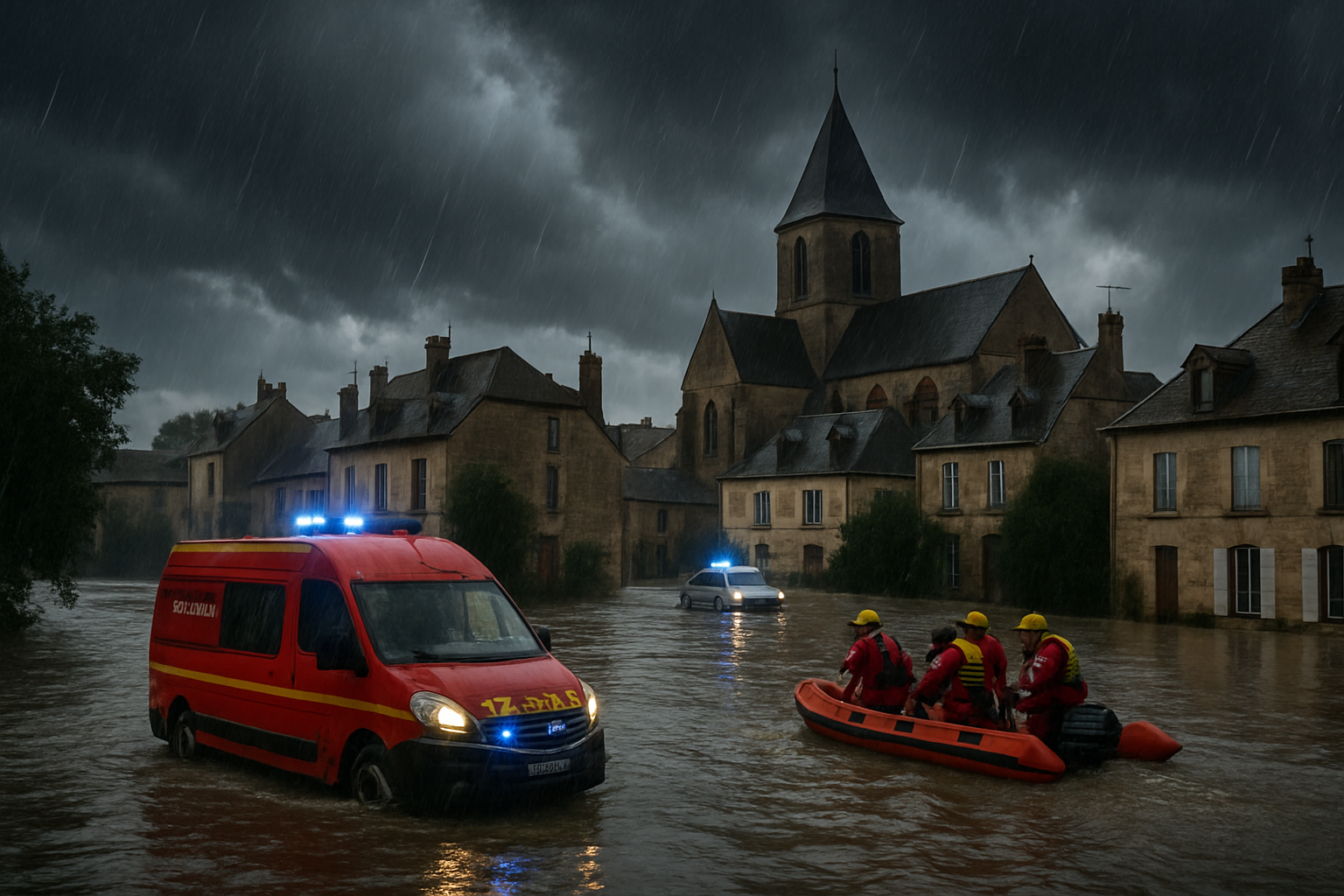
France has shattered rainfall records with 36 consecutive days of rain, the longest period since the 1950s, as Storm Pedro approaches western Europe threatening to unleash further devastation across a continent already overwhelmed by extreme weather emergencies.
The unprecedented rainfall has pushed five French departments—Loire-Atlantique, Gironde, Lot-et-Garonne, Charente-Maritime, and Maine-et-Loire—into red alert status, the highest warning level for life-threatening conditions. Prime Minister Sébastien Lecornu convened an emergency meeting Thursday bringing together ministers, prefects, and emergency professionals to address the escalating crisis of "storms, floods, and river overflows."
Unprecedented Rainfall Crisis Grips France
The 36-day rainfall streak represents France's most prolonged wet weather episode in over seven decades, with meteorological services warning that saturated soils can no longer absorb additional precipitation. This creates dangerous conditions where even moderate rainfall triggers immediate flooding as waterlogged ground reaches capacity limits.
Vigicrues, France's national flood monitoring service, has declared that flood alert systems are working at "record pace" as river levels surge across the country. The Garonne River basin faces particular concern, with authorities warning of "important and major overflows within 24 hours" as Storm Pedro approaches from the Atlantic.
"All records are broken, and there is no return to normal for the coming days,"
— Vigicrues Officials
The relentless precipitation has created a compounding crisis where each additional storm system builds upon already critical conditions. Eleven additional departments remain under orange flood warnings, including Charente, Charente-Maritime, Corrèze, Dordogne, Ille-et-Vilaine, Indre-et-Loire, Landes, Loire-Atlantique, Sarthe, Tarn-et-Garonne, and Vendée.
Regional Flooding Devastates Communities
The prolonged rainfall has caused catastrophic flooding across multiple regions, forcing hundreds of evacuations as rivers burst their banks. The Garonne River shows "slow but temporary" water level drops after devastating floods that inundated towns and villages, but authorities warn these improvements remain precarious with Storm Pedro's imminent arrival.
Infrastructure damage has been extensive, with transportation networks severely disrupted by road and railway closures. Aging flood defense systems, designed for historical rather than current climate patterns, have been overwhelmed by unprecedented water volumes. The crisis has exposed fundamental vulnerabilities in France's flood management infrastructure.
Agricultural devastation spans thousands of hectares now submerged under floodwater, forcing livestock evacuations and destroying crops that will impact food supplies and local economies for months ahead. Tourism infrastructure has suffered extensive damage, with many rural businesses questioning their ability to reopen for the crucial summer season.
European Context: Continent Under Siege
France's rainfall crisis represents the latest chapter in Europe's most severe weather emergency in recent memory. The continent has endured a devastating succession of Atlantic storms—Kristin, Leonardo, Marta, Nils, and now Pedro—that have claimed over 30 lives across Portugal, Spain, and France while requiring unprecedented emergency response coordination.
Portugal deployed 26,500 rescue personnel in its largest peacetime operation, including 1,975 military personnel and 30 naval vessels, responding to more than 1,800 weather incidents since February began. Critical infrastructure has collapsed, including the A1 highway viaduct near Coimbra, severing the vital Lisbon-Porto transportation corridor for several weeks.
Albania has experienced significant infrastructure disruption, with heavy rainfall from the Devoll River causing landslides and severely damaging the Gjinikast bridge in Moglicë. Local authorities have installed a temporary metal bridge to maintain connectivity while planning permanent repairs to restore full functionality.
Climate Change Accelerating Extreme Weather
The current crisis unfolds against the backdrop of January 2026 marking the 18th consecutive month where global temperatures exceeded 1.5°C above pre-industrial levels—a threshold scientists consider critical for climate stability. This unprecedented warming streak demonstrates how human-induced climate change is overriding natural climate variability, even during periods when natural cooling effects like La Niña should moderate temperatures.
The European Scientific Advisory Council on Climate Change has issued urgent warnings that the European Union remains critically unprepared for accelerating climate impacts. The advisory body emphasizes that "extreme meteorological and climate phenomena are already causing severe losses across Europe," with heat events alone causing tens of thousands of premature deaths.
"Current conditions represent a preview of routine 2030s circumstances without immediate climate adaptation investment,"
— European Climate Scientists
This climate volatility creates a paradox where record global warmth enables both unprecedented heat and devastating regional extremes through polar vortex disruption and altered atmospheric circulation patterns. The February 2026 crisis provides a stark template for the type of permanent climate volatility European societies must prepare to navigate.
Infrastructure Failures Expose Vulnerabilities
The prolonged crisis has revealed fundamental inadequacies in European infrastructure designed for historical rather than future climate conditions. Transportation networks, power grids, and communication systems are operating beyond their design parameters, with emergency services reaching capacity limits across the continent.
Power outages have affected hundreds of thousands of residents, with some Portuguese communities enduring 18 days without electricity. Railway services face indefinite suspension on critical routes, while aviation sees repeated disruptions with major airports cancelling hundreds of flights due to severe weather conditions.
The scale of infrastructure damage requires comprehensive vulnerability assessments and fundamental redesign approaches. Recovery timelines stretch from months to years, with government promises to "build back better" through climate-resilient infrastructure that can withstand future extreme weather events.
International Cooperation Under Strain
The simultaneity and scope of European weather emergencies have strained traditional mutual aid mechanisms typically designed for regional disasters. The EU Civil Protection Mechanism has been activated, with Sweden and Denmark providing a €246 million assistance package—the largest coordinated European weather response in history.
However, when multiple nations face concurrent emergencies, the usual pattern of neighboring countries providing support breaks down. Emergency services operate at capacity limits while international cooperation frameworks struggle to coordinate responses across borders effectively.
This crisis tests European solidarity and demonstrates the urgent need for enhanced continental emergency response capabilities designed specifically for multi-national climate emergencies that are expected to become routine as extreme weather frequency intensifies.
Economic and Social Devastation
The economic toll spans multiple sectors, with billions in damages across agriculture, tourism, and infrastructure. Spanish reservoirs have surged to 67.3% capacity, while agricultural losses devastate olive groves and citrus operations throughout the Iberian Peninsula.
The human cost extends far beyond economic statistics, with families losing generational homes, small businesses facing extinction, and vulnerable populations requiring extended emergency support. Mental health services report increased demand as communities grapple with the trauma of repeated disasters and uncertain recovery prospects.
Cultural heritage faces particular vulnerability, with over 100 Portuguese museums and monuments damaged during the storm succession. UNESCO World Heritage sites require urgent protection measures as climate-controlled systems fail and flood risks threaten irreplaceable artifacts.
Looking Forward: Adaptation Imperatives
The February 2026 weather crisis represents a watershed moment forcing fundamental reconsideration of European climate preparedness strategies. Scientists warn that the choice between reactive crisis management and transformative infrastructure adaptation becomes increasingly urgent as extreme weather frequency and intensity accelerate.
Additional Atlantic systems continue developing, suggesting the crisis may persist for weeks, establishing what experts describe as a "new normal" of extreme weather frequency that requires comprehensive adaptation strategies across all European sectors.
The window for effective climate action continues narrowing as ecological systems reach critical thresholds. European response to the February 2026 crisis will provide a crucial template for continental climate adaptation as societies confront the reality of permanent climate volatility requiring unprecedented coordination, infrastructure innovation, and international cooperation frameworks.
As Storm Pedro approaches and France enters its 37th consecutive day of rain, the immediate question remains when relief will arrive. But the deeper challenge confronting European leaders involves preparing their societies for a climate future where such extreme conditions become routine rather than exceptional—a transformation that demands nothing less than reimagining how modern societies protect themselves from an increasingly volatile natural world.