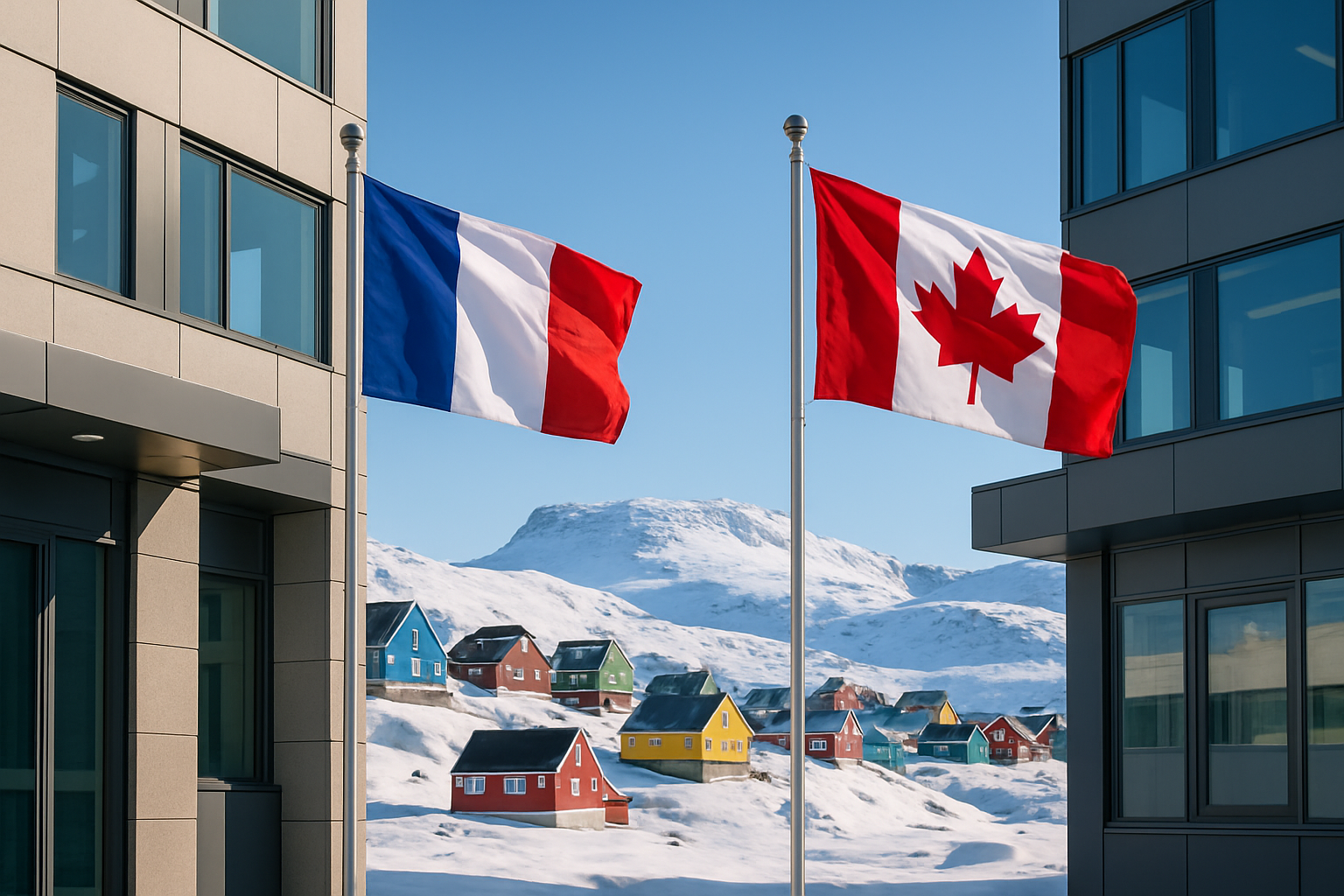
France and Canada opened their first diplomatic consulates in Nuuk, Greenland's capital, on Friday in a carefully coordinated show of international support for Danish sovereignty amid escalating pressure from the Trump administration to secure control over the strategically vital Arctic territory.
The simultaneous opening of both consulates represents an unprecedented diplomatic response to President Donald Trump's renewed territorial ambitions toward the autonomous Danish territory. Canadian Foreign Minister Anita Anand traveled personally to Nuuk for the ceremony, accompanied by Canada's Indigenous Governor General Mary Simon, while French officials inaugurated their consulate with newly appointed General Consul Jean-Noël Poirier.
The timing of these diplomatic moves carries profound significance, coming just weeks after Trump administration officials began working group meetings with Greenlandic representatives on January 28, 2026. Greenland's Prime Minister Jens-Frederik Nielsen had warned parliament that the Trump administration continues pursuing territorial control despite his firm declaration that "Greenland is neither for sale nor for purchase."
Strategic Response to American Pressure
Both France and Canada have positioned their consulate openings as direct opposition to Trump's claims on Greenland, which he has repeatedly justified as necessary for U.S. national security and control of Arctic shipping routes. Since returning to the White House, Trump has intensified his focus on the mineral-rich island, which sits at the intersection of vital Arctic sea lanes and contains substantial rare earth deposits critical to global supply chains.
According to multiple diplomatic sources, the coordinated nature of the consulate openings reflects broader European and North American concerns about unilateral territorial claims. The Danish government has welcomed this international support, viewing it as validation of Greenland's autonomous status within the Kingdom of Denmark while rejecting any transfer of sovereignty.
"These consulates represent more than diplomatic formality—they are concrete demonstrations of international law and respect for sovereignty,"
— Canadian Foreign Minister Anita Anand
Diplomatic Architecture and International Law
The establishment of permanent consular services in Nuuk marks a significant elevation in international engagement with Greenland. While both French and Canadian citizen populations in Greenland number only in the dozens, the symbolic and strategic value of these diplomatic missions extends far beyond consular services.
International law experts note that the timing and coordination of these openings serve to reinforce principles of territorial integrity and peaceful resolution of disputes. The consulates provide platforms for enhanced cooperation on climate change research, Inuit rights advocacy, and Arctic governance—areas where Canadian Indigenous expertise and French diplomatic experience offer valuable contributions.
The presence of Governor General Mary Simon, herself of Inuit heritage, underscored the cultural and historical connections between Arctic Indigenous peoples. Sources familiar with the ceremony reported that an Inuit delegation from Canada delivered a pointed message regarding American territorial ambitions, stating simply: "Back off."
Greenland's Strategic Importance
Greenland's geopolitical significance has grown exponentially as Arctic ice melts open new shipping routes and expose mineral deposits. The territory controls access to crucial Arctic passages while possessing substantial reserves of rare earth elements essential for renewable energy technology and military applications.
These strategic assets have attracted international attention, but they have also intensified American interest under the Trump administration. Working group meetings between U.S. and Greenlandic representatives, which began in late January 2026, represent the most serious American diplomatic engagement toward potential territorial arrangement since Trump's failed 2019 purchase proposal.
The mineral wealth includes lithium, cobalt, and rare earth elements that are critical components in electric vehicle batteries, wind turbines, and advanced military systems. China currently dominates global rare earth processing, making Greenland's deposits strategically valuable for Western nations seeking supply chain diversification.
International Alliance Building
The France-Canada consulate coordination reflects broader international concern about preserving sovereignty principles in an era of great power competition. European Union officials have privately expressed support for the diplomatic initiative, viewing it as an appropriate response to territorial pressures that could set dangerous precedents.
NATO allies have watched the Greenland situation carefully, as any change in territorial status could affect Alliance defense arrangements and Arctic security architecture. The synchronized diplomatic response demonstrates Western unity in supporting smaller allied nations against pressure from major powers, even when that pressure comes from within the Alliance itself.
Danish authorities have expressed gratitude for the international support while maintaining their position that Greenland's status remains non-negotiable. The autonomous territory's government has cautiously engaged with American representatives while firmly rejecting any sovereignty transfers.
Arctic Governance and Climate Implications
Beyond territorial politics, the new consulates are expected to facilitate increased cooperation on Arctic governance and climate research. Greenland's ice sheet contains approximately 10% of global freshwater reserves, and its melting patterns significantly impact global sea level rise.
French climate research capabilities and Canadian Arctic expertise provide opportunities for enhanced scientific collaboration. Both nations have committed to supporting Greenlandic climate adaptation initiatives and Indigenous knowledge preservation programs.
The consulates also enable expanded cooperation on sustainable development projects, including renewable energy initiatives that could reduce Greenland's dependence on imported fossil fuels. These practical partnerships offer alternatives to the resource extraction focus of American engagement.
Precedent for Sovereignty Defense
International relations experts view the France-Canada initiative as establishing important precedents for collective responses to territorial pressure campaigns. The coordinated diplomatic support demonstrates how middle powers can effectively support sovereignty principles through practical measures rather than merely rhetorical statements.
The success of this diplomatic coordination could influence responses to territorial disputes elsewhere, particularly in regions where major powers seek to alter established boundaries or sovereignty arrangements. The Arctic region's strategic importance makes it a testing ground for 21st-century approaches to territorial integrity.
As climate change continues reshaping Arctic accessibility, the international community's response to territorial pressures in Greenland may define broader approaches to sovereignty protection in an era of intensifying resource competition and strategic rivalry.
The establishment of these consulates represents a significant diplomatic investment in preserving international law principles while supporting the autonomy and self-determination of Arctic peoples. Their success will likely influence future international responses to territorial pressures in strategically valuable regions worldwide.